10.46°N 84.70°W · Volcano country, lake & hot springs
Arenal and La Fortuna Eco-Lodges: Rainforest, Volcano and Lake Stays
6 places to stay
Arenal is one of the easiest places in Costa Rica to combine comfortable lodging with real time in the forest. You can walk old lava flows in the national park in the morning, tour a regenerative farm after lunch and look for tree frogs on a guided night walk. Where you sleep decides how much of that happens on your doorstep and how much involves a drive and a ticket.
The short answer: for volcano views with forest trails on site, stay inside or beside the national park on the volcano’s western side; for farm life and a quieter lake landscape, choose El Castillo or the Lake Arenal shore; for rainforest away from the crowds, look at Chachagua and the Peñas Blancas valley south of town; and for restaurants and easy tours, stay in or near La Fortuna. This directory covers La Fortuna, the volcano’s foothills, El Castillo, Lake Arenal and Chachagua. Monteverde now has its own Monteverde directory, and Río Celeste and Bijagua are in our Northern Lowlands directory.
Compare the main Arenal lodging areas
| Area | Best for | Lodges to compare | Main compromise |
|---|---|---|---|
| Volcano’s western foothills | Volcano views, trails from your room, park access | Arenal Observatory Lodge | Away from town; views depend on clouds |
| El Castillo | Off-grid farm, education, waterfalls, yoga | Rancho Margot | About 40 minutes from La Fortuna |
| La Fortuna edge | Night tours, birding, short trips to town | Arenal Oasis Eco Lodge | More traffic and tour groups nearby |
| Chachagua and Peñas Blancas | Lowland rainforest, spring-fed pools, farm stays | Chachagua Rain Forest Lodge, Finca Luna Nueva | Volcano not the focus |
| Lake Arenal (west side) | Lake views, small family-run lodges | Ceiba Tree Lodge | Long drive to La Fortuna’s attractions |


The volcano today: what you will and won’t see
Arenal’s famous eruptive phase began on July 29, 1968, and ended in late 2010. The national volcano observatory, OVSICORI, told CRHoy in 2023 that Arenal is geologically active but has been dormant since the end of 2010, that the fumaroles near the summit release mostly water vapor with very small amounts of sulfur dioxide, and that recent earthquakes in the area are tectonic rather than volcanic. In short, there’s no glowing lava to watch. Any hotel photo of red lava flows dates from before 2011.
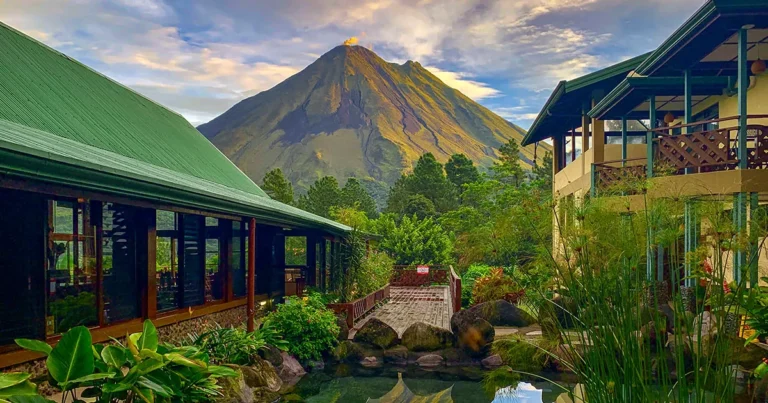
What you get instead is a near-perfect cone, often wrapped in cloud, rising over rainforest that is still recolonizing the old lava fields. The weather here is shaped by the Caribbean side of the country, which the national tourism board notes has a longer rainy period than the Pacific coast. Clear views come and go in every month. Plan at least two mornings if a summit photo matters to you, and enjoy the frogs and birds that rain brings out.
Arenal Volcano National Park and nearby trails
Arenal Volcano National Park was created on September 30, 1991, and enlarged in 1992 and 1994. SINAC notes that one of its main roles is protecting the water that feeds the Arenal reservoir and nearby towns, and that all entry fees go to the National Parks Fund, which supports protected areas nationwide. The park opens daily from 8 a.m. to 4 p.m. Climbing the cone or its immediate surroundings is strictly prohibited.
| Trail or site | Length | What you’ll see | Source |
|---|---|---|---|
| Heliconias trail (national park) | 610 m | Flat, narrow forest path with crater views | SINAC |
| Coladas trail (national park) | 1.7 km | Lava flows from 1992, views of the cone, Lake Arenal and the Tilarán range | SINAC |
| El Ceibo trail (national park) | 2.3 km | Fairly flat; a giant ceiba tree SINAC estimates at over 400 years old | SINAC |
| Volcano viewpoint (national park) | 1.5 km from the entrance | Open view of the cone | SINAC |
| Arenal Observatory Lodge reserve | 11 km of self-guided trails, 800 m wheelchair-accessible | Primary and secondary forest, volcano views | Lodge |
| Místico Arenal Hanging Bridges | 3.2 km loop with 16 bridges, 6 of them hanging | Canopy-level walk near the Lake Arenal dam | Místico |
Some of the region’s best-known walks are on private land. Místico Arenal Hanging Bridges runs a 3.2 km loop with 16 bridges, six of them hanging, beside the Lake Arenal dam, open daily from 6 a.m.; it holds Elite status in the official CST directory. Arrive at opening for birds; busy late mornings on a suspended bridge are less rewarding for wildlife. Our Arenal and Río Celeste guide covers the park in more depth.
Arenal Observatory Lodge: trails from your door
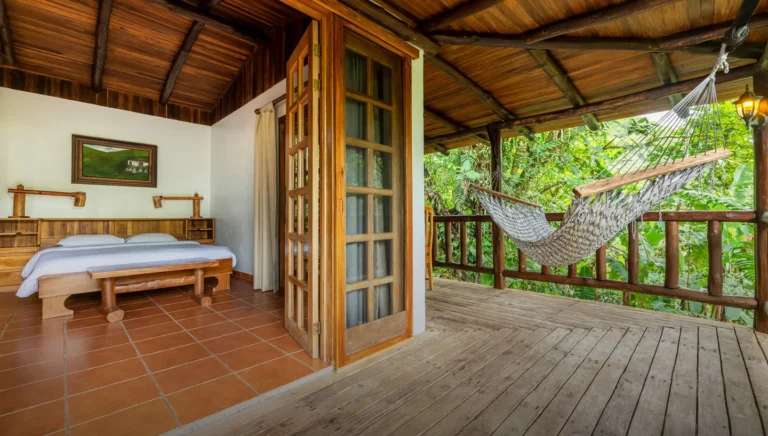
Arenal Observatory Lodge is the closest thing to sleeping on the volcano. The lodge describes itself as inside Arenal Volcano National Park, on the same road as the park entrance about 16 km from La Fortuna, on a reserve of more than 352 hectares that includes 110 hectares of primary forest. Guests can walk 11 km of self-guided trails, including 800 meters built for wheelchairs, and the lodge also sells a day pass for non-guests. Room types range from standard rooms to villas.
It suits travelers who want to step out at dawn for birds and volcano views without driving to a trailhead. Clouds are part of the deal, and it is a fair drive from town, so plan dinners and arrival times with that in mind.
Rancho Margot: an off-grid farm by Lake Arenal
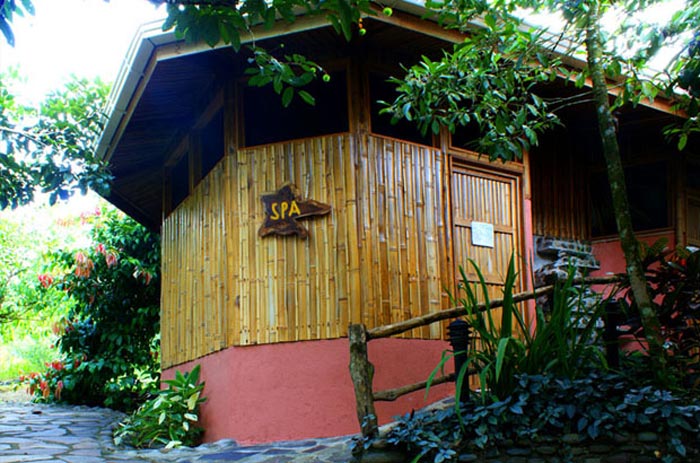
Rancho Margot lies in a mountain valley near El Castillo, about 40 minutes from La Fortuna, close to the park’s western gateway and the shore of Lake Arenal. Rancho Margot covers more than 400 acres and runs entirely off the grid; it reports that it was certified carbon neutral in 2012 and that much of its furniture is made from wood harvested on the property. Guests stay in 19 bungalows or 20 bunkhouse rooms spread across the hillside.
The ranch works as a living classroom. Daily life includes a farm tour, guided night walks, two yoga classes a day, spring-fed pools and longer immersion and volunteer programs. It is a strong fit for families, students and anyone curious about how food, energy and waste systems work in the tropics, and less suited to someone who wants to be in La Fortuna for dinner every night. Our organic farm stays guide compares it with other farm lodges.
Chachagua and Peñas Blancas: rainforest first
South of La Fortuna, the valleys around Chachagua and the Peñas Blancas river feel wetter and quieter, and the volcano drops out of the picture.
Chachagua Rain Forest Lodge, now operating as Chachagua Rainforest Hotel & Hot Springs, sits in a protected rainforest reserve on the northeastern edge of the Children’s Eternal Rainforest, the large private reserve that stretches toward Monteverde. Accommodation ranges from bungalows and a treehouse to river villas and larger houses. The hotel runs a daily guided nature walk, a 6 a.m. birdwatching walk, a rainforest night walk and horseback rides, and has warm and cool spring-fed pools. It works well for families and couples who want forest and comfort in equal measure.
Nearby, Finca Luna Nueva is a regenerative farm and rainforest lodge about 25 minutes from La Fortuna, according to the farm, with miles of trails through forest, farmland and herb gardens and more than 150 edible species grown on site. Farm tours, a chocolate workshop and farm-to-table meals are the focus. Together, Chachagua and Luna Nueva make this valley the best part of Arenal for travelers more interested in rainforest and food than volcano views.
La Fortuna’s edge: night tours and easy access
Arenal Oasis Eco Lodge is a small family-style lodge and wildlife refuge 800 meters south of the main Z-13 entrance in La Fortuna. Arenal Oasis offers guided bird watching, a sloth tour, a butterfly garden and a well-known frog-watching night walk on its own grounds, with bungalows and a family villa among the trees. It is a good pick if you don’t want to drive much but still want a forest setting, and the night walk is worth doing even if you sleep elsewhere. Our reptiles and amphibians guide covers the frogs you’re likely to see.
Staying near town makes the most of La Fortuna’s tour offices and restaurants. The trade-off is road noise and busier forest edges; ask for a room facing the trees.
Lake Arenal: water, wind and small lodges
Lake Arenal is a reservoir. La Nación reports that the 87-square-kilometer lake formed behind the Sangregado dam, that works began in 1974, and that the hydroelectric plant opened on December 9, 1979, after the towns of Arenal and Tronadora were relocated. The national park’s forests help keep that reservoir supplied, a neat example of conservation and power generation depending on each other.
The western and northern shores are windier, more open and more rural than the volcano side. Ceiba Tree Lodge is a small lodge about 5 km from Nuevo Arenal toward La Fortuna, with lake views, gardens for birdwatching and a restaurant where the host cooks with regional produce. It suits slow travelers and couples heading between Arenal and Guanacaste. Note that its restaurant is by reservation and closed on Mondays, according to the lodge.
Hot springs and the “eco” label
Arenal’s geothermal water feeds everything from small spring pools to large resort complexes. A hot spring is a pleasant way to end a wet hiking day, but it doesn’t make a hotel an eco-lodge. Useful questions include where the water comes from, where it goes afterward, how much forest the property actually protects and how many staff come from nearby communities.
Costa Rica’s official CST program is free and voluntary, uses Basic and Elite levels and follows Global Sustainable Tourism Council criteria. None of the Arenal lodges in this directory appeared in the official certified list when we checked in October 2026, although Místico Park did. Several of them describe detailed practices of their own, so ask for specifics. Our CST explainer shows how to look a business up, and older “five-leaf” claims refer to a retired scale.
Planning: nights, seasons and getting there
Arenal is reached by road from San José, Liberia or Monteverde. Distances look short on a map, but mountain roads, rain and slow trucks add time, and a lodge sold as “near La Fortuna” can be 40 minutes away, as Rancho Margot is. Check each lodge’s directions before you book.
Three nights covers one park walk, one night tour, a hot spring and a farm or hanging-bridges morning. Four or five nights lets you split between two bases, for example the national park side and Chachagua or El Castillo, and adds a spare morning for clear volcano views. Many travelers pair Arenal with Monteverde or Río Celeste; our ecotourism itineraries and family ecotourism guide show how to fit them together without long transfer days.
Frequently asked questions
Can I see lava at Arenal?
No. OVSICORI says the volcano has been dormant since late 2010, after an eruptive phase that began in 1968. You will see the cone and the old lava flows on clear days, and the national park strictly prohibits climbing the volcano.
Is Arenal Observatory Lodge inside the national park?
The lodge describes itself as inside Arenal Volcano National Park, on the same road as the park entrance, with its own 352-hectare reserve and 11 km of trails. That makes it the best choice in the area for walking straight from your room.
When is Arenal Volcano National Park open?
SINAC lists the park as open every day from 8 a.m. to 4 p.m. Its main trails are short and fairly flat, from 610 meters to 2.3 km, so a visit takes a morning rather than a full day.
Should I stay in La Fortuna or outside town?
Stay in or near La Fortuna for restaurants and the widest choice of tours. Stay at the volcano's base, in El Castillo or in Chachagua for quieter nights and forest on site, and plan on driving for some activities.
What is the best Arenal eco-lodge for families?
Rancho Margot and Chachagua both combine forest, pools and guided activities children enjoy, and Rancho Margot adds farm life with animals and gardens. Arenal Oasis is a simpler option close to town with an excellent night walk.
How many nights should I spend in Arenal?
Three nights is a practical minimum. Four or five lets you use two bases, add a night walk and a farm or birding morning, and gives the clouds time to clear for a volcano view.