9.66°N 82.75°W · Tortuguero, Cahuita & Puerto Viejo
Caribbean Costa Rica Eco-Lodges: Tortuguero, Pacuare, Cahuita and Puerto Viejo
17 places to stay
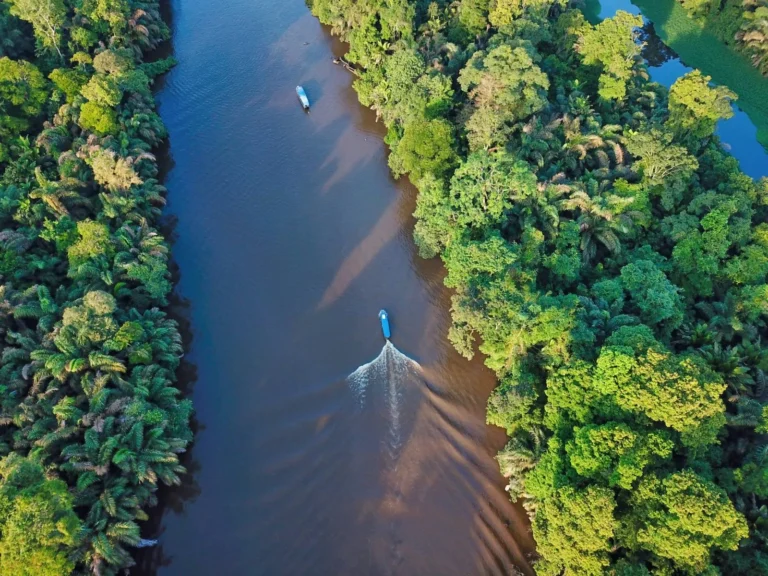
On Costa Rica’s Caribbean side, water shapes nearly everything. At Tortuguero, rivers and canals are the only roads into a flooded forest. On the Pacuare, a whitewater river carves through steep jungle where some lodges are reached by raft. Around Cahuita and Puerto Viejo, coastal forest runs right down to coral reefs, and Afro-Caribbean food, music and history give the towns a character you won’t find on the Pacific. These are very different trips, and the right lodge depends on which one you want.
This directory covers Tortuguero and the northern canals, the Pacuare River, Cahuita, Puerto Viejo, Cocles, Punta Uva and Manzanillo, and the Talamanca foothills. Every lodge we recommend below was open and taking reservations on its own website when we checked in October 2026.
Which Caribbean base is right for you?
| Area | Main nature appeal | Lodges to look at | Getting there |
|---|---|---|---|
| Tortuguero | Canals, wetlands, sea turtle nesting, birds | Tortuga Lodge, Pachira Lodge, Turtle Beach Lodge | Boat or small plane only; no road into the village |
| Pacuare River | Remote rainforest, rafting, jaguar research | Pacuare Lodge | River arrival or arranged transfer |
| Talamanca foothills | Private reserve on the edge of La Amistad | Selva Bananito | Road, then rural track |
| Cahuita | Coral reef, coastal forest trail, village life | Smaller inns near the park | Road |
| Puerto Viejo, Cocles and Playa Chiquita | Beaches, culture, yoga, farm stays | Samasati, Azania Bungalows, Geckoes Lodge, Finca Tierra | Road |
| Punta Uva and Manzanillo | Forest-to-sea scenery, Gandoca-Manzanillo refuge | Almonds and Corals | Road |
Caribbean Coast lodges on our site
Tortuguero: a park you reach by boat
Tortuguero is unlike any other Costa Rican destination. According to SINAC, Costa Rica’s national parks agency, the park was declared on September 24, 1970, and now covers 76,937 hectares: 26,653 on land and 50,284 at sea. Access is only by small boat through a network of rivers and canals, and 99% of the park’s land is kept under absolute protection, with just 1% open to visitors. In the village itself, bicycles are the only vehicles.
The park is internationally known for protecting the most important green turtle nesting beach in the Western Hemisphere. Four sea turtle species nest here: green, leatherback, hawksbill and loggerhead. The park also protects West Indian manatee habitat, one of Costa Rica’s largest jaguar populations and swamp forests of yolillo palm. It’s very wet: SINAC records about 6,000 mm of rain a year, with July and December the wettest months and March, April and October the least rainy.
How visits work. The park is open daily from 6 a.m. to noon and 1 p.m. to 4 p.m., and tickets are sold through SINAC’s online reservation system. Canal routes have their own rules: the 2.3 km Caño Chiquero and Caño Mora route is reserved for small, non-polluting craft such as canoes, kayaks and electric-motor boats, while the Río Tortuguero (4.3 km), Caño Harold (3.5 km) and Caño Palma (5.1 km) routes open up wider channels where caimans, river turtles and water birds are often seen. On foot, the El Jaguar trail runs 2.5 km parallel to the beach.
Turtle nights. During nesting season, the park works with a local organization to post trained turtle spotters on the beach. Visitors wait at holding points with their guide until a turtle is laying and can be watched without disturbing her. SINAC gives the nesting season as June to October and advises checking that the season has opened; the Sea Turtle Conservancy, which has studied Tortuguero’s turtles since the 1950s, gives June through November for green turtles. A good tour never uses flash or white light and never promises a sighting. Our Tortuguero guide and sea turtle nesting guide cover the rules in full.
Cerro Tortuguero. Just north of the park, this 119-meter hill is a volcanic cone about 1.8 million years old and the only high point on Costa Rica’s Caribbean coast. It belongs to the Barra del Colorado Wildlife Refuge and is managed by the community association of San Francisco de Tortuguero. Visits go in groups of up to 10 on an elevated trail, booked ahead through hotels or operators, and the view over canals and forest is the classic Tortuguero picture.
Tortuguero lodges
Tortuga Lodge & Gardens has 29 rooms, each looking over the Tortuguero River, and describes itself as the only hotel in Tortuguero with its own private nature reserve. It’s part of the Böëna Lodges collection and sells multi-night packages that bundle boat transfers, meals and guided tours, with private flights available.
Pachira Lodge sits on the main canal, about five minutes from the national park. It offers packages from two days and one night up to five days and four nights, built around getting guests there and back. Its website says buildings stand on pilings to reduce soil compaction and erosion, guest toiletries come in bottles made from recovered ocean plastic, and 99% of staff are local. The turtle-shaped pool is popular with families.
Turtle Beach Lodge is the quieter option, on 175 acres with private canals and stretches of Caribbean beach, reached by boat. The lodge says it has donated to the COTERC foundation for turtle research. It suits travelers who want more distance from the village bustle.
Most Tortuguero stays work best as two or three nights on a package that includes the boat transfer, so ask exactly where the boat leaves from and what time. Our guide to reaching remote eco-lodges explains the logistics.
Barra del Colorado: the remote north
North of Tortuguero, the Barra del Colorado refuge was created in 1985 and covers 81,177 hectares of land, from coastal lagoons and herbaceous swamps to flooded forest and low hills under 219 meters. It borders Nicaragua along the Río San Juan. It’s a mixed refuge, meaning communities live inside it and conservation goals are pursued with them, which makes it a natural fit for rural community tourism. Services are much thinner than in Tortuguero, and most trips here are specialist fishing or birding itineraries, so plan carefully and travel with an operator who knows the area.
Pacuare River: rafting into the rainforest
The Pacuare is a different kind of Caribbean trip: steep, forested canyon walls and a river that’s both the highway and the main activity. Pacuare Lodge is the standout here. Its sustainability page says it built only 20 bungalows inside a 340-hectare protected area, with no trees cut for construction. Power comes from three small hydroelectric turbines and 204 solar panels, stored in batteries. The lodge received the Elite level of Costa Rica’s CST certification in 2024.
The wildlife work is impressive. The lodge has supported a jaguar program since 2009, and National University camera traps on its reserve and nearby protected land recorded 18 species of large mammals and identified five individual jaguars, including a black jaguar. Most staff come from nearby communities, including the Cabécar community of Nairi Awari, and the lodge runs guide, English and food-handling training. Arrival is often by raft, which is a highlight for many guests but not right for everyone. Ask about non-rafting transfers, luggage and what happens if high water changes the plan.
Selva Bananito: a private reserve in the Talamanca foothills
Inland from Limón, Selva Bananito protects a private reserve in the Talamanca Mountains that acts as a buffer zone for La Amistad International Park, the huge protected area shared with Panama. Its website, run by host Jürgen Stein, offers nature and adventure tours, multi-day packages and volunteer stays, and displays the CST mark. It’s a good choice for travelers who want rainforest without the beach crowd and don’t mind a rural road.
Cahuita: reef, forest and village
Cahuita National Park protects the most developed coral reef on Costa Rica’s Caribbean coast. SINAC’s park page explains that it was created as a national monument in 1970 to protect the reef and became a national park in 1978. It covers 1,102 hectares of land and 23,290 hectares of sea, and about 600 hectares of that marine area is reef, with brain coral, elkhorn coral, sea fans, French and queen angelfish, lobsters and turtles.
What makes Cahuita special is how it’s run. Since 1998 a management committee of local organizations and SINAC has shared responsibility for the park, and community guides are trained by Costa Rica’s national training institute and accredited by the tourism board. At the Playa Blanca entrance, beside the village, entry is by voluntary cash contribution that’s reinvested in the community and the park; the Puerto Vargas entrance charges a set fee. Snorkeling is only allowed in designated zones, and hiring a local guide is recommended. Along the coastal trail you may see howler and white-faced monkeys, sloths, coatis, raccoons, toucans, trogons and the yellow eyelash viper, so look before you lean on a branch.
Cahuita’s lodging is mostly small inns and cabins near the village. We haven’t been able to verify current operating details for our older Cahuita listings on their own websites, so we’re not recommending specific properties here until we can. Puerto Viejo, a short drive south, has a wider choice.
Puerto Viejo, Cocles and Playa Chiquita
South of Cahuita, Puerto Viejo de Talamanca and the beaches beyond it mix Caribbean culture, cycling, surfing, restaurants and forest. Where you stay along the coastal road changes the feel of your trip: central Puerto Viejo is lively, while Cocles and Playa Chiquita are quieter and greener.
Samasati Nature Retreat is set in rainforest on the hillside about a 20-minute drive from Puerto Viejo, with a pool looking out over the Caribbean Sea. It’s a yoga retreat at heart, and classes can be booked whether or not you’re staying. See our yoga retreats guide for similar places.
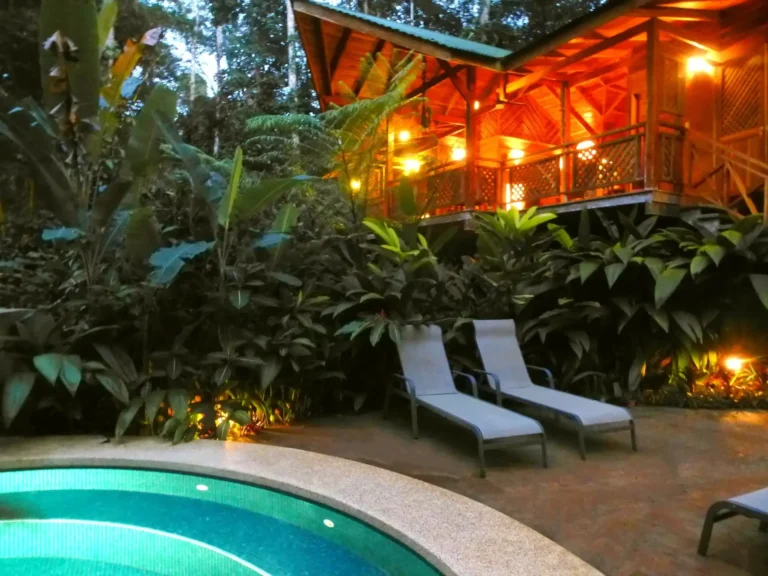
Azania Bungalows has 10 jungle bungalows spread through a tropical garden opposite Cocles Beach, about 1.5 km south of Puerto Viejo, with a free-form pool and waterfall.
Geckoes Lodge in Cocles rents four vacation homes, each with its own private garden and plunge pool, a good fit for families or friends who want space and privacy.
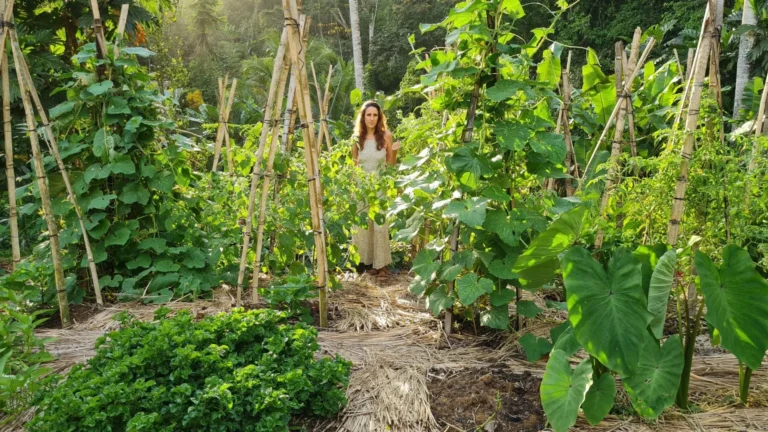
Finca Tierra is a nine-acre permaculture farm a few kilometers from Cocles Beach. It runs a 15-day Permaculture Design Course limited to 12 students, plus a week-long plant, harvest and cook retreat, with students staying in bamboo cabinas. Our guide to organic farm stays and permaculture covers similar places.
Punta Uva, Manzanillo and the Gandoca-Manzanillo refuge
Toward the end of the coastal road, forest meets small coves and reef. The Gandoca-Manzanillo National Wildlife Refuge was created in 1985 and covers about 5,092 hectares of land and 5,360 hectares of sea between the Cocles and Sixaola rivers. It protects around 5 square kilometers of reef off Punta Uva, Manzanillo and Punta Mona, nesting beaches for leatherback, loggerhead, green and hawksbill turtles, manatee habitat and the only natural mangrove oyster bank in the country. SINAC records 377 bird species, 38 mammal species and more than 1,200 vascular plants. It’s a mixed-ownership refuge, with communities living inside it, so stay on marked trails, respect private land and don’t stand on coral.
Almonds and Corals sits 2 km before Manzanillo, surrounded by forest. Its restaurant describes itself as eco-conscious and cooks with local, seasonal ingredients. It’s the most comfortable base for exploring the refuge and the beaches around Punta Uva.
Community and culture
Inland Talamanca is home to Bribri and Cabécar communities whose relationship with forest, rivers and cacao is central to the region. Community-run visits, such as cacao and chocolate experiences, can be genuinely rewarding when they’re arranged with the host community and payments go to them directly. Ask before photographing people, follow your hosts’ lead and don’t expect hotel standards in a homestay. Our community and Indigenous ecotourism guide explains how to find and book responsible visits.
Weather and planning
The Caribbean doesn’t follow the Pacific’s seasons. Costa Rica’s tourism board notes that the Caribbean coast has no well-defined dry season. February to March and September to October are relatively drier; November to January brings the heaviest rain, December is usually the wettest month, and rain falls mostly at night and in the morning. That makes September and October, the Pacific’s wettest months, a good time for this coast.
Sample plans. For seven nights, combine two or three nights in Tortuguero with four in Puerto Viejo or Cocles. For a more active trip, swap Tortuguero for two nights at Pacuare Lodge. With ten nights, add a stay near Manzanillo or Selva Bananito. Remember that Tortuguero and the Pacuare need arranged transfers, while the southern coast is a straightforward drive. Our 7, 10 and 14-day itineraries help with timing.
Sustainability questions for Caribbean lodges
Each landscape here has its own pressures. On the coast, ask about wastewater treatment, reef-safe practices and beach-facing lights, which can disorient nesting turtles and hatchlings. In Tortuguero, ask about boat speed, noise and fuel. On the rivers, ask about erosion and riverbank forest. Costa Rica’s official Certification for Sustainable Tourism now uses two levels, Basic and Elite; older “five leaves” awards belong to the previous system. Our CST guide explains how to read these claims.
Frequently asked questions
Can I drive to Tortuguero?
No. SINAC confirms the park is reached only by small boat, and there are no cars in the village. Most travelers book a lodge package that includes a shuttle to the boat dock and the boat ride, or fly in on a small plane. Confirm the meeting point and departure time with your lodge.
When is turtle season in Tortuguero?
SINAC gives the nesting season as June to October and recommends checking that it has opened before you travel; the Sea Turtle Conservancy gives June through November for green turtles. Turtle walks are guided only, with trained spotters, and sightings are never guaranteed.
Is Cahuita good for snorkeling?
Yes, in the right conditions. The park protects about 600 hectares of reef, the most developed on the Caribbean coast, but snorkeling is only allowed in designated zones and a local guide is recommended. Visibility drops after heavy rain. Our snorkeling and diving guide compares sites around the country.
Do I have to raft to reach Pacuare Lodge?
Rafting in is the classic arrival and part of the lodge's River Package, but it isn't suitable for everyone. Ask the lodge about other transfer options and age or fitness limits before booking.
What's the driest time to visit the Caribbean coast?
February to March and September to October are the relatively drier periods, according to Costa Rica's tourism board. December is usually the wettest month.
Where can I combine rainforest and beach?
Cocles, Playa Chiquita, Punta Uva and Manzanillo all have forest running down to the sand. Almonds and Corals near Manzanillo and the bungalows around Cocles give you both within a short walk. For more beach-and-forest lodges nationwide, see our beachfront eco-lodges guide.