9.39°N 84.14°W · Manuel Antonio & Carara
Central Pacific Eco-Lodges: Carara, Tárcoles, Manuel Antonio and the Savegre
7 places to stay
Costa Rica’s Central Pacific coast is often sold as an easy beach region, and it is easy: it’s the closest stretch of coast to San José, with good roads and every kind of hotel. But look past the resort strip and you’ll find scarlet macaws flying over transition forest at Carara, crocodiles in the Tárcoles River, squirrel monkeys in Manuel Antonio’s coastal forest and quiet river valleys inland. The challenge is telling a genuine nature lodge from a conventional hotel with a few palms around the pool.
This directory covers Tárcoles and Carara, the Turrubares hills, Herradura and Punta Leona, Quepos and Manuel Antonio, and the Savegre River valley. The coast south of the Savegre, around Dominical and Uvita, has its own page: see our Southern Pacific eco-lodges. Every lodge recommended below was open and taking reservations on its own website when we checked in October 2026.
Compare Central Pacific bases
| Base | Key nature experience | Lodges to look at | What to know |
|---|---|---|---|
| Tárcoles and Carara | Scarlet macaws, transition forest, river wildlife | Santa Lucia Jungle Hacienda | Close to San José; best for early birding |
| Turrubares hills | Forest edge birding, farm life | Macaw Lodge | Rural roads above the coast |
| Herradura and Punta Leona | Beaches with forest behind them | Punta Leona | Busier coastline, especially on weekends |
| Manuel Antonio and Quepos | National park wildlife, beaches, mangroves | Sí Como No, Arenas del Mar, Gaia, Parador | Popular and often crowded; book park tickets early |
| Savegre River valley | Rafting, private reserve, rural quiet | Rafiki Safari Lodge | Inland drive from the coastal highway |
Central Pacific lodges on our site



Carara: where dry forest meets rainforest
Carara National Park is the main reason to stop in the northern Central Pacific instead of driving straight to the beach. SINAC, Costa Rica’s national parks agency, describes it as the only transition forest in the Central Pacific, where species of dry and wet forest overlap. The land was once the Hacienda Coyolar, one of the largest private estates in Costa Rica’s history. It became a biological reserve on April 26, 1978, and a national park on November 18, 1998. Its name comes from the Huetar language and means “river of crocodiles.”
The park’s species list is remarkable for its size: 420 bird species (47% of the 893 recorded in Costa Rica), 124 reptiles, 112 mammals and 62 amphibians. The scarlet macaw is its emblem, and SINAC notes it’s the second-largest parrot species in the country. Carara sits on Route 34 about 90 km from San José, and the tourism board puts the drive at roughly an hour and a half, which makes it an easy first or last stop on a trip.
Trails. Carara was the first national park in Costa Rica with a universal-access trail: 1.2 km with nine rest areas, drinking water, adapted restrooms and signs in Spanish, English and Braille. The Araceae loop (about 1,200 m, an hour) shows off climbing plants; the Quebrada Bonita loop (1,300 m, about 1.5 hours) passes big trees along a stream; and the Laguna Meándrica trail, just over 2 km one way and taking two to four hours, leads to an oxbow lagoon where crocodiles live and birders gather in the mornings.
Rules worth knowing. Since September 1, 2023, Carara’s tickets are sold only online. Food isn’t allowed on the trails, single-use plastic isn’t allowed in the park and there’s no food for sale inside. Local guides work independently and aren’t park staff, so agree on the details before you set off. Our birds of Costa Rica guide explains what to look for.
Where to stay near Carara
Santa Lucia Jungle Hacienda, which replaced the older Hotel Villa Lapas, sits on riverbanks at the edge of Carara National Park, with villas, terraces, trails and bridges set in forest. Marriott announced in November 2025 that the 87-room hotel had joined its Autograph Collection and was accepting reservations. It’s the most comfortable base for walking into Carara at opening time.
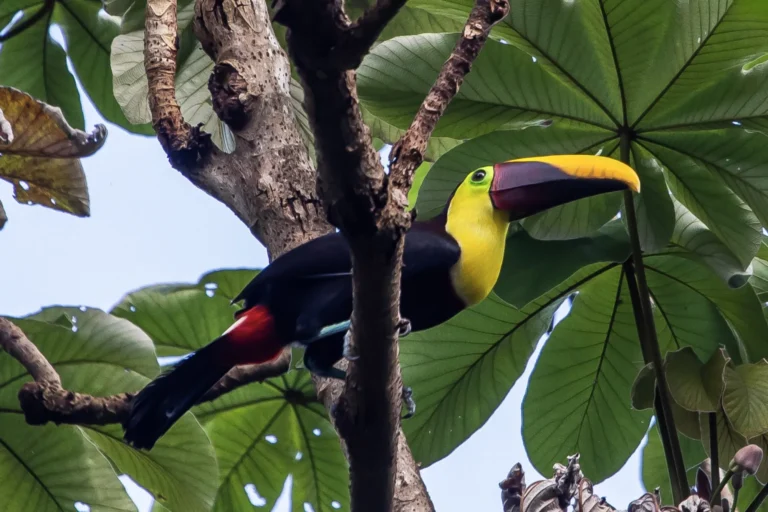
Macaw Lodge sits higher up in the Turrubares hills, where its website says humid and dry tropical forests meet, with more than 350 bird species recorded in the area. It’s a small place, with 15 rooms (eight in the main building and seven bungalows), and guests can tour its fruit and cocoa orchard and learn about its sustainable farming. It suits birders and travelers who want a rural stay rather than a beach town.
The Tárcoles River and responsible crocodile watching
The Río Tárcoles is famous for its crocodiles, and boat tours leave from the river mouth near the park. They can be exciting and educational, especially for the waterbirds along the estuary and mangroves, but choose your operator carefully. Avoid any tour where guides feed crocodiles or coax them close to the boat for photos; feeding changes their behavior and makes them more dangerous to people. Costa Rica’s tourism board and SINAC give clear advice for any wildlife encounter: don’t feed, touch or handle wild animals, keep your distance, and keep crocodiles and snakes in sight as you move away. Our reptiles and amphibians guide covers the American crocodile in more detail.
Herradura and Punta Leona
Between Tárcoles and Jacó, the coast has a mix of large resorts and residential developments. Punta Leona is the best known for nature. Its website highlights two beaches, Playa Blanca and Playa Mantas, and a scarlet macaw conservation project that guests can follow on live cameras. It’s a large resort with hotel rooms, apartments and home rentals rather than a small eco-lodge, but its forested setting and macaw work make it a reasonable choice for beach time near Carara.
Jacó itself is a busy surf and nightlife town. It’s convenient, but if forest and wildlife are your priority, you’ll be happier near Carara or farther south.
Manuel Antonio: wildlife-rich and very popular
Manuel Antonio National Park is small, beautiful and busy. SINAC’s park page tells how it began: in 1972, after local people protested foreign owners blocking access to the beaches, Law 5100 created a national recreation park. The park sits 157 km south of San José, with the main entrance 7 km from Quepos. SINAC records about 352 bird species, 109 mammal species and 346 plant species. The emblem is the Central American squirrel monkey (titi), and you may also see white-faced capuchins, howler monkeys, both two- and three-toed sloths, coatis and raccoons.
How visits work. The park is open Wednesday to Monday, 7 a.m. to 3 p.m., and closed on Tuesdays. Tickets are sold only online through SINAC’s SICORE reservation system, which for Manuel Antonio allows one transaction per user per day, with up to six entries per purchase. There’s no parking at the park, and the single road from Quepos gets congested in high season, so go early. A guiding concession run by Quepos’s certified guides association operates inside the park, with afternoon and night tours on set days during the November to April season.
Park rules. You can’t bring food onto the beaches or trails; there’s a designated eating area run by a concession. Soap and shampoo aren’t allowed in the showers, and drinking fountains let you refill bottles. Don’t sit under the manzanillo (manchineel) trees on the beach: SINAC warns they’re toxic. And never feed the monkeys. September and October are the quietest months, though they’re also among the wettest.
| Carara National Park | Manuel Antonio National Park | |
|---|---|---|
| Protected since | 1978 (reserve), 1998 (national park) | 1972 |
| Habitat | Transition forest, river, oxbow lagoon | Coastal forest, beaches, mangrove lagoon, islands |
| Signature wildlife | Scarlet macaws, crocodiles, forest birds | Squirrel monkeys, capuchins, sloths |
| Recorded species | 420 birds, 124 reptiles, 112 mammals | About 352 birds, 109 mammals |
| Tickets | Online only | Online only (SICORE); closed Tuesdays |
| Best for | Birding, accessible forest walk | Wildlife plus beach time |
Manuel Antonio lodges
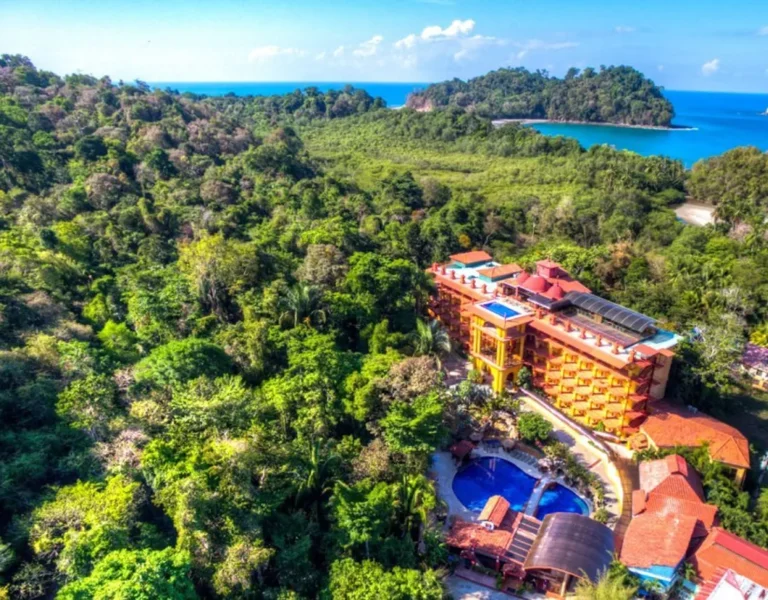
Sí Como No describes “10 protected acres of natural forest terraces” above the coast, about 10 minutes from the park entrance. It has an adults-only area as well as a family pool, so it works for both couples and families.
Arenas del Mar is the area’s best option for forest and beach together. Its website describes 11 acres of rainforest reserve with direct access to two beaches, including Playitas, and the national park on its doorstep. It’s a member of the Cayuga Collection of sustainable luxury hotels.
Gaia Hotel & Reserve is a five-star boutique hotel in the coastal forest of Manuel Antonio with its own Gaia Reserve, where its website says it protects local species. It cites recognition as World’s Leading Green Hotel 2025 from the World Travel Awards. It suits travelers looking for a high-end stay with forest around them.
Parador Resort and Spa sits on the Punta Quepos promontory overlooking the Pacific, on what it describes as 12 acres of tropical rainforest. Its website says it holds CST Elite certification, the highest level of Costa Rica’s sustainability program. It’s a large resort with many facilities, for travelers who want amenities alongside nature.
For a wider look at upscale options, see our guide to the best luxury eco-lodges in Costa Rica.
Inland: the Savegre River valley
South of Quepos, the Savegre River runs out of the Talamanca mountains through a quieter, greener valley. Rafiki Safari Lodge sits on the river about 16 km inland from the coastal highway, inside what it describes as a 600-acre private wilderness reserve. Guests stay in luxury safari tents, and the river’s class II and III rapids mean rafting is a big part of the experience; the lodge says the stretch in front of the property suits families and friends year-round. Note that this lowland Savegre valley is a very different place from the cold highland valley of San Gerardo de Dota at the river’s source, covered in our Central Valley and highlands directory.
Weather and planning
The Central Pacific follows the Pacific pattern. According to Costa Rica’s tourism board, the dry season runs from December to March, with March the driest and hottest month. Rains begin in May, ease a little in July and August (the “veranillo” or little summer) and peak in September and October. Rain usually falls in the afternoon, so mornings are best for parks and wildlife in any season.
Sample plans. With three nights, pick one base: Carara for birds, or Manuel Antonio for wildlife plus beach. With five nights, try two near Carara and three in Manuel Antonio. With seven, add two nights on the Savegre or continue south to Uvita or the Osa Peninsula. Our 7, 10 and 14-day itineraries show how this coast fits into a longer trip, and our family ecotourism guide has ideas for traveling with children.
What makes a Central Pacific hotel truly sustainable?
This is one of Costa Rica’s most developed coastlines, so the questions are mostly about development. Ask how a hotel treats its wastewater, how much forest it protects (and whether that forest connects to the parks), how it manages lighting and noise near wildlife, and whether it employs and buys locally. In Manuel Antonio especially, a good hotel should actively discourage guests from feeding animals.
Costa Rica’s official Certification for Sustainable Tourism now uses two levels, Basic and Elite; the older “five leaves” scale belongs to the previous system. Our guides to CST certification and choosing a truly sustainable hotel explain how to check claims, and our private nature reserves guide shows why small hotel reserves around the parks matter for wildlife.
Frequently asked questions
Do I need to book Manuel Antonio tickets in advance?
Yes. Tickets are sold only online through SINAC's SICORE system, with one transaction per user per day and up to six entries per purchase. The park is closed on Tuesdays and open 7 a.m. to 3 p.m. on other days.
Where's the best place to see scarlet macaws?
Carara National Park and the surrounding forest around Tárcoles are the classic spot. Go early with a guide and you have a good chance, though no wild bird sighting is guaranteed. Our wildlife watching guide covers other macaw areas.
Can I stay inside Manuel Antonio National Park?
No. Hotels are outside the national park, though several, like Arenas del Mar and Gaia, protect their own forest reserves next to or near the park. Check exactly how far your hotel is from the entrance, since there's no parking at the park.
Is Carara accessible for travelers with limited mobility?
Carara was Costa Rica's first national park with a universal-access trail: 1.2 km with nine rest areas, adapted restrooms and signs in Spanish, English and Braille. Contact the park before visiting to confirm current conditions.
Are crocodile tours on the Tárcoles River ethical?
Some are, some aren't. Choose an operator that watches from a respectful distance and never feeds the crocodiles. Feeding wild animals is against SINAC and tourism board guidance and makes crocodiles bolder around people.
When is the best time to visit the Central Pacific?
December to April is the driest stretch. September and October are the wettest months but also the quietest in Manuel Antonio, and mornings are often dry even in the rainy season.