
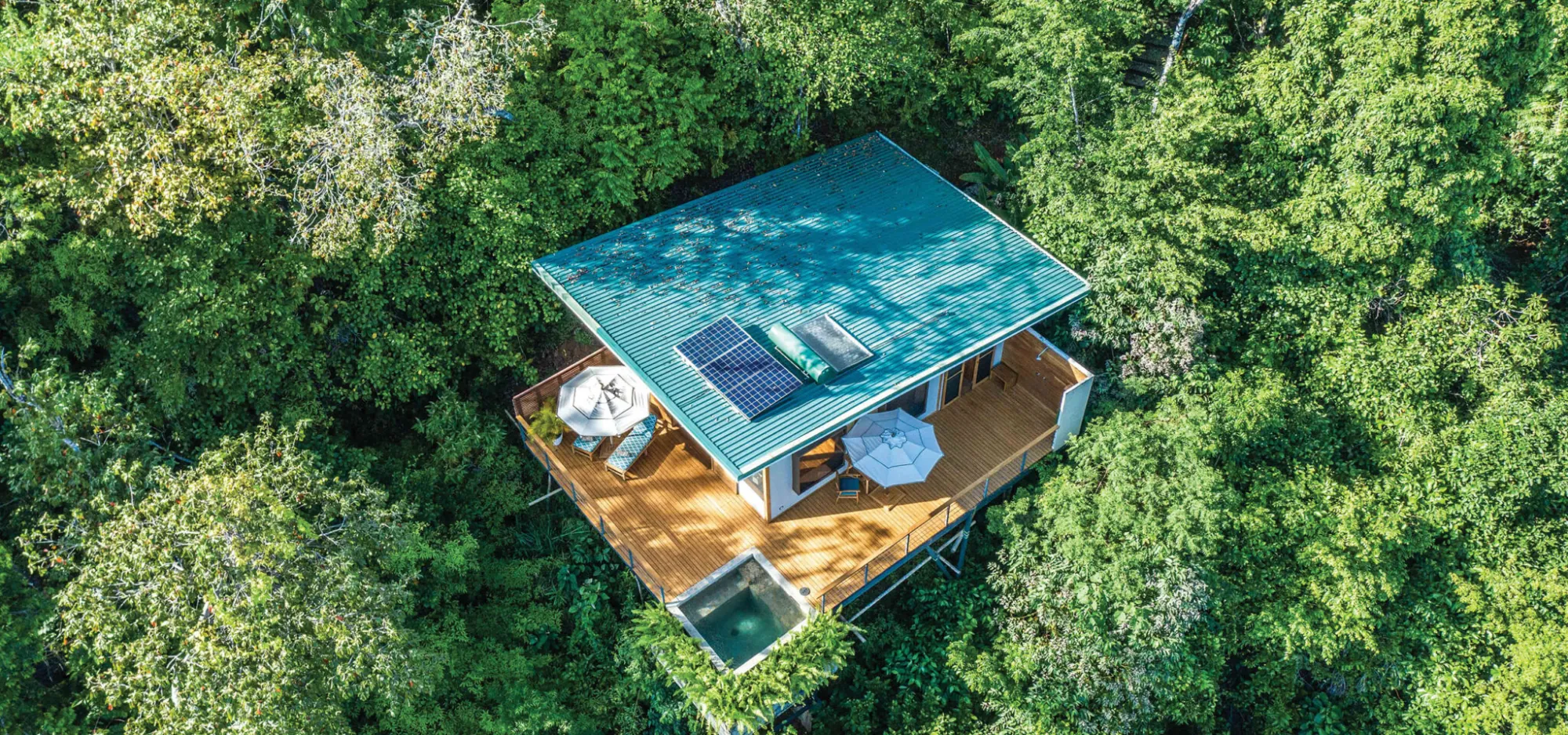
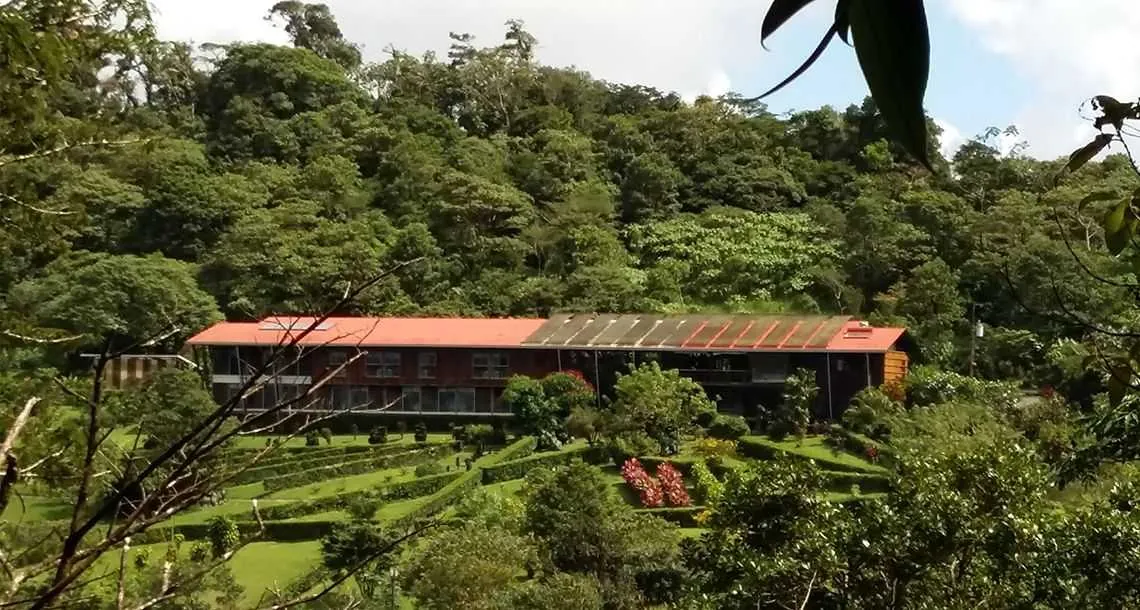
Costa Rica makes it easy to fall for the idea of an eco-vacation. There are forest cabins ringed by hummingbirds, design-led hotels with living roofs, beach resorts with nature trails and lodges where a naturalist helps you read tapir tracks. Choosing among them is the hard part. “Eco-friendly” appears everywhere, and the evidence behind it varies enormously.
A sustainable hotel is not defined by bamboo furniture or paper straws. It understands its ecological setting, manages its impacts, treats people fairly and can explain what it does in concrete terms. This guide gives you a practical way to compare those claims before you book, with real examples from lodges we review.
Start with the land, not the advertising
Where was the hotel built, and what was there before? Has it protected mature forest, restored degraded land or cut into important habitat? A lodge built on old cattle pasture may be doing excellent restoration work. Another may have cleared intact forest to create an “immersive rainforest experience.” Those deserve very different verdicts.
Serious land stewardship is described with a place, a size and, ideally, a breakdown. Arenal Observatory Lodge is a good model of specificity: the lodge says its land covers more than 352 hectares, of which 110 are primary forest, 160 are gardens and reforested land, and 80 are still grazing land. Lapa Ríos says it protects a 1,000-acre private reserve on the Osa Peninsula, and Bosque del Cabo nearby describes more than 750 acres. Small places count too: Leaves and Lizards near Arenal is a former dairy farm where, as our review notes, the owners planted thousands of trees after 2006.
A vague promise to “give back to nature” is not the same as protecting a named forest corridor. The Costa Rican Private Nature Reserves Network lists more than 200 privately protected properties, some of them lodges. Membership is not a hotel certification, but it is a useful clue. Watch, too, for hotels that describe a neighboring national park as “their” reserve; our national parks guide can help you tell the two apart.
Check the official certification, properly
Costa Rica’s Certification for Sustainable Tourism (CST) is the best single starting point. It has two current levels, Basic and Elite, and the CST program says a certificate is valid for two years. Older listings may still mention one to five leaves; that was an earlier scale, and an old five-leaf graphic is not proof of current Elite status. Our CST certification guide explains the history.
Checking takes a minute. Open the official CST directory of certified entities, type one distinctive word from the hotel’s name into the keyword box and read the category and level. On October 20, 2026, for example, Selva Verde in Sarapiquí and Lagarta Lodge in Nosara were both listed at Elite, while Si Como No in Manuel Antonio was listed at Basic. Some hotels still describe themselves using the old scale: Rancho Margot calls itself a “5-Leaves resort” on its website, so it is worth asking what that means today.
Certification is evidence of assessed practices under a defined standard, not a promise of perfection, and it says nothing about food or birdwatching. CST is free and voluntary, so many responsible independent lodges never apply, while some certified businesses are large resorts with heavy resource needs. Use it as one strong piece of evidence, not the final verdict.
Ask how water is supplied and treated
Water is one of the most revealing topics in Costa Rica. In very wet rainforest regions, drainage, erosion and wastewater are the main concerns. In the dry northwest, supply itself can become a serious seasonal issue. Everywhere, a poor sewage system can damage groundwater, rivers and reefs.
A thoughtful hotel knows its water source, how drinking water is tested, how wastewater is treated and how the grounds are irrigated. Low-flow fixtures and leak repairs are good, but they do not replace proper treatment. When a beachfront resort promotes its towel-reuse program, ask whether its wastewater gets equal attention. You do not need to be an engineer: a confident, specific answer inspires far more trust than “we are green.”
Look beyond solar panels
Costa Rica’s grid is unusually clean. The national utility ICE reports that 98.6 percent of the country’s electricity came from renewable sources in 2025. For a grid-connected hotel, then, efficient equipment and smart design matter more than a photo of a few panels. In remote places, solar, batteries or small hydro systems genuinely reduce fuel brought in by boat or truck; Bosque del Cabo says its rooms run on solar or hydroelectric power, and Playa Nicuesa Rainforest Lodge, reachable only by boat, says it runs on renewable energy.
Ask about the whole operation. Refrigeration, kitchens, pumps, hot water, heated pools and air conditioning usually dominate energy use. Shade and cross-ventilation reduce demand. At the same time, a stifling room is not proof of virtue. The goal is reasonable comfort with a manageable footprint.
Follow the waste
A real waste plan starts before anything reaches a bin. Does the kitchen buy in bulk and plan portions? Are refillable containers used? Is food waste composted somewhere that does not attract wildlife? Are recyclables actually collected and processed?
Remote communities sometimes lack reliable recycling, and honest operators say so instead of making zero-waste claims. A hotel that cuts deliveries, packaging and disposables may do more good than one with an elaborate recycling station and nowhere for the materials to go. Guests can help by carrying a refillable bottle and using reef-safe sunscreen, both recommended in the ICT’s sustainable traveler advice.
How the hotel treats wildlife
Healthy habitat attracts wildlife on its own. At a good forest property, staff know which trees are fruiting, where frogs call after rain and how to read tracks without disturbing anything. Red flags include feeding monkeys for photos, presenting wild animals as pets, letting guests touch sloths or staging encounters with captive animals.
The official Costa Rica Silvestre responsible tourist resources address feeding, pets and an ethics code for wildlife photos. Good guides use distance, patience and spotting scopes instead. A reliable lodge will also remind you not to leave food where coatis, monkeys or raccoons can reach it.
Night walks and beach lighting deserve extra care. On turtle beaches the stakes are high: SINAC warns at the Ostional refuge that light can frighten a nesting turtle into abandoning her nest, and Tortuguero’s beach is closed to the public from 6 pm to 6 am between March and October. Ask a beachfront hotel how it shields its lights and how its night tours are organized. Our sea turtle nesting guide covers the rules beach by beach.
Local people should benefit
A hotel’s sustainability story is incomplete without its neighbors. Does it hire local people for skilled jobs, train staff and buy from local suppliers? Are the naturalist guides from nearby communities? Does it work with residents when tourism affects roads, water or beach access?
Locally owned hotels are not automatically sustainable, and foreign-owned ones are not automatically irresponsible. What matters is who benefits and who has a say. Cultural tourism should be organized with real community participation, never by turning Indigenous or rural communities into a staged attraction.
Check conservation partnerships
A lodge may donate to a wildlife group, host researchers, help protect nearby land or let scientists work on its property. All of that can be valuable, but the scale varies, and a logo in a brochure proves little. Look for a named project, the hotel’s specific role and whether the partnership is ongoing.
Conservation groups usually explain their work publicly, which makes claims easy to cross-check. In southern Costa Rica, for instance, Osa Conservation reports planting 530,654 trees and releasing 145,650 sea turtle hatchlings, and it manages a private wildlife refuge of 8,124 acres. If a hotel says it supports a group like this, the group’s own description should match. Our review of Turtle Beach Lodge in Tortuguero, for example, mentions donations to turtle research; that is the kind of claim worth asking the lodge to describe in more detail.
Questions to send a hotel
You do not need elaborate answers to all of these. Specific and truthful is what counts.
| Question | A strong answer sounds like | A red flag |
|---|---|---|
| What land do you protect or restore? | A size, a map or a named reserve, and how long it has been protected | “We are surrounded by nature” |
| Do you hold a current CST certificate? | The level, the date granted, and a name you can find in the directory | A five-leaf logo with no date |
| How is wastewater treated? | A named system and how it is maintained | “It is all natural here” |
| Where does drinking water come from? | The source and how it is tested | No answer, or “bottled” with no reason given |
| What happens to food waste and recyclables? | Composting, bulk buying, a real collection route | A row of bins and nothing more |
| Are your guides local and qualified? | Names, training, years guiding in the area | Guides brought in only for the high season |
| How do you handle wildlife encounters? | Distance, scopes, no feeding, small night groups | Photos of guests holding animals |
| What are the real access and mobility conditions? | Honest detail on roads, steps, boats and trails | “Easy access” with no detail |
You can also ask what the property plans to improve next. Continuous progress is a hallmark of credible sustainability. A hotel that admits its recycling is imperfect and explains what it is doing about it may be more trustworthy than one claiming to be flawless.
Comfort, luxury and impact
A beautiful high-end rainforest resort may protect a lot of land and employ many local people. It may also use a lot of energy and water through private pools, hot tubs and big gardens. A simple cabin may have a small footprint but limited wastewater treatment or hard access. Avoid assuming that rustic means sustainable, or that expensive means well run.
Some lodges show how both can work. The Pacuare Jungle Lodge offers comfortable suites inside a 340-hectare protected area on the Pacuare River, according to the lodge. At the same time, a hotel that cannot provide safe drinking water, decent sanitation or fair working conditions is not a model eco-lodge just because guests are willing to rough it.
Common greenwashing patterns
Be wary of claims that are impossible to check: “100 percent environmentally friendly,” “completely carbon neutral” or “the greenest resort in Costa Rica” with no scope, method or evidence. Reforestation claims should separate planting seedlings from keeping trees alive. Carbon claims should say what was measured, what was reduced and who verified it.
Watch for borrowed credentials too. A certificate held by a sister tour company does not cover the hotel. A Blue Flag on the beach in front of a resort is a separate award, and the ICT’s Blue Flag page describes it as an annual program with ten categories, from beaches to communities. Neither is a substitute for asking about the hotel’s own practices. Our guide to what an eco-lodge is explains the terminology.
Build a shortlist that fits your trip
Compare each property across five things: habitat and location, sustainability evidence, conservation contribution, local benefit, and fit for your trip. Weight them to suit you. A traveler hoping for quetzals needs cloud forest (our Monteverde cloud forest guide covers the classic area); a family with young children may care most about transfers and gentle trails; a serious naturalist may choose a remote lodge for its guides alone. Our complete Costa Rica ecotourism guide explains what each region offers, and our Osa Peninsula eco-lodges and Caribbean eco-lodges are good places to start browsing.
Compare what is included, not just the room. Boat transfers, required guides, meals and park entry can be bundled or extra, and a remote lodge that looks costly at first may be good value once guided activities and transport are counted.
The goal is a better choice, not a perfect score
Sustainability is a practice, not a decorating style. The best choice is a property that puts nature at the center of how it operates, tells the truth about its impacts and offers the experience you actually want. In Costa Rica those places come in many forms, from family-run forest cabins to remarkable private conservation lodges. A few good questions and a minute in the CST directory will help you find them.
Frequently asked questions
Is CST Elite proof that a hotel has no negative impact?
No. It shows the business met the Elite requirements of the official standard when it was audited. Every hotel uses resources, so look at its specific setting and practices too.
How do I check a hotel's CST status myself?
Use the official CST directory at turismo-sostenible.co.cr under "Entidades certificadas." Search one distinctive word from the name, check that the listed business is the hotel itself, and note the level. Certificates last two years, so ask for the date if it matters.
Can a small, uncertified lodge be sustainable?
Yes. CST is voluntary and many small lodges never apply. Look for credible evidence of land protection, water management, local employment and good wildlife practice.
Does organic food make a hotel an eco-lodge?
Not by itself. Food sourcing matters, but so do habitat, wastewater, energy, waste, labor and community relationships.
Are wildlife feeding stations ethical?
Feeding wild mammals for tourist encounters changes their behavior and creates risks, and official guidance discourages it. Natural observation from a respectful distance is the better choice.
What is the single best question to ask?
"What measurable conservation or environmental improvements has this property made?" How specific the answer is often tells you more than any marketing.