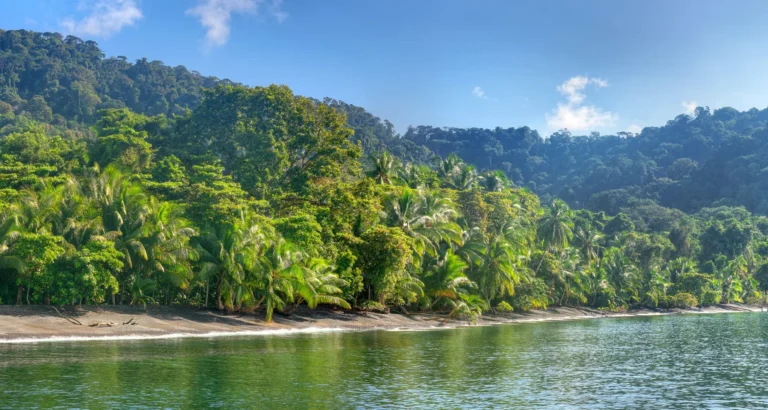
Bosque del Cabo is one of the Osa Peninsula’s longest-running nature lodges: thatched bungalows and a few rental houses on a cliff about 500 feet above the point where the Golfo Dulce meets the Pacific, surrounded by more than 750 acres of the owners’ own forest. It opened in 1990, runs largely on micro-hydro and solar power, and is known among naturalists for how much wildlife walks through the grounds. Stay here if you want to see monkeys, macaws and the occasional wild cat from a cabin porch, with trails down to empty beaches.
At a glance
| Location | Cabo Matapalo, the southern tip of the Osa Peninsula, 22 km south of Puerto Jiménez |
|---|---|
| Style | Owner-run rainforest lodge: ocean-view bungalows, garden cabins and self-catering houses |
| Setting | 750+ acre private reserve of primary and regenerating forest with 3+ km of Pacific beach |
| Best for | Wildlife watchers, photographers, birders, hikers and families with older kids |
| Getting there | Flight or drive to Puerto Jiménez, then about 45 minutes by 4×4 on a gravel road |
| CST status | Not in the official CST directory (checked 2026-Oct-21) |
Where it is
The lodge’s FAQ places it at the very tip of the Osa, 22 kilometers south of Puerto Jiménez (about 45 minutes in a 4×4), on the road halfway between town and Corcovado National Park. A driveway roughly a mile long leads in from the public road.
Most guests fly from San José to Puerto Jiménez, and the lodge includes a round-trip transfer from town with cabin stays. Driving takes 5.5 to 8 hours from San José depending on route and weather, according to the lodge’s driving directions, and a sturdy 4×4 is needed once you’re on the peninsula.
How it started
Phil Spier, then a young business owner from Stuart, Florida, began buying land on Cabo Matapalo in 1987 after years of vacations in Costa Rica, partly for the surf. The owners page says the original farm had been worked with slash-and-burn methods and that some of it was still smoking when he took possession. About 100 acres had been cleared for crops and cattle.
Phil reforested part of the cleared land, planted some with plantation trees and left the rest to grow back on its own (which, the lodge notes, made for the more diverse forest). After three years he built three cabins and a restaurant and opened in 1990. He and his wife Kim still own and run the lodge. The pasture along the driveway is now secondary forest where peccaries, wild cats and even tapirs have been seen.
The grounds
The lodge’s grounds page estimates that 90 to 95 percent of the reserve is established or regenerating forest. The property includes creeks, watershed land, more than 3 kilometers of rugged Pacific beach with tide pools and rock arches, and 8 to 10 acres of botanical gardens with collections of heliconias, palms, gingers, bamboo and bananas. Spring-fed ponds in the gardens draw red-eyed tree frogs, masked tree frogs and other night creatures.
A 300-foot suspension bridge crosses a forested gorge about 75 feet deep to reach the Tropical Garden, where the cheaper cabins and one of the houses sit.
Rooms and houses
The main grounds hold about ten ocean-view bungalows built of tropical hardwood and thatch, or stucco and tile, each with an indoor bathroom plus an outdoor garden shower, screened windows and a porch with hammock. The accommodations page splits them into:
- Classic cabinas (Bambu and Sol): two double beds.
- Deluxe cabinas: a king bed, bigger bathroom and wraparound deck. Three (Tucan, Manglillo and La Palma) add a loft with a single and a double bed, and two (Mariposa and Tucan) have outdoor bathtubs.
- Houses: Casa Blanca (two bedrooms), Casa Miramar (three bedrooms, plunge pool) and Casa Coco (two bedrooms, plunge pool), all with full kitchens. A three-night minimum applies.
- Tropical Garden: Casa Teka and garden cabinas across the bridge, without ocean views.
The rates page says cabin stays include three meals a day and the transfer from Puerto Jiménez. House stays are room-only, with meal packages on request. There’s a pool with a solar-powered pump.
Food
All meals are made from scratch with local ingredients, mixing American, Costa Rican and international cooking. Breakfast and lunch run at set hours, lunches can be packed for the trail, and dinners are often buffets served at large candlelit tables. The food page says vegetarians are welcome and other diets can be handled with notice. Drinking water is filtered spring water from the property, and there’s a high-powered telescope in the restaurant for watching wildlife.
Every week, usually on Wednesday evening, a conservation group working on the Osa gives a free talk in the restaurant library.
Trails and activities
Trails maintained by the lodge’s forest guard lead down to the Pacific and the Golfo Dulce. The trail descriptions are detailed: the Pacific Trail, for example, is 0.3 miles of steep descent through old forest past the lodge’s small hydroelectric plant, reaching beaches that are only passable around low tide, with tide pools and a waterfall about a mile along the sand.
The lodge’s signature activity is its tree platform, in use since 1999: a 250-foot zip line delivers you to a deck more than 110 feet up a giant tree beside the creek, and guides lower you back down. Other options include guided walks, surfing at the Matapalo breaks, kayaking, dolphin watching, snorkeling, waterfall rappelling, tree climbing, horseback riding, fishing, massage and yoga.
Wildlife
Scarlet macaws and Central American squirrel monkeys, both scarce in much of their old range, are regulars at Bosque. According to the lodge’s wildlife page, howler and white-faced monkeys, toucans, coatis, agoutis, collared peccaries, tayras and tapirs are seen on the grounds, and pumas, jaguarundis and ocelots turn up from time to time. One visiting naturalist quoted there reports seeing all four monkey species in a single morning. Regional specialties include the black-cheeked ant-tanager, yellow-billed cotinga and Golfo Dulce poison dart frog.
Sustainability
According to the sustainability page, most of the lodge’s power comes from micro-hydro and solar, grey water passes through a constructed wetland, food scraps are composted or go to a neighbor’s pigs, and recyclables are sent to a recycling center. Staff are mostly local, and the lodge sponsors three employees’ children at a bilingual school. The owners say they use most of the lodge’s proceeds to buy threatened land in the corridor between Matapalo and Corcovado, and the lodge hosts the annual science meeting of Friends of the Osa.
Bosque supports the CST program and describes its practices against CST standards, but it isn’t in the official CST directory, so these are the lodge’s own statements.
Who it suits
Bosque del Cabo is best for travelers whose main goal is wildlife: photographers, birders and anyone who wants to walk out of their cabin onto real forest trails. Families can take the houses with kitchens, and the tree platform accepts children.
It’s not a beach resort; the beaches are a steep walk down, the cabins have fans rather than air conditioning, and the road is rough. If you’d prefer to be right on the sand, compare Encanta la Vida a short drive away, or Lapa Rios Ecolodge for a more polished stay with its own reserve. Browse more Osa Peninsula eco-lodges or read our Corcovado and Osa Peninsula guide.
Frequently asked questions
Are meals included at Bosque del Cabo?
For the cabins, yes: rates include three meals a day and the round-trip transfer from Puerto Jiménez. The rental houses are booked room-only with optional meal packages, since each has a full kitchen.
How hard are the trails down to the beach?
They're steep. The Pacific Trail is only 0.3 miles but drops through forest to the shore, and the lodge advises going within a few hours of low tide because the beach isn't passable at high water.
Can children do the tree platform?
Yes. The lodge keeps children's harnesses, and two trained guides run each climb. Closed-toe shoes are required.
Is it close enough to visit Corcovado?
Yes. The lodge sits halfway between Puerto Jiménez and Carate, the southern park entrance, and can arrange guided trips. A certified guide is required inside Corcovado.