

Rancho Margot is a working regenerative farm and eco-lodge on the south shore of Lake Arenal, near the village of El Castillo, where guests sleep in bungalows or a bunkhouse, eat buffet meals largely grown on the ranch, and can tour the hydro plant, biodigesters and compost system that keep it running. Founded in 2004 on more than 400 acres of worn-out pasture, it’s one of Costa Rica’s best places to see self-sufficiency up close. Stay here to learn, do yoga by a river and eat from the farm, not for luxury.
At a glance
| Location | Caño Negro River valley, about 3 km from El Castillo and 28 km (40 minutes) from La Fortuna |
|---|---|
| Style | All-inclusive farm lodge: 19 bungalows, a 20-room bunkhouse and a rental house |
| Setting | 420+ acres of farm, gardens and forest on the south side of Lake Arenal, bordering the Children’s Eternal Rainforest |
| Best for | Families, students, volunteers, yoga lovers and anyone curious about sustainable farming |
| Getting there | Paved road from La Fortuna most of the way, then 2.5 km of gravel |
| CST status | Not in the current CST directory (checked 2026-Oct-21); the ranch says it holds 5 Leaves |
Where it is
The ranch lies in the valley of the Caño Negro River, below Monteverde and on the south shore of Lake Arenal. Its FAQ puts El Castillo, with a few shops, cafés and bars, about 3 kilometers away and downtown La Fortuna about 28 kilometers, or 40 minutes by car. Most of the road is paved; the final 2.5 kilometers are rough gravel that a normal car can manage slowly.
One man’s mountain village
Juan Sostheim, a Chilean-born former fast-food executive turned environmentalist, bought more than 420 acres of overgrazed pasture here in January 2004, after spotting the valley while riding along what’s now called the Mirador Ridge. The ranch’s story page says the land was surrounded by protected forest, with the Caño Negro running through it, and that he wanted to recreate the mountain village of his childhood.
Community work came early. In 2006 the ranch signed an agreement with the Children’s Eternal Rainforest, Costa Rica’s largest private reserve, to hire, house and equip forest rangers to curb poaching. For four years it paid for a daily van to take El Castillo’s children to school in La Fortuna, then bought two buses and ran them free until a secondary school opened in the village. It still provides space, materials and teachers for English classes at the local school.
How the ranch runs itself
The ranch’s regenerative farm page is the most detailed sustainability statement of any lodge in the Arenal area. According to Rancho Margot:
- Energy: two on-site hydroelectric generators run on river water (about 130 liters per second) and feed a computerized grid around the clock, with some solar and a diesel generator only for backup. The first turbine was a rebuilt Pelton wheel salvaged from a scrap pile.
- Biogas: three biodigesters treat liquid animal waste and produce methane for cooking and heating in the kitchen.
- Compost: food, plant and solid animal waste go through a microorganism-assisted composting system that becomes fertilizer for the gardens.
- Food: the ranch produces well over half of all the food eaten by guests, residents and staff, sometimes more than 75 percent. Vegetables and animal feed grown on the ranch are chemical-free; chickens, pork, dairy and occasional beef come from the farm; and condiments, sauces and even vinegar (made from the ranch’s bananas and plantains) are made from scratch.
- Carbon: the ranch says it was verified carbon-negative under the PAS 2050 and PAS 2060 standards by Carbon Clear in 2012.
Rooms
The lodging page describes four options:
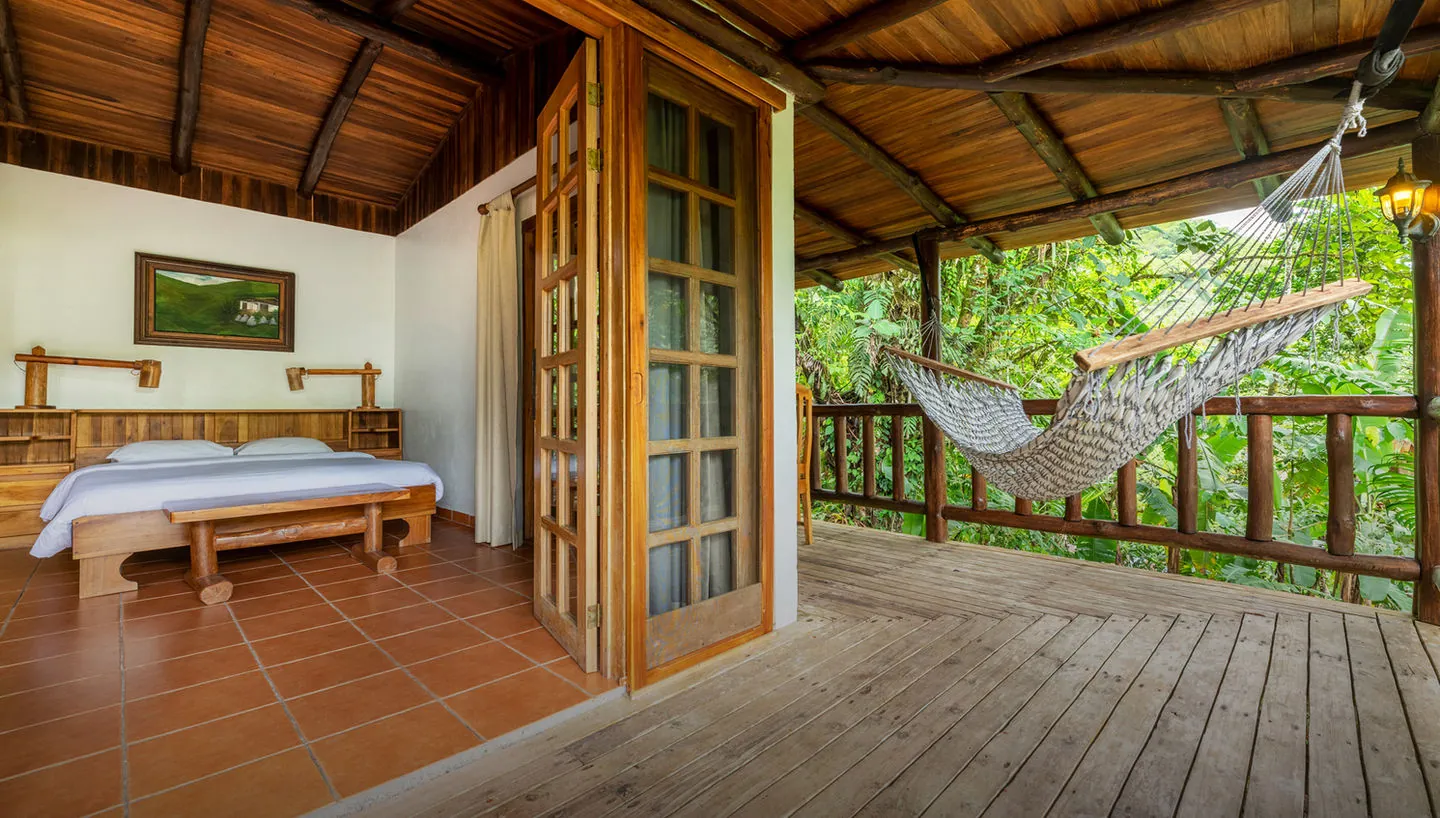
- Bungalow Deluxe: the main choice, for up to four, with queen and/or single beds, a private bathroom, a wraparound terrace with hammock, ceiling fan and a coffee station. Furniture across the ranch is mostly handmade from wood harvested on the property.
- Bungalow Superior: a 25-square-meter version for one adult, with reading nooks and front and back balconies.
- Field House (bunkhouse): a 20-room dormitory with single bunks and shared bathrooms, built for solo travelers, students and volunteers.
- Rental house: two stories, three bedrooms and three bathrooms, a full kitchen and a fireplace, for up to six adults.
There’s no air conditioning anywhere (rooms rely on fans and screened windows), and Wi-Fi is limited to the restaurant, bar and front desk. Because the ranch makes its own power, rooms don’t have refrigerators, though staff will store medicines.
Meals, pools and yoga
Stays are all-inclusive with three buffet meals a day: perhaps gallo pinto, plantains, French toast and homemade yogurt at breakfast; brick-oven pizza, a salad bar, legumes, vegetables and pork or chicken later in the day. The kitchen handles vegetarian, vegan and gluten-free diets with notice. The bar serves smoothies, local craft beer and the ranch’s own kombucha, and often has live music.
Two stone-edged pools are filled with spring water from the mountain and heated with solar and gas; one has a vanishing edge looking at primary forest. The open-air yoga shala on the bank of the Caño Negro River holds classes every day at 7 a.m. and 4 p.m., described on the facilities page.
Things to do
The signature activity is the two-hour guided regenerative farm tour, covering the gardens, animals, food processing and power system. The tours page also lists a night hike, flatwater kayaking, a self-guided climb to the Mirador lookout with views of the Arenal, Tenorio and Miravalles volcanoes, a forest trail, massage, and hands-on workshops in cheese making, soap making and “mountain microorganisms.” Staff can book volcano hikes, waterfalls, horseback rides and other Arenal tours.
Longer stays are possible through a Sustainable Living Immersion program (six nights minimum, in the bunkhouse) and a Spanish immersion course. Volunteers with relevant skills can join a work exchange of at least four weeks.
Wildlife
The ranch borders the Children’s Eternal Rainforest, managed by the Monteverde Conservation League, so forest birds and mammals move freely across the valley. Night hikes focus on frogs, insects and other nocturnal life, and the Mirador and forest trails are good for birding.
About the certification
Rancho Margot’s site says it received 5 Leaves, the top level of Costa Rica’s Certificate for Sustainable Tourism. It doesn’t appear in the current official CST directory, so the certification may have lapsed or not yet been renewed. The practices described above are visible on the farm tour either way.
Who it suits
Rancho Margot is ideal for families with curious kids, students, yoga practitioners, travelers who want to understand how a self-sufficient farm actually works, and anyone happy with simple rooms, buffet meals and early nights. Budget travelers do well in the bunkhouse.
It’s less suited to travelers who need air conditioning, room Wi-Fi or à la carte dining, or who want to be close to La Fortuna’s hot springs every evening. For a polished stay facing the volcano, compare Arenal Observatory Lodge, or for another farm-based lodge in the region, Finca Luna Nueva Lodge. See all of our Arenal and La Fortuna eco-lodges and our guide to organic farm stays and permaculture in Costa Rica.
Frequently asked questions
Are meals and yoga included at Rancho Margot?
The ranch describes stays as all-inclusive with three buffet meals a day, and runs yoga classes twice daily for guests. Confirm whether the guided farm tour is part of your package or booked separately.
Do I need a 4x4 to reach the ranch?
No. The road from La Fortuna is mostly paved, and the last 2.5 kilometers of gravel can be driven slowly in a regular car, according to the ranch.
Can children stay?
Yes, in the Bungalow Deluxe and the rental house; children 5 and under stay free, and children 6 to 11 receive a discount. The single-occupancy Bungalow Superior isn't suitable for children, and the bunkhouse doesn't take unsupervised children 12 and under.
Can I visit without staying overnight?
Yes. Day visitors can book the regenerative farm tour (offered at 8:30 a.m., 10:30 a.m. and 1:30 p.m.) and should call ahead to reserve a meal at the restaurant.