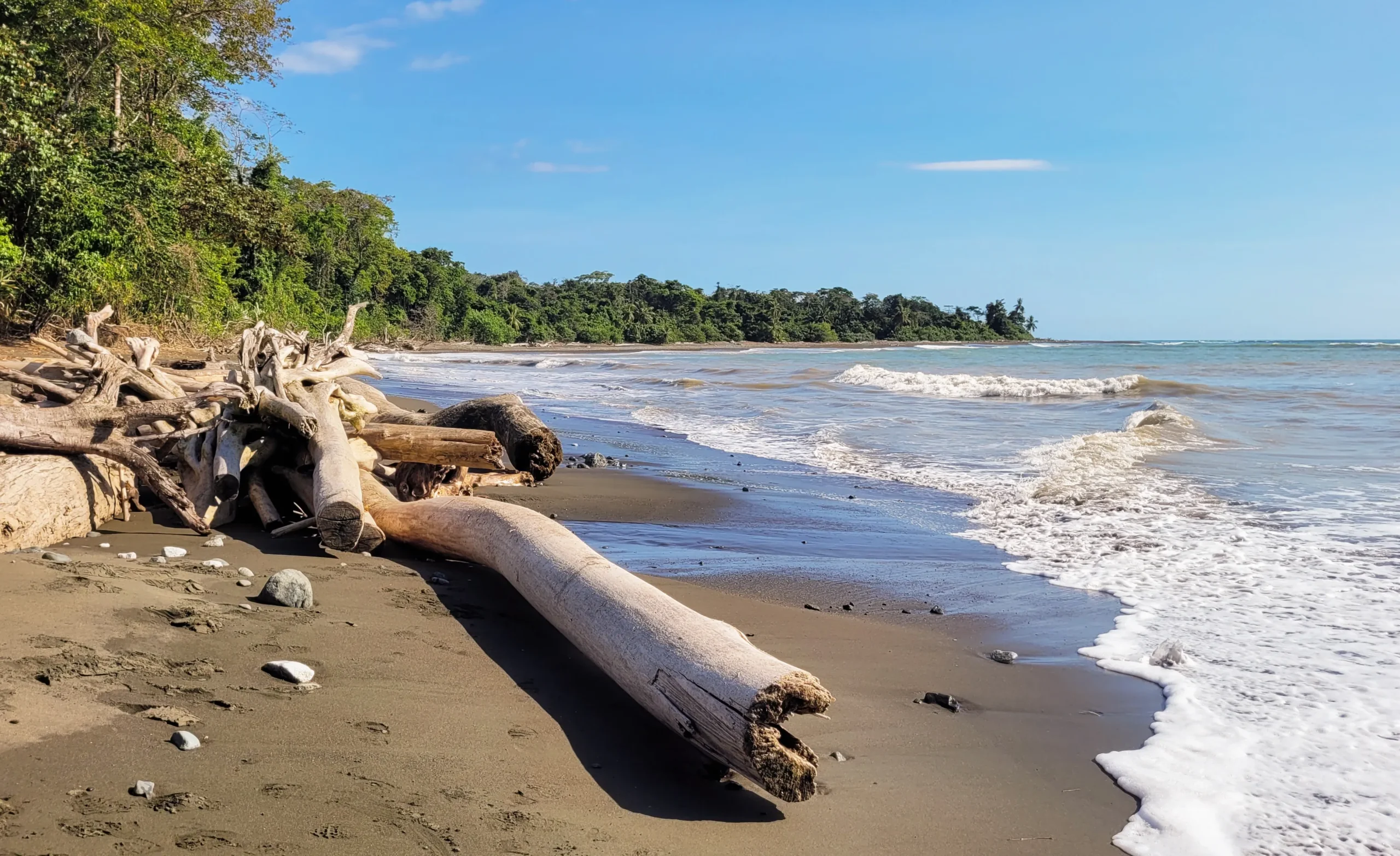
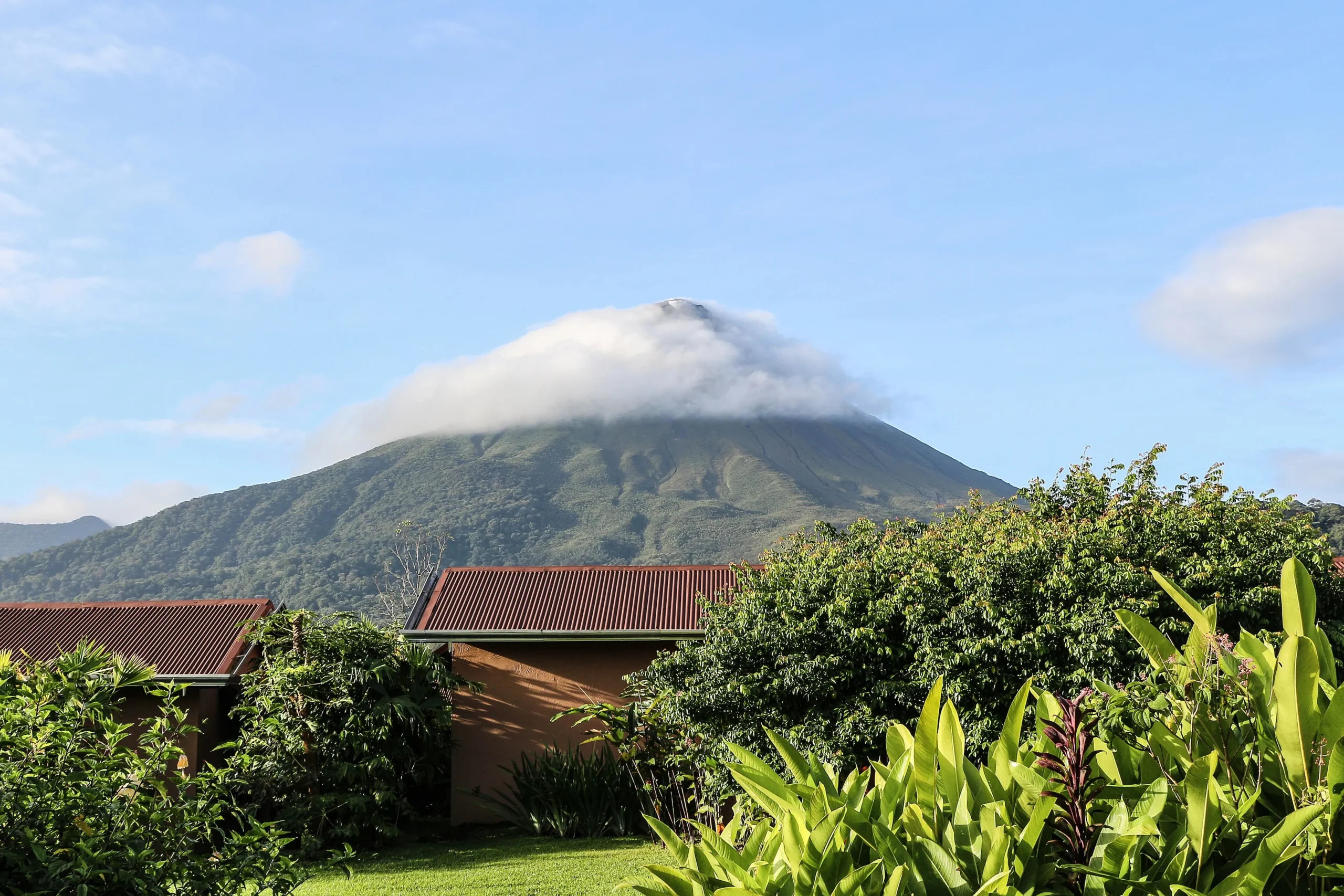
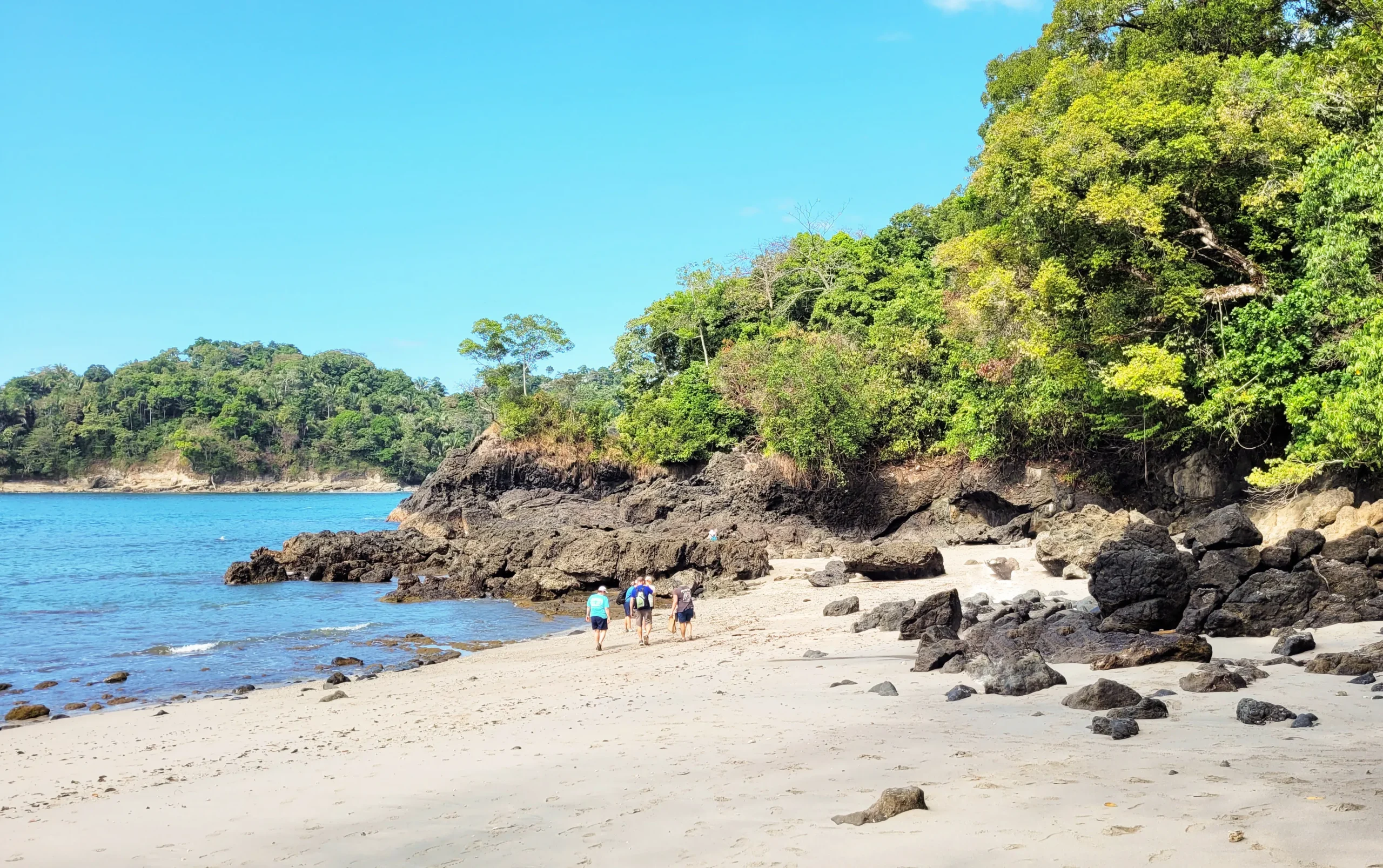
Costa Rica’s national parks protect far more than a collection of beautiful viewpoints. They include rainforest where tapirs walk the beach at dawn, volcanoes still shaped by eruptions, dry forests that change color with the seasons, coral reefs and whale nurseries, and mountain summits where cold winds sweep over páramo and glacial lakes.
For travelers, the challenge isn’t finding a good park. It’s choosing among very different places and understanding how each one works. Some welcome independent walkers on short, maintained trails. Others require advance reservations, accredited guides, boat transfers or serious mountain fitness. A park can be an easy half-day outing or the center of a multi-day wilderness trip.
This guide organizes Costa Rica’s major national parks by experience, gives the official facts that matter for planning, and connects each park with nearby eco-lodges. Park rules change, so treat it as a starting point and confirm details on the official park page before you go.
How Costa Rica’s national parks work
The National System of Conservation Areas, known by its Spanish initials SINAC, runs the country’s public protected areas through regional conservation areas. National parks are one category among several. Wildlife refuges, biological reserves, forest reserves, protected zones and wetlands follow different rules, and not every protected area is set up for visitors. SINAC’s national parks page links to the official page for each park, with hours, sectors and current notices.
Most popular parks now sell entry only in advance. Poás, Irazú, Tapantí, Rincón de la Vieja, Tortuguero, Chirripó and others use SINAC’s online reservation and payment system, Manuel Antonio has its own official ticket site, Santa Rosa books through the Guanacaste Conservation Area, and Corcovado still takes reservations by email through its regional office. Don’t assume a ticket booth will sell walk-up entry, and don’t rely on an old blog’s instructions.
A park visit also isn’t an animal show. Wildlife is unpredictable, weather changes fast and managers close trails or sectors to protect people and ecosystems. Choose a landscape you want to understand, and treat the animals and views as part of that larger experience.
Costa Rica’s major national parks at a glance
| Park | Region | Best known for | How visits work | Eco-lodge base |
|---|---|---|---|---|
| Corcovado | Osa Peninsula | Lowland rainforest, tapirs, all four monkey species | Advance reservation required; guides required on key routes | Drake Bay, Carate, Puerto Jiménez |
| Manuel Antonio | Central Pacific | Forest trails to beaches, easy wildlife viewing | Online tickets; closed Tuesdays | Manuel Antonio hills |
| Tortuguero | North Caribbean | Canals, green turtle nesting, manatee habitat | Boat or small-plane access; online tickets; regulated turtle tours | Tortuguero village and lagoon |
| Arenal Volcano | Northern plains | Lava-flow trails, rainforest, volcano views | Open daily; trails, not the summit | La Fortuna, Lake Arenal |
| Tenorio Volcano | Northern volcanic range | Río Celeste’s blue water and waterfall | Daily visitor cap; morning entry window | Bijagua |
| Rincón de la Vieja | Guanacaste | Fumaroles, mud pots, waterfalls | Online tickets; two sectors with different closing days | Rincón area haciendas |
| Santa Rosa | Guanacaste | Dry forest and national history | Reservation through the conservation area; closed Tuesdays | Liberia and Rincón area |
| Carara | Central Pacific | Scarlet macaws, transition forest | Day visits; universal-access trail | Tárcoles and Jacó area |
| Cahuita | South Caribbean | Coral reef snorkeling, coastal forest | Two sectors; community-run beach entrance | Cahuita and Puerto Viejo |
| Marino Ballena | South Pacific | Humpback whales, Whale’s Tail sandbar | Four sectors; tide-dependent | Uvita, Ojochal, Dominical |
| Palo Verde | Guanacaste | Wetland birds and dry forest | Open daily; best with a local guide | Bagaces and Cañas area |
| Poás Volcano | Central Valley | Giant active crater | Online reservation only; last entry 2 p.m. | Central Valley highlands |
| Chirripó | Talamanca | Highest summit, páramo, glacial lakes | Online permit; registration; very early start | San Gerardo de Rivas |
| Los Quetzales | Talamanca | Resplendent quetzal, oak cloud forest | Open daily; short trails | San Gerardo de Dota |
Corcovado National Park: the Osa Peninsula’s wild heart
Corcovado is the country’s flagship lowland rainforest park. SINAC lists it at 42,560 hectares of land and 3,354 hectares of sea, created by decree on 24 October 1975, and says it holds about 2.5 percent of the world’s biodiversity. Rainfall averages about 5,500 millimeters in the hills and 3,500 on the coast, with a drier spell from mid-December to mid-April. Tapirs, peccaries, scarlet macaws and all four of Costa Rica’s monkey species live here, along with elusive big cats.
Logistics shape the whole visit. SINAC lists six visitor sectors: San Pedrillo, Sirena, La Leona, Los Patos, Los Planes and El Tigre. Every visit needs an advance reservation, made by email with the regional office; El Tigre is booked through a local community association. The long routes from La Leona to Sirena and from Los Patos to Sirena must be walked with a tourism guide, and SINAC’s own recommendations say to hire a local guide for walks inside the park. Night walks aren’t allowed, single-use plastic is banned, and swimming at the park’s beaches is prohibited because of strong currents. For the full Los Patos to Sirena to La Leona traverse, SINAC suggests allowing three days.
Corcovado suits travelers who want deep rainforest and accept that nothing is guaranteed. Many arrive by boat from Drake Bay. Casa Corcovado sits on a 170-acre private hilltop reserve on the park’s border near Drake Bay. On the southern side, the family-owned La Leona Eco Lodge is close to the La Leona sector and runs guided rainforest and night tours on its own land outside the park. Our Corcovado and Osa guide compares gateways, sectors and lodges in detail.
Manuel Antonio National Park: forest and beach in one morning
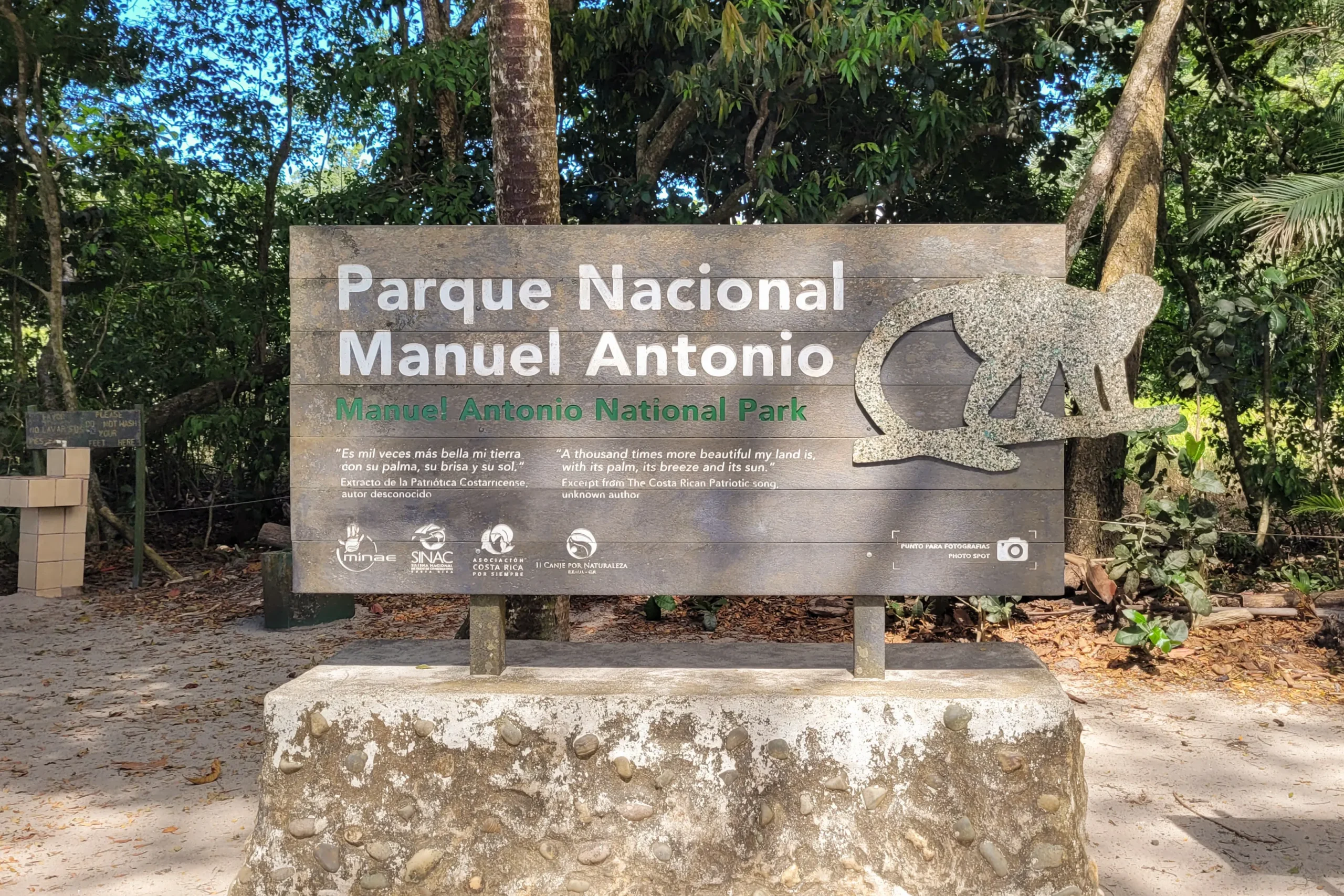
Manuel Antonio is small but famous, combining forest trails, white-sand coves and visible wildlife. It began in 1972 as a recreational park created by law after local residents objected to foreign owners blocking access to the beaches. SINAC records about 352 bird species and 109 mammal species, and the squirrel monkey (mono tití) is its emblem.
The park opens Wednesday to Monday, 7 a.m. to 3 p.m., and closes on Tuesdays. Tickets are sold only through the official website. Inside, the certified guides’ association of Quepos runs the official guide concession, with afternoon and night tours offered in some seasons. You’ll find showers, but soap and shampoo aren’t permitted, and food may be eaten only in the designated area. Feeding animals, leaving food unattended and crowding wildlife cause real problems in a park this busy.
Two of the area’s best-known nature-focused hotels sit on the forested hills nearby. Si Como No maintains a butterfly garden and a 30-acre wildlife refuge, and Arenas del Mar spreads across about 12 acres of beach and forest, where guests leave their cars and ride electric carts to the open-air lobby. For a quieter alternative nearby, add Carara (below) or a mangrove outing.
Tortuguero National Park: canals and Caribbean wetlands
Tortuguero was declared a national park on 24 September 1970, building on sea turtle research begun in the 1950s by zoologist Archie Carr. SINAC lists it at 76,937 hectares, of which 26,653 are land and 50,284 marine. Ninety-nine percent of the land is kept under absolute protection, with 1 percent open to visitors. SINAC calls it the most important green turtle nesting beach in the Western Hemisphere, and the park also protects nesting by leatherback, hawksbill and loggerhead turtles, habitat for the West Indian manatee, and 442 bird species.
There are no roads to the village. You arrive by boat or small plane, then explore by canal and on foot. Average rainfall is about 6,000 millimeters, with March, April and October usually the least rainy months. Tickets are sold through SINAC’s online system.
Turtle watching is tightly managed. SINAC gives the nesting season as June to October and advises checking that the season has opened. During tours, trained local spotters locate nesting turtles while visitors wait at set points until a turtle is laying and can be watched without disturbance. To protect the turtles, SINAC restricts beach access between 6 p.m. and 6 a.m. from 1 March to 31 October.
Tortuga Lodge & Gardens, owned by Costa Rica Expeditions and one of the area’s oldest lodges, sits on 146 acres facing the park. Our Tortuguero guide covers transfers and canal tours, and our sea turtle nesting guide compares beaches and seasons nationwide.
Arenal Volcano National Park: lava flows and rainforest
Arenal Volcano National Park was created on 30 September 1991 and later enlarged. SINAC stresses its role in protecting the watershed that feeds Lake Arenal, alongside the volcano’s scenery. The park opens daily from 8 a.m. to 4 p.m., and its short trails cross old lava flows, including those from 1992, and lead to viewpoints over the cone and the lake. Climbing the volcano isn’t part of a normal visit; stay on marked trails.
Much of what’s sold as “Arenal” happens outside the park, on private reserves, hanging-bridge parks, waterfalls and hot springs around La Fortuna. That’s useful to know when comparing tours. Arenal Observatory Lodge began in 1987 as a research station for Smithsonian scientists and sits on a private reserve on a ridge facing the volcano. On the other side of town, Chachagua Rain Forest Lodge is a working ranch with a biological station, about 300 acres in all.
Arenal works well for first-time visitors who want several experiences from one base. Leave time for at least one slow guided walk. Our Arenal and Río Celeste guide covers both areas.
Tenorio Volcano National Park and Río Celeste
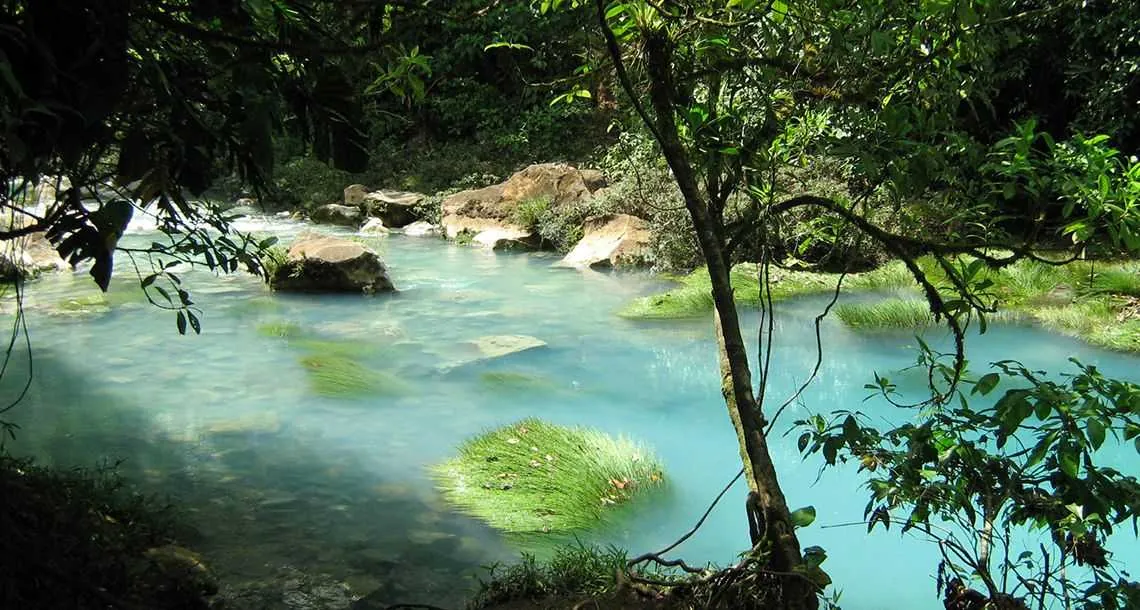
Tenorio protects the forests around Río Celeste, the river famous for its sky-blue water. Its legal roots go back to Law 1917 of 1955, which protected two kilometers around the crater; today the park and its adjoining protected zone cover about 18,402 hectares and form part of UNESCO’s Agua y Paz Biosphere Reserve, named in 2007. The climate is Caribbean-influenced, with about 3,500 millimeters of rain a year.
The main trail is 3 kilometers one way, about 6 kilometers and three hours round trip, passing the roughly 20-meter Río Celeste waterfall, a viewpoint, the blue lagoon, bubbling springs and the “Teñidero,” where two clear streams meet and the color appears. The park opens daily, with entry between 8 a.m. and 2 p.m. SINAC caps visits at 1,200 people a day and 500 on the trail at once, so arrive early in busy seasons. Heavy rain can cloud the water, and swimming isn’t part of the visit.
Bijagua is the natural base. Celeste Mountain Lodge is surrounded by forest reserves and looks out on the Tenorio and Miravalles volcanoes, and Sueño Celeste, a small B&B founded in 2008 on partly reforested land, has views of Tenorio from its balconies.
Rincón de la Vieja National Park: volcanic Guanacaste
Rincón de la Vieja became a national park by law on 23 October 1973 and covers about 14,300 hectares. It sits on the divide between the Caribbean and Pacific, and SINAC notes that 32 rivers rise within it. There are two visitor sectors with different schedules: Las Pailas opens Tuesday to Sunday and closes Mondays, while Santa María opens Thursday to Monday and closes Tuesdays and Wednesdays. Tickets are sold only online.
At Las Pailas, a 3-kilometer loop of about two hours passes fumaroles, bubbling mud pots and a small “volcancito.” A separate trail leads to La Cangreja waterfall, about 5 kilometers each way, with entry limited to the morning in the dry season and regulated access in the rains. SINAC currently lists the summit trail to the active crater as closed because of volcanic activity. The dry season runs December to April; mornings are best year-round.
Buena Vista Lodge, a former cattle hacienda on the park’s edge, protects a large tract of forest and is a convenient base for both sectors.
Santa Rosa National Park and the dry forest
Santa Rosa is the heart of the Área de Conservación Guanacaste, which joined the World Heritage list in 1999. The IUCN’s World Heritage Outlook describes the site as about 147,000 hectares of land and sea holding the largest, best-preserved and most representative sample of Neotropical dry forest, along with an important olive ridley nesting population. The same review rated its conservation outlook as “significant concern” in 2025, a reminder that protection is ongoing work.
Santa Rosa opens Wednesday to Monday, closed Tuesdays, and visits require a reservation through the conservation area’s own booking site. La Casona, the park’s historic ranch house, operates as a history museum on the same days, which is why SINAC describes Santa Rosa as a place where history and nature meet. Visit early in the dry season for open views and wildlife at water sources, or in the green season to see the forest transformed.
Carara National Park: macaws in a transition forest
Carara, about 90 kilometers from San José, sits where wetter southern forest meets the drier north. It was set aside as a biological reserve in 1978 and became a national park in 1998. SINAC records about 420 bird species there, roughly 47 percent of the country’s total, and 124 reptile species. It’s one of the best places in the country to see scarlet macaws.
Carara was the first national park with a universal-access trail, a 1.2-kilometer loop with rest bays and signs in Spanish, English and Braille. Other short trails follow the Tárcoles River meander, where crocodiles bask. Local guides work outside the park rather than for it, so arrange one in advance if you want help with bird calls.
Santa Lucia Jungle Hacienda, formerly Hotel Villa Lapas, sits in a 500-acre private reserve near Carara and the Tárcoles River.
Cahuita National Park: forest and Caribbean coral
Cahuita was created as a national monument in 1970 to protect its coral reef and became a national park in 1978. About 600 hectares of its marine area protect what SINAC calls the most developed coral reef on Costa Rica’s Caribbean coast, with designated snorkeling zones. On land, a coastal trail passes howler and capuchin monkeys, sloths, toucans and basilisks.
The park is unusual for its community role. Since 1998 a management committee of local organizations and SINAC has helped run it, and community guides trained by the national training institute and accredited by the tourism institute lead visitors. Both sectors, Playa Blanca beside the village and Puerto Vargas to the south, open daily from 8 a.m. to 4 p.m., and the Playa Blanca entrance is run on a voluntary-donation basis that supports the community and the park.
Cabinas Caribe Luna is in Cahuita village, within walking distance of the park. Snorkel only in the designated zones and with a guide when conditions allow.
Marino Ballena National Park: whales and a living coastline
Marino Ballena near Uvita protects 5,160 marine hectares and 171 land hectares along 15 kilometers of coast, from beaches and mangroves to rocky islets and reefs with 17 coral species. Local fishermen and residents first pushed for it, and its creation was confirmed by decree in 1992. SINAC notes two humpback whale seasons each year: whales from the north from December to April and from the south from July to November, with resident dolphins year-round.
The park’s famous Whale’s Tail, a sandbar that links the beach to a rocky point, can be walked only at low tide, so check the tide table. Choose whale-watching operators who keep their distance and don’t chase animals.
Marino Las Baulas National Park: leatherback beaches
Las Baulas, beside Tamarindo, was created to protect nesting leatherback turtles on Playa Grande, Ventanas and Langosta, along with the Tamarindo estuary and its mangroves. SINAC describes the leatherback as critically endangered worldwide. The park opens daily from 6 a.m. to 6 p.m., with beach use ending at 5 p.m. during the nesting season from October to February.
Be realistic here. SINAC’s current visitor notice says there is no turtle observation, and that estuary visits run with local guides. Treat any tour promising leatherbacks with caution, and check the official notice before you plan around it. The estuary’s birdlife and the dry forest around it are worthwhile on their own.
Palo Verde National Park: wetlands and dry forest
Palo Verde covers about 19,800 hectares between the Bebedero and Tempisque rivers, where seasonal marshes meet tropical dry forest. It receives only about 1,230 millimeters of rain a year. SINAC lists more than 280 resident and migratory bird species, and the park protects Isla de Pájaros, home to the country’s largest colony of black-crowned night herons. The Organization for Tropical Studies runs a research station here.
The park opens daily from 8 a.m. to 4 p.m. Birding is best from the end of the rains into the dry season, when waterbirds gather on shrinking lagoons. Heat is a real factor, so start early and bring plenty of water.
Poás, Irazú and Turrialba: the central volcanoes
Poás rises to 2,708 meters. Its main crater measures about 1,320 meters across and some 300 meters deep and holds a hot, acidic lagoon, while the older Botos crater holds a cold lake. The park opens daily from 8 a.m. to 4 p.m., with last entry at 2 p.m., and entry is by advance online reservation only. SINAC warns that weather at the viewpoints changes quickly and the crater isn’t always visible, so an early slot gives you more time to wait for a clear moment.
Irazú, near Cartago, is the country’s highest volcano and offers views into several craters when the weather cooperates. Turrialba, its neighbor, is an active volcano where SINAC allows visits only with an accredited guide under safety rules. Check current notices for both, and never cross a barrier. Highland temperatures can be cold, so bring layers.
Chirripó National Park: the high mountain trek
Chirripó holds Cerro Chirripó, at 3,820 meters the highest point in Costa Rica and the second highest in Central America. The name comes from a Cabécar word SINAC translates as “land of eternal waters,” and the summit area shows clear signs of past glaciers: U-shaped valleys, moraines and lakes. The park was created in 1975.
This is an expedition, not a stroll. Entry is by advance online reservation only, hikers must register at the park office in San Gerardo de Rivas, and the trailhead is open only from 3 a.m. to 10 a.m. Trails range from about 3 to 25 kilometers, and some routes require guides from local communities. Expect freezing nights, strong sun and fast-changing weather, especially outside the December to April dry season.
Los Quetzales and Tapantí: wet highland forests
Los Quetzales, created in 2006, protects about 4,117 hectares of oak cloud forest between 1,240 and 3,190 meters, at the head of the Savegre River and about 76.5 kilometers south of San José. It’s open daily, and short trails such as a 480-meter birding path make it easy to explore. The valley below is one of the best places in the country for resplendent quetzals. Savegre Mountain Hotel, run by the Chacón family in San Gerardo de Dota, has its own trail network on a private reserve.
Tapantí-Macizo de la Muerte, near Orosi, is one of the wettest places in Costa Rica, averaging more than 6,500 millimeters of rain a year and occasionally up to 8,000. It spans 700 to 3,491 meters and five life zones, from very wet premontane forest to subalpine páramo, with 1,229 plant species recorded. Tickets are sold only online, and some trails close without notice when landslide risk is high.
La Amistad and the wild south
La Amistad International Park, created in 1982, is Costa Rica’s largest land-based protected area: about 199,147 hectares in Costa Rica and 207,000 more in Panama. It’s a World Heritage Site (since 1983), a biosphere reserve core area and a Ramsar wetland, with oak forest, cloud forest, páramo and high-altitude peat bogs. Most trails start from rural and Indigenous communities that offer guiding, meals and lodging. Several routes, including the multi-day trek to 3,549-meter Cerro Kamuk, require local guides and have strict group limits.
Near Golfo Dulce, Piedras Blancas National Park protects lowland rainforest that SINAC notes was once part of Corcovado, and wildlife moves between the two. Esquinas Rainforest Lodge, on the park’s edge near the village of La Gamba, combines guest stays with local conservation and research work.
Other parks worth knowing
Braulio Carrillo protects steep, wet mountain forest close to San José and connects with La Selva in the Caribbean lowlands; its Quebrada González sector on the Guápiles highway is an easy introduction. Barra Honda in Guanacaste is the only park with an underground cave system, open on guided visits. Isla del Coco, far out in the Pacific, is a World Heritage marine park reached only on specialist dive expeditions. Smaller parks such as La Cangreja, Juan Castro Blanco, Barbilla, Diriá and Isla San Lucas have more limited facilities, so check access before you plan a visit.
How to choose parks for a one-week trip
For a first trip, choose two bases and skip the list of five distant parks. Arenal and Tenorio pair volcanic rainforest with Río Celeste. Manuel Antonio and Carara give you accessible wildlife and macaws. A focused Osa trip allows time for Corcovado and nearby private reserves, but transfers take time. A Caribbean trip can link Tortuguero with Cahuita. Guanacaste visitors can combine Rincón de la Vieja, Santa Rosa and Palo Verde without long drives.
The best itinerary isn’t the one with the most parks. It’s the one that gives you time to experience distinct ecosystems rather than constantly packing and unpacking.
Guides, tickets and responsible visits
Check the exact park and sector, not just the park’s name. Some sectors open on different days, some need a guide, and some cap numbers by time slot. If a tour package includes a park visit, confirm which sector, whether entry is booked and who the guide is.
A qualified local guide can transform a walk, particularly for birds, reptiles and forest ecology, even where one isn’t required. SINAC and the tourism institute’s joint guidance for protected areas asks visitors to use ICT-certified guides and operators, enter only through official access points, stay on trails, keep their distance from wildlife and never touch, trap or feed animals. Bring water, rain gear, sturdy shoes and sun protection, and respect closures: tropical rivers can rise fast.
National parks can’t protect every habitat alone. Private reserves, wildlife refuges and research stations add buffers and corridors around them. Our private nature reserves guide explains how those places work and how to visit.
Frequently asked questions
Which national park is best for wildlife?
Corcovado offers the richest lowland rainforest and the best chance of tapirs and other large mammals, but it's remote and needs planning. Manuel Antonio and Carara are far easier to reach and often good for monkeys, sloths and macaws. Tortuguero is best for wetland wildlife and, in season, nesting turtles.
Do I need to book national park tickets in advance?
For most popular parks, yes. Poás, Irazú, Tapantí, Rincón de la Vieja, Tortuguero and Chirripó sell entry through SINAC's online system, Manuel Antonio has its own official website, Santa Rosa books through the Guanacaste Conservation Area, and Corcovado takes reservations by email. Book early for weekends, holidays and the December to April dry season.
Can I visit Corcovado without a guide?
Every visit needs a reservation, and the long routes between La Leona or Los Patos and Sirena must be done with a tourism guide. SINAC recommends a local guide for all walks in the park. In practice, nearly every visitor goes with a registered guide arranged through a lodge or local operator.
Which parks are closed on certain days?
Manuel Antonio closes on Tuesdays, and so does Santa Rosa. Rincón de la Vieja's Las Pailas sector closes on Mondays and its Santa María sector on Tuesdays and Wednesdays. Most other major parks open daily, but schedules change, so check the official page.
Can I see turtles nesting in a national park?
Yes, at Tortuguero, where SINAC gives the nesting season as June to October and night viewing works through an official program with trained spotters. SINAC also restricts night access to the beach from March through October. At Las Baulas, SINAC's current notice says there's no turtle observation. Ostional, a wildlife refuge rather than a national park, is known for mass olive ridley nestings; see our turtle guide for details.
Is the rainy season a bad time to visit parks?
Not necessarily. Forests are lush, crowds are smaller and wildlife is active, but some trails close, rivers rise and volcano views cloud over. Plan mornings outdoors, keep afternoons flexible and check notices before driving to a remote sector.
How many national parks does Costa Rica have?
SINAC's visitor page lists 25 national parks, plus Guayabo National Monument and two reserves, and the wider protected-area system includes many more wildlife refuges, biological reserves and wetlands. Not all of them have visitor facilities, so check SINAC's park pages before you go.