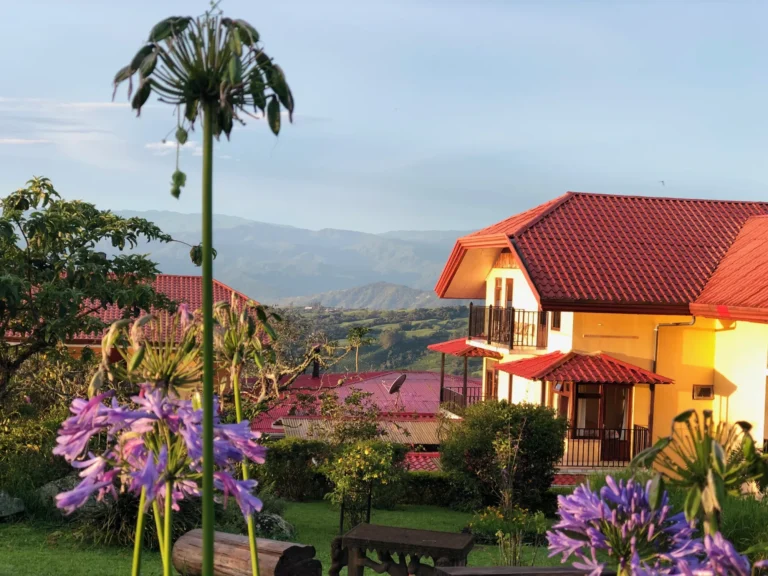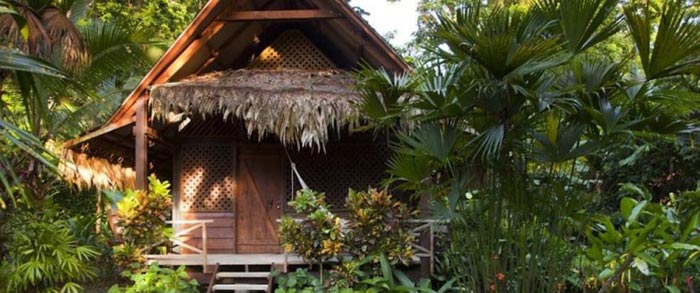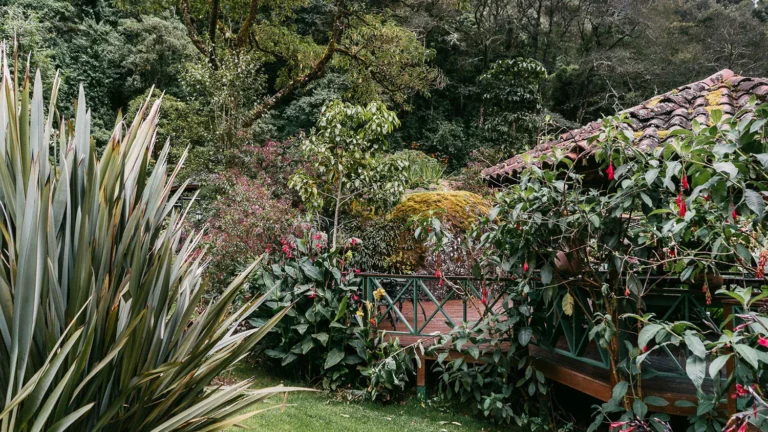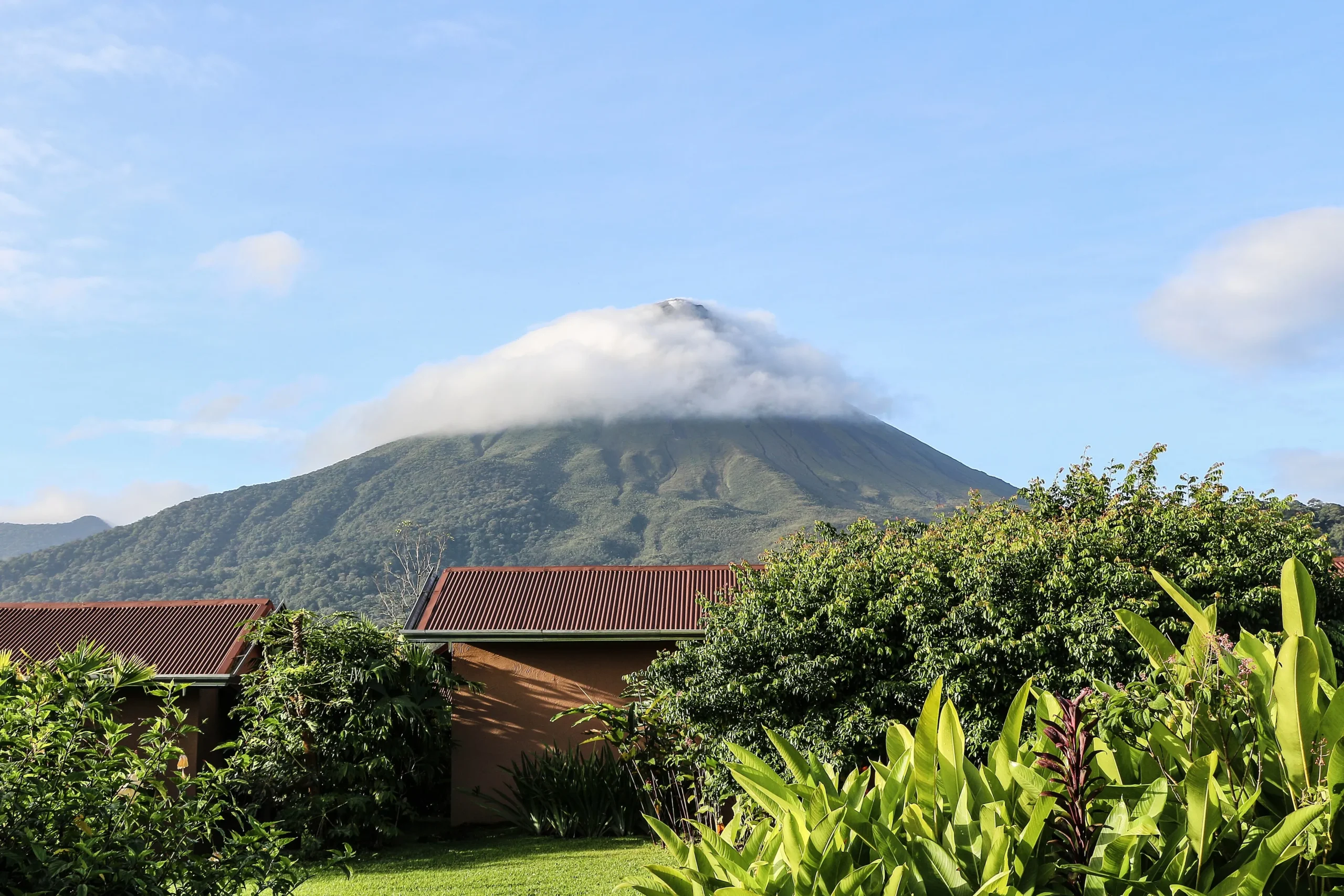

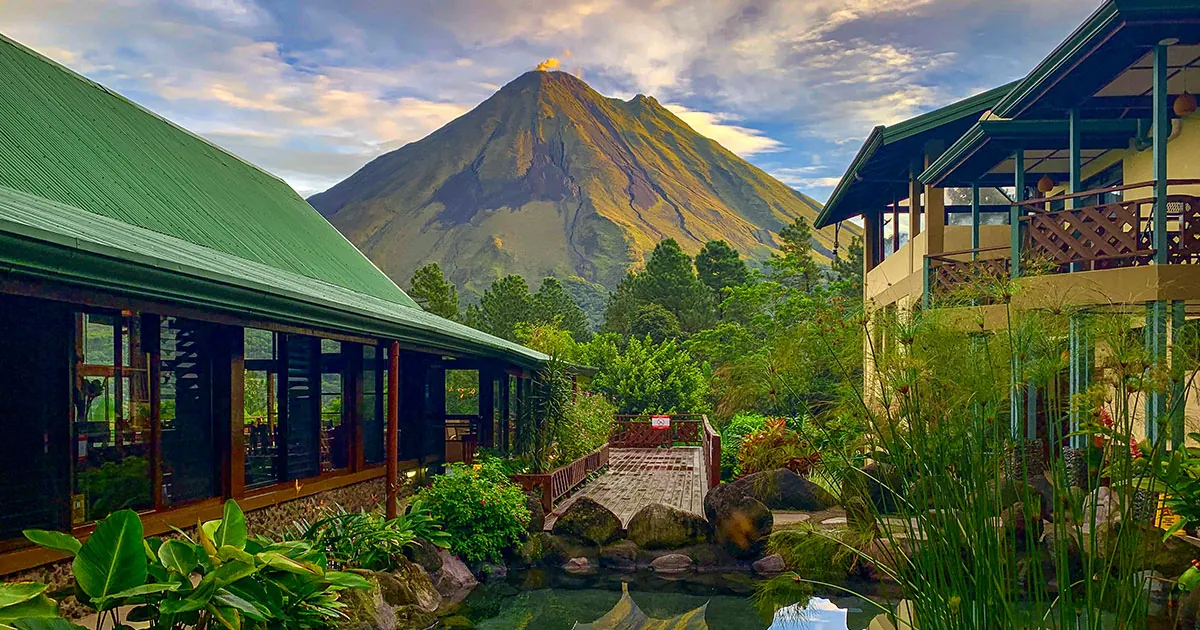
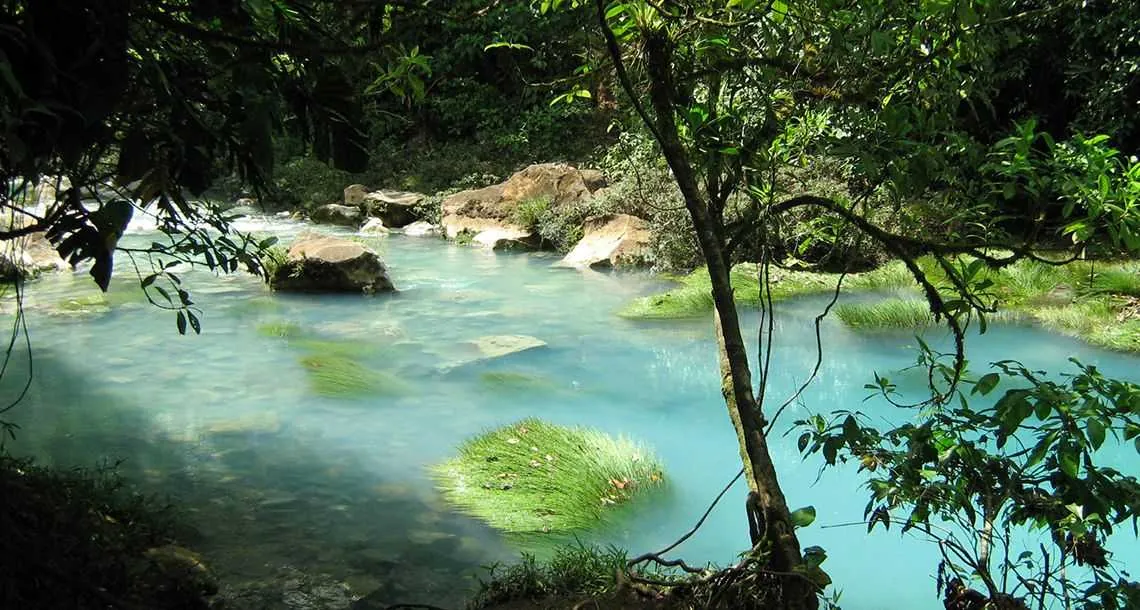
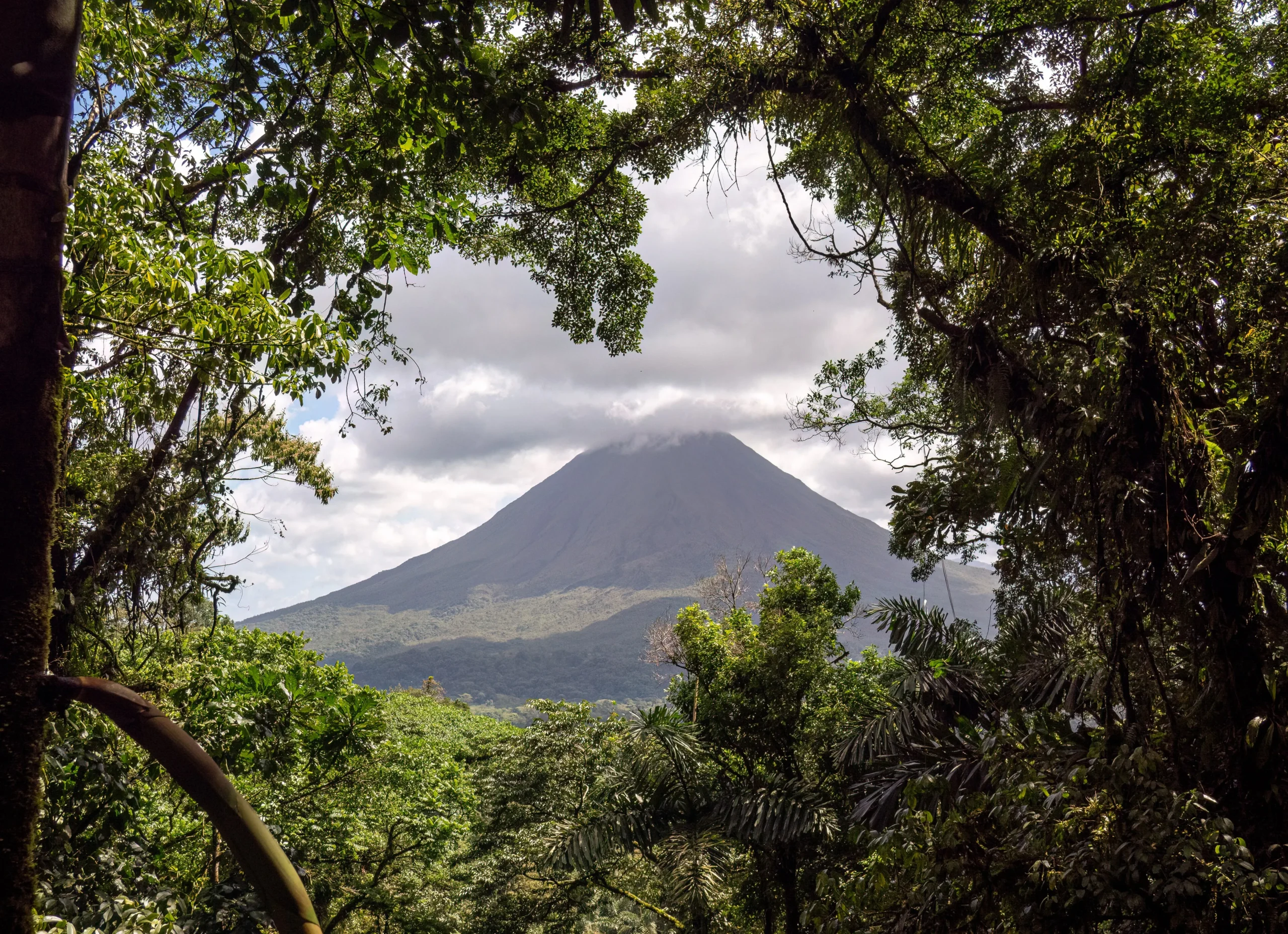
Arenal and Río Celeste appear in many Costa Rica itineraries for good reason. One is a towering volcanic cone surrounded by rainforest, rivers and hot springs. The other is a startlingly blue river flowing through the forests of Tenorio Volcano National Park. Together they make a fine introduction to the country’s volcanic landscapes and tropical ecology, with plenty of nature-focused lodges to choose from.
They are not the same destination, however. Arenal centers on La Fortuna and Lake Arenal, while Río Celeste is usually reached from the small town of Bijagua. This guide explains both parks and their current rules, the science behind the blue water, how to choose a base and which of the lodges we review suit each area. For the wider park system, see our Costa Rica national parks guide.
Arenal Volcano and La Fortuna
Arenal rises above the Northern Plains with the near-perfect cone that has become one of Costa Rica’s most recognizable views. Its modern history began with a deadly eruption on 29 July 1968, and the volcano stayed active for decades afterward. Costa Rica’s volcano observatory, OVSICORI, has said that Arenal is geologically active but has been dormant since late 2010, with only low gas emissions and seismic activity of tectonic rather than volcanic origin. That means no more nightly lava shows, but the volcano is still monitored, and the cone is off limits.
Arenal Volcano National Park was created on 30 September 1991 and later expanded. SINAC highlights lava flows from 1992, a ceiba tree more than 400 years old and trails through extensive rainforest. The park also protects the water that feeds the Arenal reservoir, which contributes to the national electricity system. SINAC notes that all park entry fees go to the National Parks Fund, which supports protected areas across the country.
La Fortuna is the main service town, with restaurants, tour operators and transport. Properties farther out, around El Castillo on the south side of the volcano or along the lake toward Nuevo Arenal, feel much quieter. “Arenal area” covers a wide range of settings and drive times, so check exactly where a lodge is before you book.
Arenal and Tenorio at a glance
| Arenal Volcano National Park | Tenorio Volcano National Park (Río Celeste) | |
|---|---|---|
| Created | 1991 | 1995 (protection near the crater dates to 1955) |
| Size | Expanded in 1992 and 1994 | 12,871 ha of park; 18,402 ha with the adjoining protective zone |
| Main base | La Fortuna, El Castillo | Bijagua |
| Opening hours | Daily, 8 a.m. to 4 p.m. | Entry 8 a.m. to 2 p.m.; visitors may stay until 4 p.m. |
| Signature trails | Heliconias (610 m), Coladas (1.7 km), El Ceibo (2.3 km), volcano viewpoint 1.5 km from the entrance | Misterios del Tenorio, a 3 km linear trail (about 6 km and 3 hours round trip) |
| Highlights | 1992 lava flows, 400-year-old ceiba, views of the cone and Lake Arenal | Río Celeste waterfall (about 20 m), Laguna Azul, bubbling vents and El Teñidero |
| Key rules | Climbing the cone and its immediate surroundings is strictly prohibited | Tickets sold only online; no entering the river; no single-use plastic; no drones |
Sources: SINAC pages for Arenal and Tenorio. Fees are set and updated by SINAC, so check the official pages before you go.
The rainforest beyond the postcard
Arenal is not only about a clear view of the cone. The forests around it hold toucans, monkeys, sloths, frogs, butterflies and many other species, and a good guide who knows calls and fruiting trees will find far more than you would alone. Even when clouds hide the volcano, which is common, a forest walk can be excellent.
The region offers guided rainforest trails, hanging bridges, river trips and naturalist night walks. Bridges help you appreciate canopy structure; slow forest hikes reveal plant relationships and small animals; night walks are especially good for frogs and insects but should never involve handling animals or blinding them with lights. Hanging bridge parks and La Fortuna Waterfall are privately or locally managed attractions outside the national park, with their own tickets and rules. The waterfall descent involves many steps, and swimming areas may close after heavy rain.
For context on these habitats, see our ecosystems guide.
Hot springs and the geothermal question
Thermal pools are one of Arenal’s signature experiences. Some are elaborate landscaped resorts; others are quieter. They vary widely in how they source, treat and discharge water and how much energy they use. A natural geothermal resource does not automatically make an attraction low-impact. A well-run property should be able to explain its water management clearly. Follow posted safety rules about temperature, and do not assume that natural rivers or thermal streams are safe places to swim.
Río Celeste: why is the water blue?
Río Celeste’s color is a natural optical effect, not dye or chemistry. Researchers from the University of Costa Rica and the National University explained the phenomenon in 2013. Two clear streams, the Quebrada Agria and the Río Buena Vista, meet at a spot called El Teñidero (“the dyer”). There, particles of aluminosilicate minerals clump together into larger particles suspended in the water, and these scatter sunlight so that the river reflects blue tones. The team found a whitish mineral coating on stones mainly in the Buena Vista. The blue color continues downstream for roughly 14 km.
That explanation is more interesting than the common claim that two colored rivers simply mix. It also explains why the color varies: after heavy rain, sediment can turn the water murky. Do not assume that an intensely blue promotional photograph shows what you will see after a storm.
Visiting Tenorio Volcano National Park
SINAC’s Tenorio page sets out the current visiting system:
- Tickets are sold only online through SINAC’s official reservation site. Buy before you drive to the entrance.
- Daily capacity is limited to 1,200 people, with no more than 500 on the trail at once.
- Entry is between 8 a.m. and 2 p.m., and you may stay until 4 p.m.
- The main route is the Misterios del Tenorio trail, which passes the waterfall, a viewpoint over three of the Tenorio massif’s four cones, the intense blue Laguna Azul, bubbling volcanic vents and El Teñidero itself.
- Rules: no entering the river, no single-use plastics, no drones, no pets, no alcohol and no smoking. Stay on the trail.
The park lies mostly under Caribbean weather influence, with rain for much of the year, average rainfall around 3,500 mm and an average temperature of about 23°C. Trails are often muddy and slippery, and the waterfall viewpoint involves a long staircase that has had temporary closures or partial access after heavy rains. Check current conditions before you go, start early and wear shoes with good grip.
The park is part of UNESCO’s Agua y Paz Biosphere Reserve, named in 2007. SINAC lists wildlife including tapir, puma, jaguarundi, ocelot, margay, peccaries, white-faced capuchins, the bare-necked umbrellabird and the sunbittern. Most are shy; a naturalist will help you read signs of them along the trail rather than promise sightings.
Bijagua: a quieter nature base
Bijagua, about 9 km from the park according to SINAC, is the practical base for Río Celeste and a quieter alternative to La Fortuna’s larger tourism scene. Lodging ranges from simple cabins to more comfortable rainforest properties, many with birding, gardens or small farms. That does not make every Bijagua property an eco-lodge. Ask what native habitat the lodge protects and what you can do on its own grounds. With several nights, add a guided birding walk or forest hike outside the park so the area is more than one waterfall.
Where to stay: bases and lodges we review
| Base | Best for | Lodges we review |
|---|---|---|
| La Fortuna | Convenience, families, the widest choice of tours | Arenal Oasis Eco Lodge, Catarata Eco Lodge, Chachagua Rain Forest Lodge |
| Inside or beside the national park, El Castillo and Lake Arenal | Volcano views, trails, quieter evenings | Arenal Observatory Lodge, Rancho Margot, Leaves and Lizards |
| Toward Nuevo Arenal | A slower lakeside stay | La Ceibatree Lodge |
| Bijagua and Tenorio | Río Celeste, birding, small family lodges | Celeste Mountain Lodge, Tenorio Lodge, Sueño Celeste, Finca Verde Lodge |
Around La Fortuna:
- Arenal Oasis Eco Lodge is run by the local Rojas Bonilla family on an ecological farm about ten minutes from the town center, with a simple, family-style feel.
- Catarata Eco Lodge is a family-run La Fortuna lodge with volcano views and easy access to waterfalls, rivers and thermal waters.
- Chachagua Rain Forest Lodge is a working ranch in the foothills of the Tilarán range, bordered by a biological station for a total of about 300 acres, and sources much of its kitchen produce from its own farm.
Near the park and lake:
- Arenal Observatory Lodge describes itself on its own website as being inside Arenal Volcano National Park, on more than 352 hectares that include 110 hectares of primary forest, with about 11 km of self-guided trails and 800 meters of wheelchair-accessible trail.
- Rancho Margot is an off-grid ranch of more than 400 acres near Lake Arenal, about 40 minutes from La Fortuna, that grows much of its own food, according to its website. Our review notes its ranger-station partnership with the Monteverde Conservation League.
- Leaves and Lizards Arenal occupies 26 acres of a former dairy farm; the current owners bought it in 2006, planted about 3,000 trees and worked to protect its springs. It is also known for horseback riding on private trails.
- La Ceibatree Lodge sits on 37 acres off the road between La Fortuna and Nuevo Arenal, about 3.7 miles from Nuevo Arenal, at roughly 1,500 feet.
Around Bijagua and Tenorio:
- Celeste Mountain Lodge is a bioclimatic-design lodge near Volcán Tenorio, surrounded by forest reserves, with views of the Tenorio and Miravalles volcanoes.
- Tenorio Lodge sits on 17 acres at about 1,640 feet, with heliconia gardens, ponds, trails and hot cedar tubs, and describes energy conservation, waste reduction and recycling programs.
- Sueño Celeste Bed and Breakfast is a small lodge founded in 2008 by a Belgian couple on three partially reforested acres in Bijagua, with four bungalows and forest trails.
- Finca Verde Lodge is a family-run organic farm in Bijagua with a butterfly garden and a small laboratory that rears butterflies and frogs for release.
Browse more on our Arenal and Monteverde eco-lodges page and northern eco-lodges page. If you are heading east toward the Caribbean, Selva Verde in Sarapiquí protects a 500-acre rainforest reserve popular with birders, and Maquenque Eco Lodge near Boca Tapada sits on a 60-hectare reserve beside the Maquenque National Wildlife Refuge.
Choosing a lodge that does more than look green
Some properties actively restore forest, keep private reserves or combine lodging with regenerative farming. Others are conventional hotels near nature. Ask about land stewardship, wastewater, energy, local hiring and current certifications rather than choosing from a forest photo. Costa Rica’s CST program now certifies at Basic and Elite levels; older “leaf” ratings you may see on websites describe the previous system. Our guide to choosing a sustainable hotel offers a practical checklist.
Arenal or Río Celeste: which should you choose?
Choose Arenal for the widest range of activities, family services, transport, hot springs and hotels. Choose Río Celeste and Bijagua for forest walking, a smaller-town atmosphere and the unusual river. Combining them works well if you allow for the drive between the two; do not assume they share a valley.
With four or five nights you can split your time without rushing, for example two nights near La Fortuna and two near Bijagua, which leaves room for a forest tour, a hot springs evening, Río Celeste and a quiet birding morning. With only two nights, pick one base. Rain falls in every month, and sunny mornings often give way to cloudy afternoons, so do your volcano viewing early and keep a flexible day. Monteverde, covered in our Monteverde cloud forest guide, is the classic next stop; birders should also see our birds of Costa Rica guide.
Two landscapes, one excellent nature trip
Arenal offers volcano scenery and easy access to rainforest experiences. Río Celeste offers a natural phenomenon with a satisfying scientific explanation and a quieter forest setting. Together they show how Costa Rican ecotourism balances famous sights with genuine curiosity. The best memories may be the ones you did not schedule: a toucan overhead, rain gathering in the canopy or the hush after a stream crossing.
Frequently asked questions
Are Arenal and Río Celeste in the same national park?
No. Arenal Volcano National Park and Tenorio Volcano National Park are separate protected areas managed by different regional conservation offices, with their own tickets, hours and rules.
Is Arenal Volcano still erupting?
No. OVSICORI describes Arenal as geologically active but dormant since late 2010. It is still monitored, and climbing the cone or its immediate surroundings is strictly prohibited.
Do I need to buy Río Celeste tickets in advance?
Yes. SINAC sells Tenorio tickets only through its online system, with a daily cap of 1,200 visitors and last entry at 2 p.m. Buy them before you arrive.
Can I swim in Río Celeste?
No. Entering the river is not permitted inside the national park. Enjoy it from the trail and viewpoints.
Why is Río Celeste blue, and will it be blue on my visit?
Mineral particles that form where two clear streams meet scatter sunlight and make the water look blue, as University of Costa Rica researchers showed. After heavy rain the water can turn cloudy, so the color is never guaranteed.
Is Bijagua better than La Fortuna for wildlife?
Both can be excellent. Bijagua usually feels quieter, while La Fortuna has more tours and services. The specific lodge, its habitat and your guide matter more than the town.