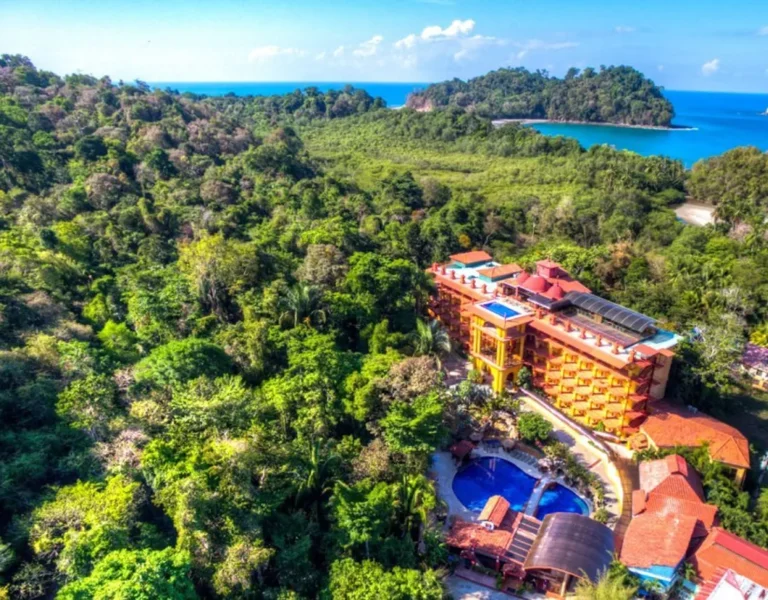


Macaw Lodge is an off-grid, 15-room lodge on a 264-acre family estate in the Turrubares hills, inland from Carara National Park, where degraded farmland has been turned back into forest, cacao groves and gardens since the 1980s. The lodge says scarlet macaws have returned with the trees. It is a detailed, working example of restoration tourism on the Central Pacific, and a strong choice for birders, yoga groups and anyone curious about how chocolate is grown.
At a glance
| Location | Las Delicias de Turrubares, in the Cerros de Turrubares next to Carara National Park |
|---|---|
| Style | Small off-grid lodge with rooms in a main building and bamboo, teak and clay bungalows |
| Setting | 264-acre restored estate of forest, springs, ponds, cacao and botanical gardens |
| Best for | Birders, adults on nature or yoga retreats, and travelers interested in farming and reforestation |
| Getting there | By road, using the lodge’s GPS coordinates and map link; the final approach is unpaved, so ask about your vehicle |
| CST status | Not in the official CST directory on 2026-Oct-21 |
Where it is
The lodge’s homepage places it among the hills and forests of the Cerros de Turrubares, in a transition zone between tropical humid and tropical dry forest. Its sustainability page names the nearest community as Las Delicias de Turrubares, and the lodge’s tours page describes its own rainforest walk as passing through mature forest next to Carara National Park.
The lodge does not publish a street address or driving time, only GPS coordinates and a map link on its reservation policies page. A birding site describes the access as an unpaved road, so check vehicle advice with the lodge when you book.
Carara, which SINAC describes as the only transition forest on the Central Pacific and home to 420 bird species, is the lodge’s natural neighbor. The lodge runs four-hour guided outings there with transport on request.
From monoculture to forest
According to the lodge’s Our Story page, the Gordienko family bought the estate, then called Macau Sanctuary Limited, in the 1980s. The land had been worn down by repeated monoculture crops. The family enrolled it in a government-sponsored forest investment program, began planting trees and agroforestry plots, and over two decades restored forest health and saw wildlife return, including the scarlet macaw. The lodge opened in 2011.
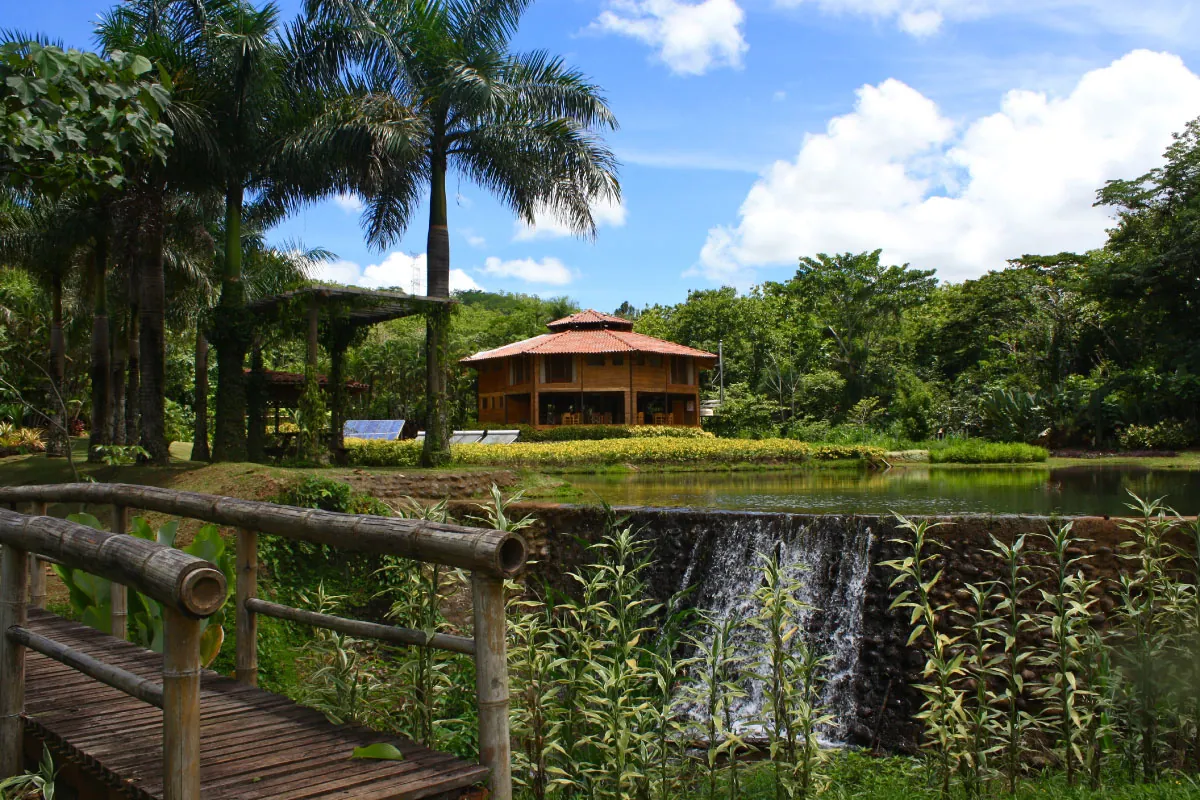
The sustainability page describes what that restoration looks like today: timber plantations, food and medicinal plants, recovered freshwater springs, and forests that feed macaws and hundreds of other species through the year, plus about eight acres of botanical gardens.
Even the buildings tell the story. The lodge says it was built from plantation timber milled on site, from trees recovered from the Tárcoles River after Tropical Storm Thomas in 2010, and from bamboo grown on the property, with local stone and marble for floors and bathrooms. Local craftsmen did the building and made the furniture.
Rooms and bungalows
The lodge page lists 15 units:
- 8 standard rooms on the second floor of the main building, opening onto a balcony above the lobby, each with two full beds, a ceiling fan, a marble bathroom with solar-heated water and Wi-Fi.
- 3 standard bungalows with large terraces and rocking chairs, sleeping three or four.
- 1 family bungalow, the largest, with a kitchen for guests who want to cook.
- 3 natural bungalows built of bamboo and teak with walls of clay and bahareque (wattle and daub), close to the main building, with marble bathrooms and pots woven by Guatemalan indigenous artisans.
All units have ceiling fans and bronze window screens, and the lodge does not list air conditioning. The bungalows have no internet, which many guests will count as a feature. Bungalow 15 has a ramp from the parking area and main building, the only accessibility feature the lodge lists.
Food
The restaurant seats about 30 and overlooks the botanical garden and lake. The lodge’s dining page describes a local chef and team cooking “from the garden to the table,” using the lodge’s own vegetables, herbs and fruit along with homemade bread, tortillas, jams and sauces. Guests choose breakfast only, half board or full board, and lunch and dinner run to three courses with coffee, tea and natural juices included. Meals are served by prior reservation, so tell the lodge your plans ahead. The wellness page says vegetarian and vegan menus are available.
What you do here
Most activities happen on the estate. From the lodge’s tours page:
- Cacao tour: about 90 minutes from tree to chocolate bar in the lodge’s cocoa plantations.
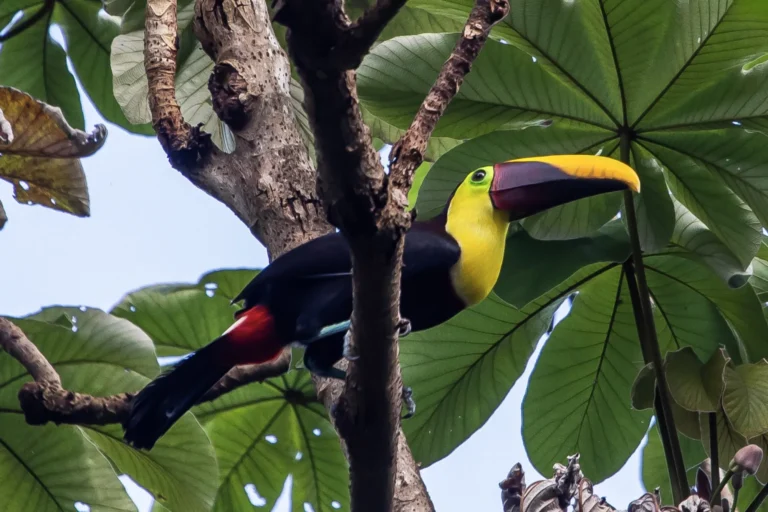
- Guided birding: walks of 2.5 or 4 hours. The lodge says more than 350 species have been recorded in the area and publishes an eBird list.
- Night walk: 90 minutes around the wetlands, ponds and streams looking for frogs, toads and reptiles.
- Sustainable living tour: composting, the aquaponics garden, medicinal plants and stingless bees.
- Self-guided walks: a 90-minute rainforest hike where the lodge suggests watching for poison dart frogs, a garden walk among more than 500 plant species, and an 800 m waterfall trail to a swimming hole on the property.
Off the estate, the lodge arranges Carara, a beach day at Punta Leona’s Playa Blanca, sea kayaking and snorkeling, outrigger canoe trips and kayak fishing near Playa Agujas.
There is no spa, but two open-air yoga platforms each hold up to 30 people, and the lodge hosts retreats through the year. In-room Thai, deep tissue or Swedish massage can be booked ahead.
Sustainability and community
According to the lodge, it runs entirely off the grid, with part of its power from solar panels, and uses LED lighting and low-voltage fans. Water comes from springs on the property and is treated without harsh chemicals. Dual-flush toilets, dry urinals and low-flow showers cut use further. The farm supplies fruit, vegetables, herbs and cocoa for guests and staff, mixing hydroponics with traditional crops, and harvest leftovers go to compost, fertilizer or seed.
The lodge says it hires locally, buys locally and runs tree-planting programs with schools, and it invites guests to make a voluntary donation toward a wildlife rescue center and clinic it hopes to build. It is not in the official CST directory, so these are the lodge’s own descriptions, though they are more detailed than most.
Who it suits
Macaw Lodge suits birders who want trails and a published species list right outside the room, yoga groups looking for a forest setting, and adults who would rather learn about cacao and spring water than sit by a pool. The off-grid setup and the quiet, unplugged bungalows are part of the point.
Families should read the fine print: the reservation policies say children under 12 are not normally accepted, though the lodge may make exceptions and also advertises a family package. Travelers who want air conditioning, a spa or a quick hop to the beach would do better near the coast. For a simpler Carara base by the main road try Cerro Lodge, and for resort comfort on the Tárcoles River see Santa Lucía Jungle Hacienda. More choices are on our Central Pacific eco-lodges page, and our organic farm stays and permaculture guide lists other working farms.
Frequently asked questions
Is Macaw Lodge really off the grid?
Yes, according to the lodge. It is not connected to the public grid, meets part of its energy needs with solar power, heats water with solar panels in the main rooms, and draws water from springs on the property.
Can children stay at Macaw Lodge?
The reservation policies say children under 12 are not accepted, with possible exceptions. The lodge also has a family bungalow and advertises a family package, so ask directly before booking with young children.
Will I see scarlet macaws?
Quite possibly, but not certainly. The lodge says macaws returned as the forest was restored, and it lists them among the species seen on guided bird walks. Like all wild birds, they come and go.
Do I need to book meals in advance?
Yes. The dining page says breakfast, lunch and dinner are served by prior reservation, and you can choose breakfast only, half board or full board.