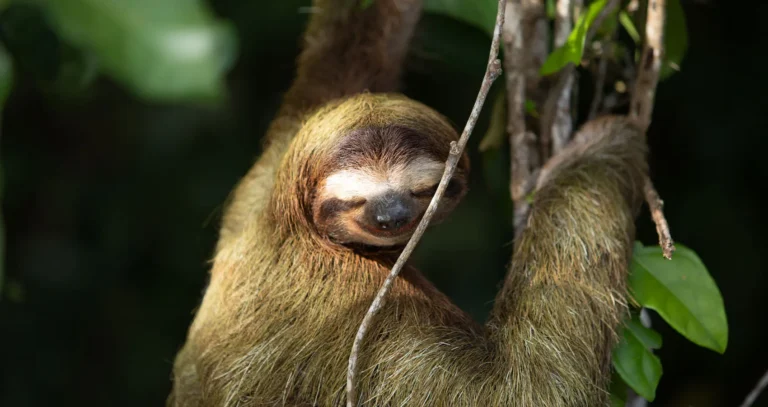

A birder’s first Costa Rican morning can feel almost unfair. While coffee brews, a motmot may perch along a garden edge, tanagers move through a fruiting tree and hummingbirds work the flowers. A little later, the forest begins to reveal birds that seemed invisible a moment before. Costa Rica rewards the patient observer, with professional binoculars or simply a curious eye.
The numbers explain why. The official list of the birds of Costa Rica, maintained by the rare-species and records committee of the Costa Rican Ornithological Association, stood at 942 species in its November 2025 update. A good trip is not about collecting the largest possible checklist, though. It is about choosing regions wisely, learning what to listen for and allowing time in each habitat.
Why Costa Rica is so good for birdwatching
Costa Rica sits on the land bridge between North and South America, and its mountains create sharp differences in rainfall and habitat over short distances. Tropical dry forest, lowland rainforest, cloud forest, páramo and coastal wetlands each hold distinct bird communities, often within a few hours’ drive.
It also lies on a major migration route. Costa Rica’s tourism board estimates that about 220 of the country’s species are migratory and that around five million birds pass through each year. Shorebirds start arriving in July, smaller songbirds and the first raptors follow in August, and migration peaks in September and October. Many North American breeders then spend the northern winter here before heading home in spring, so a December trip combines resident tropical birds with familiar warblers and tanagers.
Even one well-studied forest shows the depth of this diversity. The Organization for Tropical Studies’ La Selva Research Station in Sarapiquí has recorded 470 bird species on its 1,600 hectares. Protecting such different habitats is what makes the national total possible. Our ecosystems guide explains how those habitats change with elevation and rainfall.
Resplendent quetzal: the cloud forest favorite
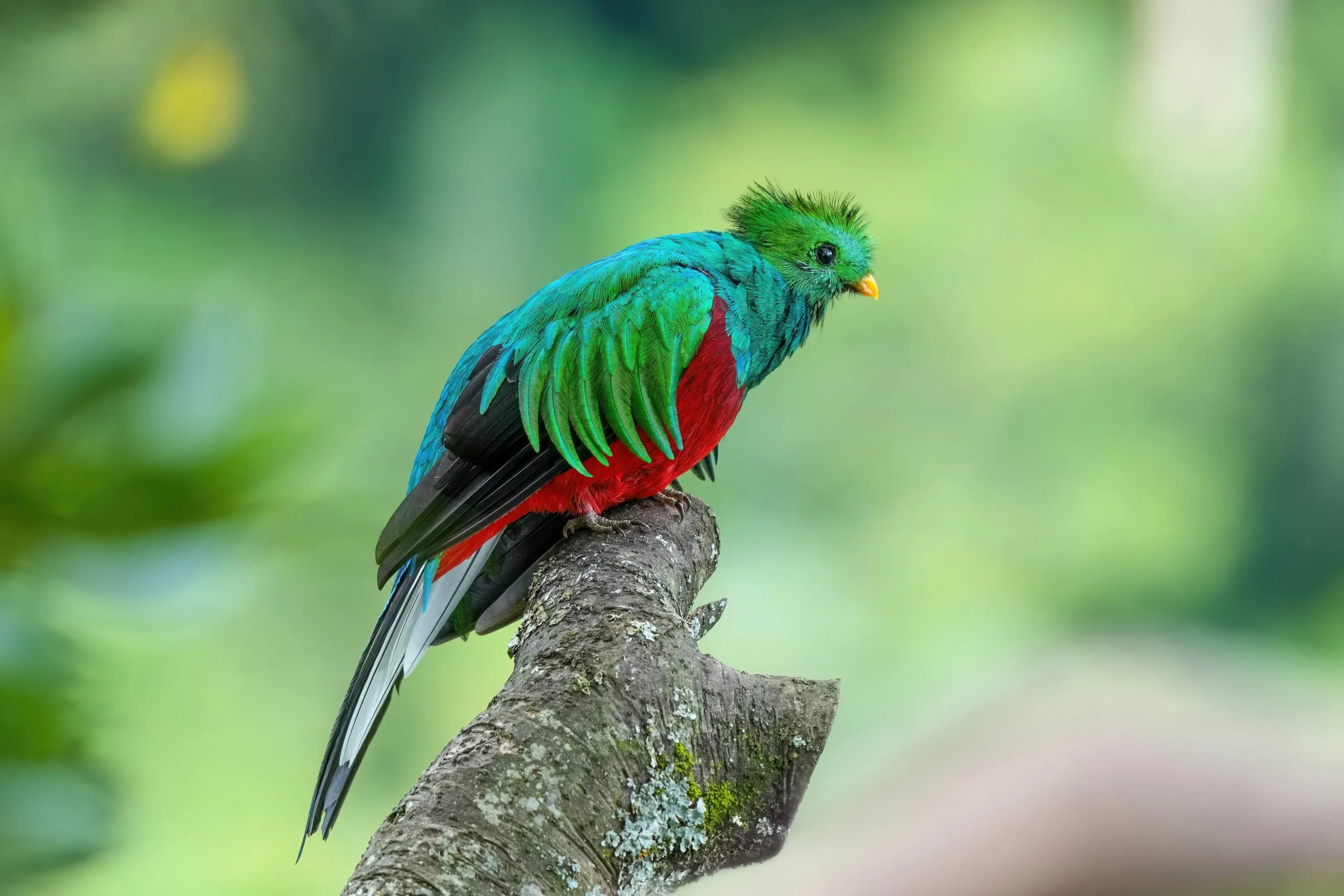
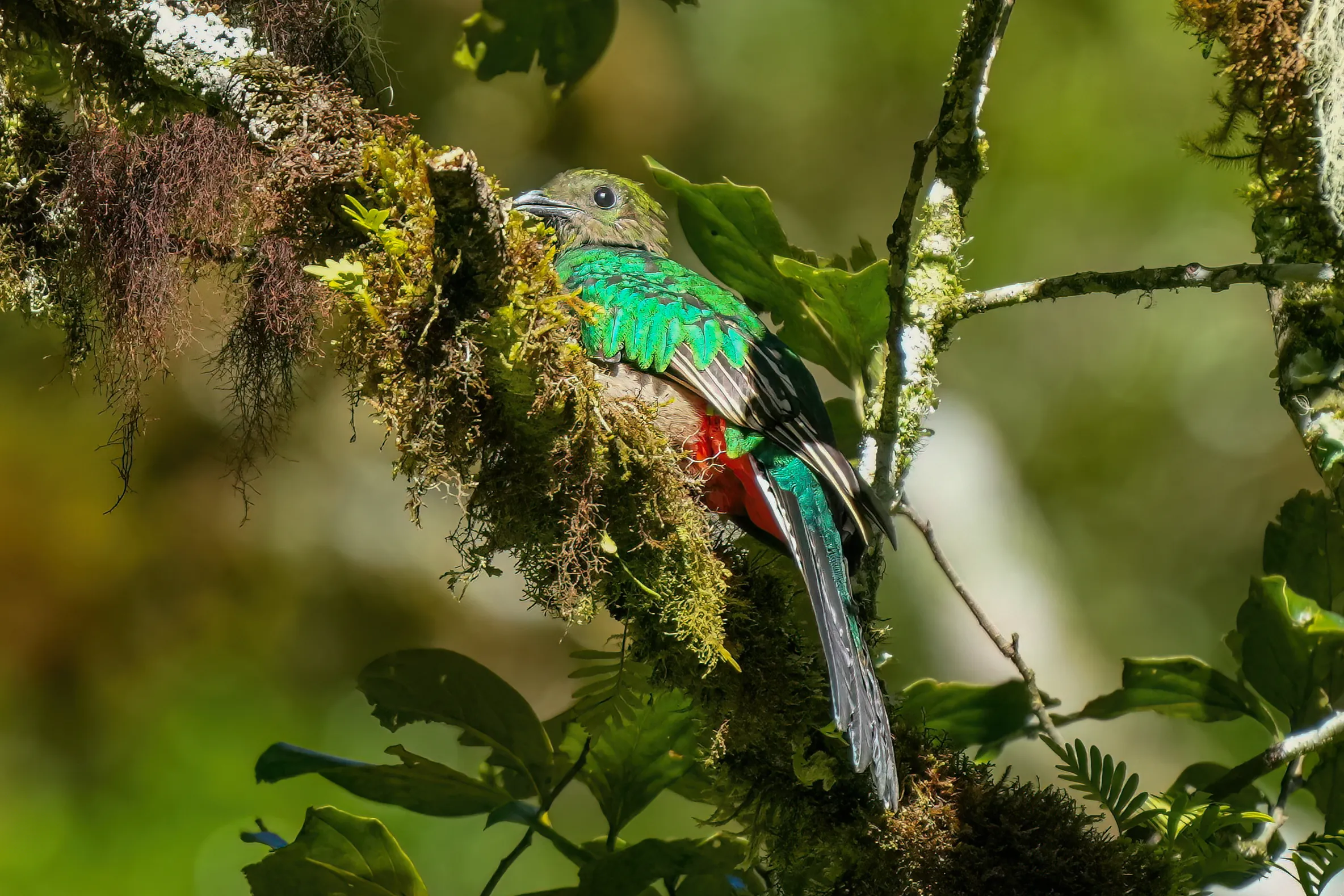
The resplendent quetzal is the bird many visitors most want to see. Males have brilliant green plumage, a red breast and long upper tail coverts that trail well below the perch. Yet finding one is often less dramatic than a postcard suggests: a guide listening in cool mist, a subtle movement in a wild avocado tree, then a flash of green.
Wild avocados are the key. The tourism board notes that quetzals, like three-wattled bellbirds, depend on the fruit of wild avocado trees that ripens for only a short period, so both species move up and down the mountains following the fruit. That is why local guides track which trees are fruiting and why sightings in a given valley can rise and fall over the year.
San Gerardo de Dota and Los Quetzales National Park are the classic destinations. The tourism board’s Los Quetzales National Park page describes it as a special area for quetzal watching, ranging from 1,240 to 3,190 meters above sea level with temperatures of about 5 to 14 degrees Celsius, and it notes that the quetzal is classed as Near Threatened by the IUCN. In the valley below, Savegre Mountain Hotel, run by the Chacón family, has trails on a private reserve and guided night tours for highland owls. The smaller, family-run Cabinas El Quetzal Lodge has a few rustic cabins on the banks of the Savegre River.
Monteverde is the other well-known option. The Monteverde Cloud Forest Reserve protects more than 4,100 hectares, limits visitor numbers by time slot and offers small guided natural history walks. Monteverde Lodge and Gardens, owned by Costa Rica Expeditions, runs early birding walks and guided reserve hikes. Our Monteverde cloud forest guide covers the reserves in detail.
Never disturb birds at nests or bend branches for a photograph. Responsible guides keep their distance and avoid concentrating groups at breeding sites. A quetzal viewed quietly through a scope is a better encounter than one stressed by a crowd.
Toucans and their relatives
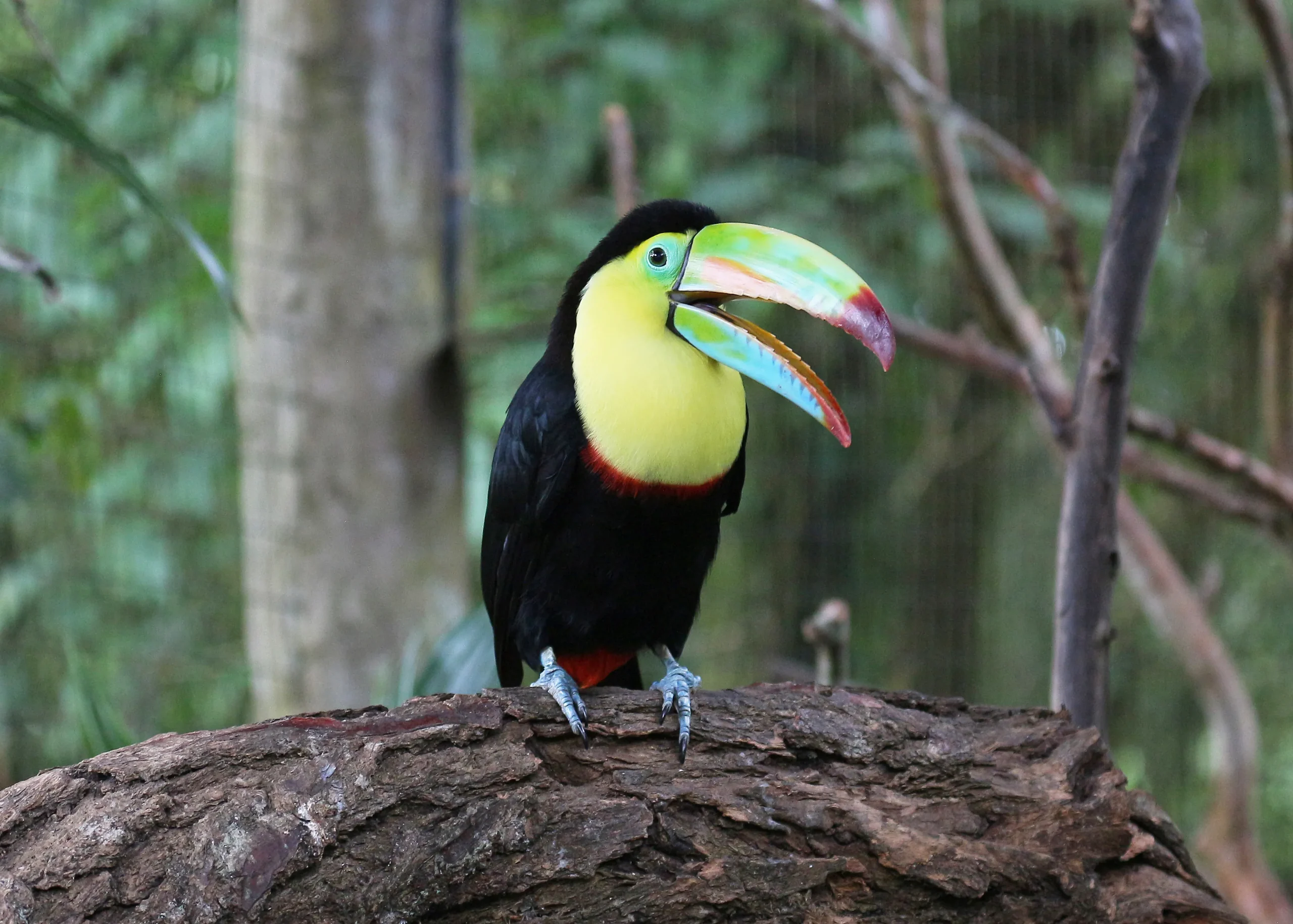
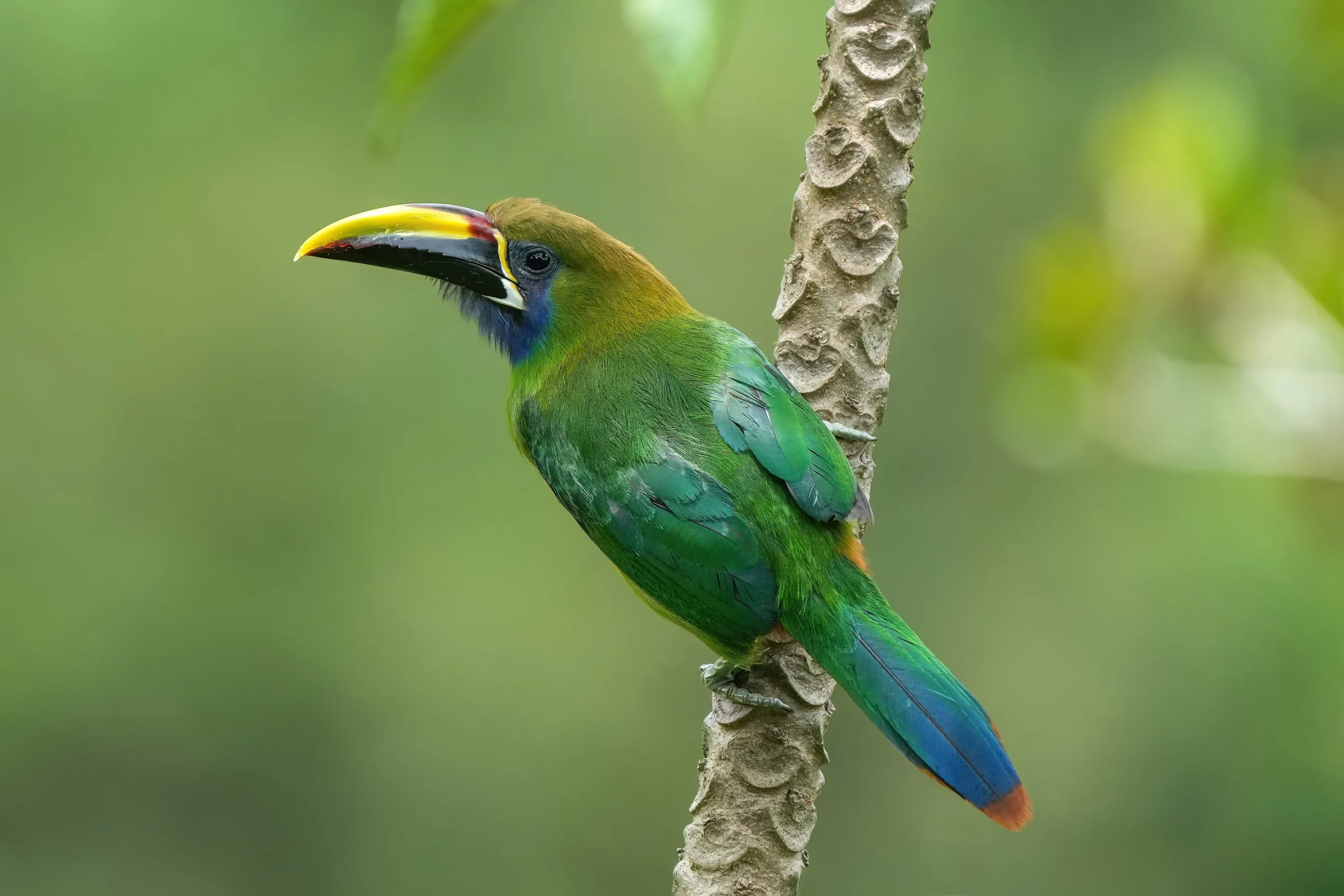
Toucans are among the most recognizable birds of the Costa Rican lowlands. The keel-billed toucan, the yellow-throated toucan, the collared and fiery-billed aracaris and the emerald toucanet occupy different regions and elevations. Their oversized bills are light, functional tools for reaching fruit at the ends of branches, and fruiting trees are the best places to watch them.
Toucans may perch conspicuously on exposed branches, but dense foliage hides them surprisingly well, so birders learn their croaking calls and undulating flight. Sarapiquí, Arenal, the Caribbean lowlands and the southern Pacific are all productive. The fiery-billed aracari is a southern Pacific specialty; Saladero Lodge, reached by boat on the Golfo Dulce beside Piedras Blancas National Park, lists it together with blue-crowned motmots and scarlet macaws among the birds around the property.
Scarlet and great green macaws
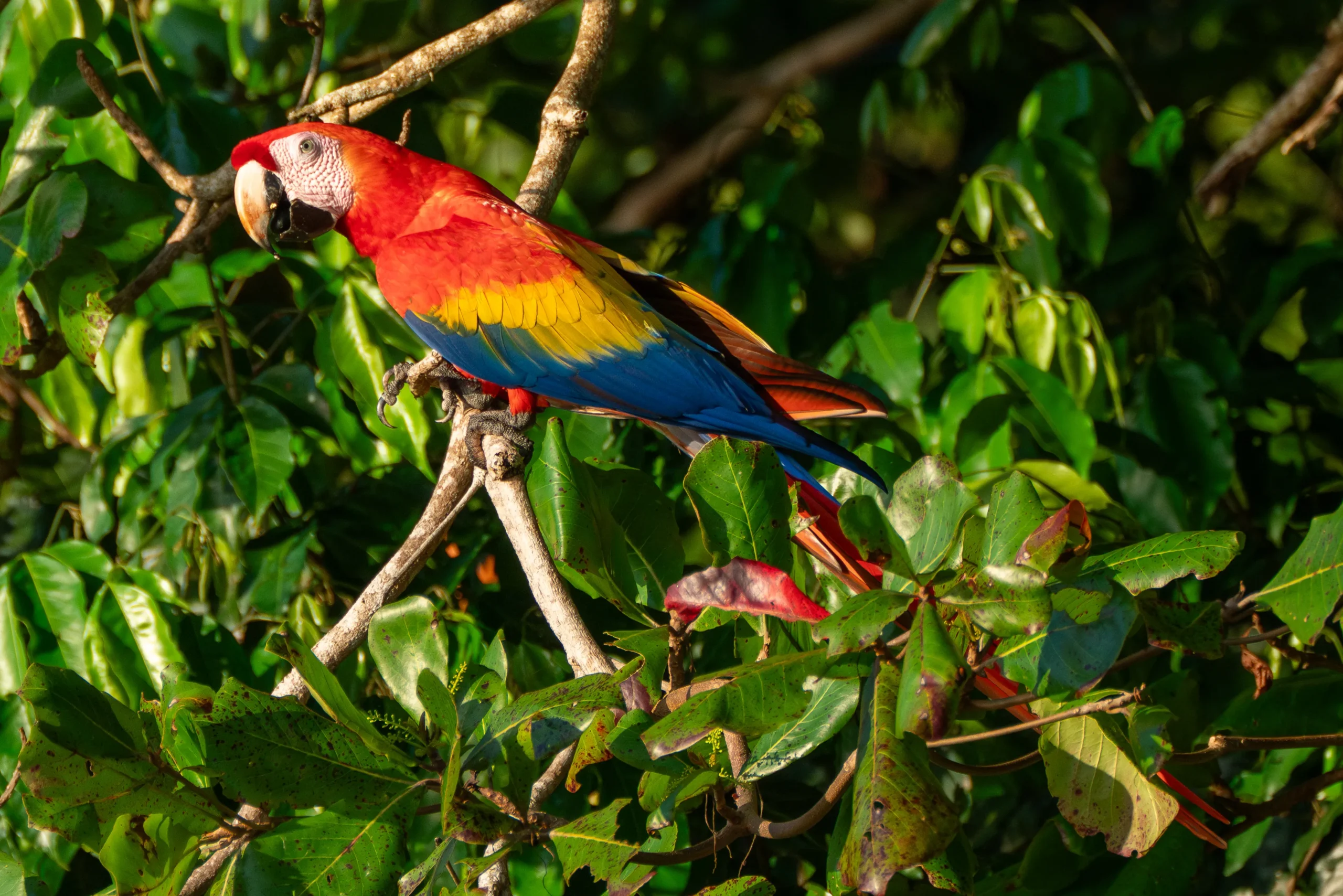
Scarlet macaws bring red, yellow and blue to Costa Rica’s Pacific forests. The tourism board explains that they roost in the same place each night and fly daily to feeding areas that shift through the year with the trees they eat from, which is why dawn and dusk flights over the canopy can be so dependable. Carara National Park, about 90 kilometers from San José, is the classic site. The park protects the only transitional forest of the Central Pacific, where dry forest and rainforest species meet, and it has a 1.2-kilometer universal-access trail. The Osa Peninsula and the southern Pacific coast are also strongholds.
Great green macaws are a conservation priority in the northern lowlands. Research by SINAC reported in El Mundo CR in 2024 notes that the species is Critically Endangered on the IUCN Red List and that, although the population has grown over the past 15 years, chick trafficking, illegal captivity and the loss of key food and nesting trees remain threats. SINAC’s page for the Arenal Huetar Norte conservation area highlights the great green macaw as a resident of its protected areas. Maquenque Eco Lodge, a 60-hectare reserve near Boca Tapada beside the Maquenque National Wildlife Refuge, is one of the most convenient bases for this species.
Carara and Boca Tapada are not next door, so decide whether macaws are the central reason for the journey or one of several interests. Our national parks guide helps connect bird destinations into one route.
Hummingbirds, motmots, trogons and bellbirds
Hummingbirds live from warm lowlands to cold mountain slopes, and their diversity is one reason even a small lodge garden can be fascinating. Native flowering plants, forest edges and well-kept feeders attract different species. If a lodge uses feeders, ask how often they are cleaned and whether natural flowering plants are part of the garden too.
Motmots often perch quietly along trails and forest edges and may sit still long enough for a good look. Trogons, the quetzal’s relatives, can be hard to spot because their colors blend with dappled forest light, so knowing their calls is often the difference between hearing one and seeing it. The three-wattled bellbird, with its strange, metallic call, is a highland and cloud forest specialty that follows the same wild avocado fruiting as the quetzal.
The best birding is rarely a nonstop parade of colorful species. Time spent learning ordinary calls and movements improves the chances of finding something elusive later.
Waterbirds and wetlands
Palo Verde National Park in Guanacaste is one of Central America’s great wetland birding sites. The tourism board’s Palo Verde page describes wetlands covering about half the park, more than 280 bird species recorded and a designation as a Wetland of International Importance. Laguna Palo Verde is a hotspot from September to March, when thousands of herons, egrets, ducks and northern jacanas gather, and Isla Pájaros in the Río Tempisque holds the country’s largest colony of black-crowned night herons. A large fire burned about 4,000 hectares of the park’s wetland in late May and early June 2026 and temporarily closed it, according to CR Hoy, so check the park’s current status before you plan a visit.
Caño Negro in the northern plains was declared a Ramsar wetland in December 1991, one of Costa Rica’s first two, and SINAC’s Caño Negro page reports 307 bird species. In the dry season the main lagoon shrinks into separate pools, which concentrates waterbirds. From the Bijagua side of Tenorio, Tenorio Lodge arranges birding trips to both Caño Negro and Palo Verde.
On the coasts, shorebird numbers shift with tides and seasons, and mangrove birds are best seen from a quiet boat. In Nosara, Lagarta Lodge borders a 90-acre private preserve and offers mangrove trips in silent electric boats. Never approach nesting colonies or flush birds resting on mudflats.
Best birdwatching regions at a glance
| Region | Signature birds | Best season notes | Lodges to consider |
|---|---|---|---|
| San Gerardo de Dota and Los Quetzales | Resplendent quetzal, highland hummingbirds, owls | Quetzals move with wild avocado fruiting; ask locally | Savegre Mountain Hotel, Cabinas El Quetzal Lodge |
| Monteverde | Quetzal, three-wattled bellbird, mixed cloud forest flocks | Mist changes visibility through the day | Monteverde Lodge and Gardens, Monteverde Cloud Forest Lodge |
| Turrialba and the Caribbean foothills | Foothill tanagers, hummingbirds, forest specialists | Good year-round | Rancho Naturalista |
| Sarapiquí and La Selva | Toucans, lowland rainforest species, migrants | Migrants September to April | La Selva, Selva Verde |
| Boca Tapada and Maquenque | Great green macaw, northern lowland species | Ask locally about fruiting and nesting | Maquenque Eco Lodge |
| Carara and the Central Pacific | Scarlet macaw, dry and wet forest mix | Park opens earlier in the dry season | Day trip from the Central Valley or the Pacific coast |
| Osa and Golfo Dulce | Scarlet macaw, fiery-billed aracari, lowland specialists | Drier mid-December to mid-April | Saladero Lodge, Esquinas Rainforest Lodge |
| Palo Verde and Caño Negro | Herons, storks, jacanas, ducks | September to March at Palo Verde; check status after the 2026 fire | Tenorio Lodge |
| Tortuguero | Herons, kingfishers, parrots along canals | Boat trips year-round | Tortuga Lodge and Gardens |
Choosing a birding lodge
The most useful questions are about access and expertise, not décor. Does the lodge maintain trails through different habitats? Is a naturalist available at dawn? Can you reach a good lookout before breakfast? Are there quiet areas away from music and traffic?
Ask which target species are regularly seen on the property rather than somewhere in the region. A macaw seen in the canton is not the same as a pair nesting near the lodge, and good lodges are clear about the difference. Some keep bird lists or support research. Rancho Naturalista near Turrialba is a dedicated birding lodge on a 125-acre foothill reserve, and our review notes more than 430 species recorded there, many visible from its upstairs terrace. La Selva offers guided birding walks and a beginner birdwatching workshop at a working biological station. Selva Verde in Sarapiquí runs birding packages on a 500-acre reserve. On the southern Pacific, Esquinas Rainforest Lodge beside Piedras Blancas National Park cites more than 360 bird species for its area, and Bosque del Río Tigre, a small lodge at Dos Brazos on the Osa, is built around guided birding on its own reserve.
Gardens planted for native wildlife can produce excellent views without artificial encounters, but a garden should complement natural habitat, not replace it. Some species use open vegetation readily; others need mature forest structure, tree cavities or particular food trees. For serious forest birding, the surrounding landscape matters more than the number of birds visible from the restaurant.
When and how to watch birds
Dawn is usually most rewarding because many birds call and forage early. Some wetland species are easier at other times, depending on light and water levels. Cloud forest visibility changes as mist moves through, and rain can pause activity and then trigger a burst of movement when it eases. Park hours vary: Carara, for example, opens at 7 a.m. in the dry season and 8 a.m. in the rainy season, according to the tourism board.
Binoculars with comfortable eye relief make the experience far more enjoyable, and a guide’s spotting scope is invaluable for distant perched birds, especially quetzals. Longer camera lenses let you keep a respectful distance. Avoid playback at nests, follow reserve rules and do not try to lure birds closer for photographs.
If you have never joined a serious birding walk, ask for a guide who enjoys beginners and agree on pace and interests before you start. Afterward, record what you saw in a notebook or on eBird, the Cornell Lab’s community database, which is also a good planning tool for hotspots. Its records reflect what other observers entered, not a promise of what you will find on a future morning.
Conservation and birdwatching
Birds reveal the health and complexity of a habitat. Forest specialists struggle when the canopy is fragmented, while generalists thrive in gardens and second growth. Protecting large forest blocks, keeping corridors open and retaining food trees all support bird diversity, and species that migrate up and down the mountains, like the quetzal and bellbird, need protected forest at several elevations.
Responsible birding tourism creates local jobs and gives protected areas visible value. Visitors can do their part by staying on trails, keeping away from breeding sites, choosing lodges that protect habitat and hiring local guides. For other wildlife on the same trip, see our mammals guide and wildlife watching guide.
Frequently asked questions
How many bird species does Costa Rica have?
The official list maintained by Costa Rica's bird records committee had 942 species in its November 2025 update. The total changes slightly each year as new records are accepted.
Where is the best place to see a quetzal?
San Gerardo de Dota and Los Quetzales National Park, and the Monteverde area, are the best-known choices. Quetzals follow wild avocado fruiting, so a local guide who knows which trees are in fruit makes the biggest difference.
When is the best time of year for birdwatching?
Birding is good all year. From roughly September to April, North American migrants join the resident birds, and migration peaks in September and October. Wetlands such as Palo Verde are usually best in the dry months.
Where can I see scarlet macaws?
Carara National Park and the surrounding Central Pacific, the Osa Peninsula and the southern Pacific coast are the most reliable areas. Watch for pairs flying at dawn and dusk.
Where can I see great green macaws?
The northern lowlands around Boca Tapada and the Maquenque National Wildlife Refuge are the main area. The species is Critically Endangered, so sightings are never guaranteed and nests should never be approached.
Can beginners enjoy birdwatching in Costa Rica?
Yes. A half-day outing with a patient naturalist introduces common calls and species without specialist equipment, and many lodges have productive gardens and trails right outside your room.
Are hummingbird feeders harmful?
Not necessarily, but hygiene, placement and sugar concentration matter. Ask how often feeders are cleaned, and favor lodges that also plant native flowering species.