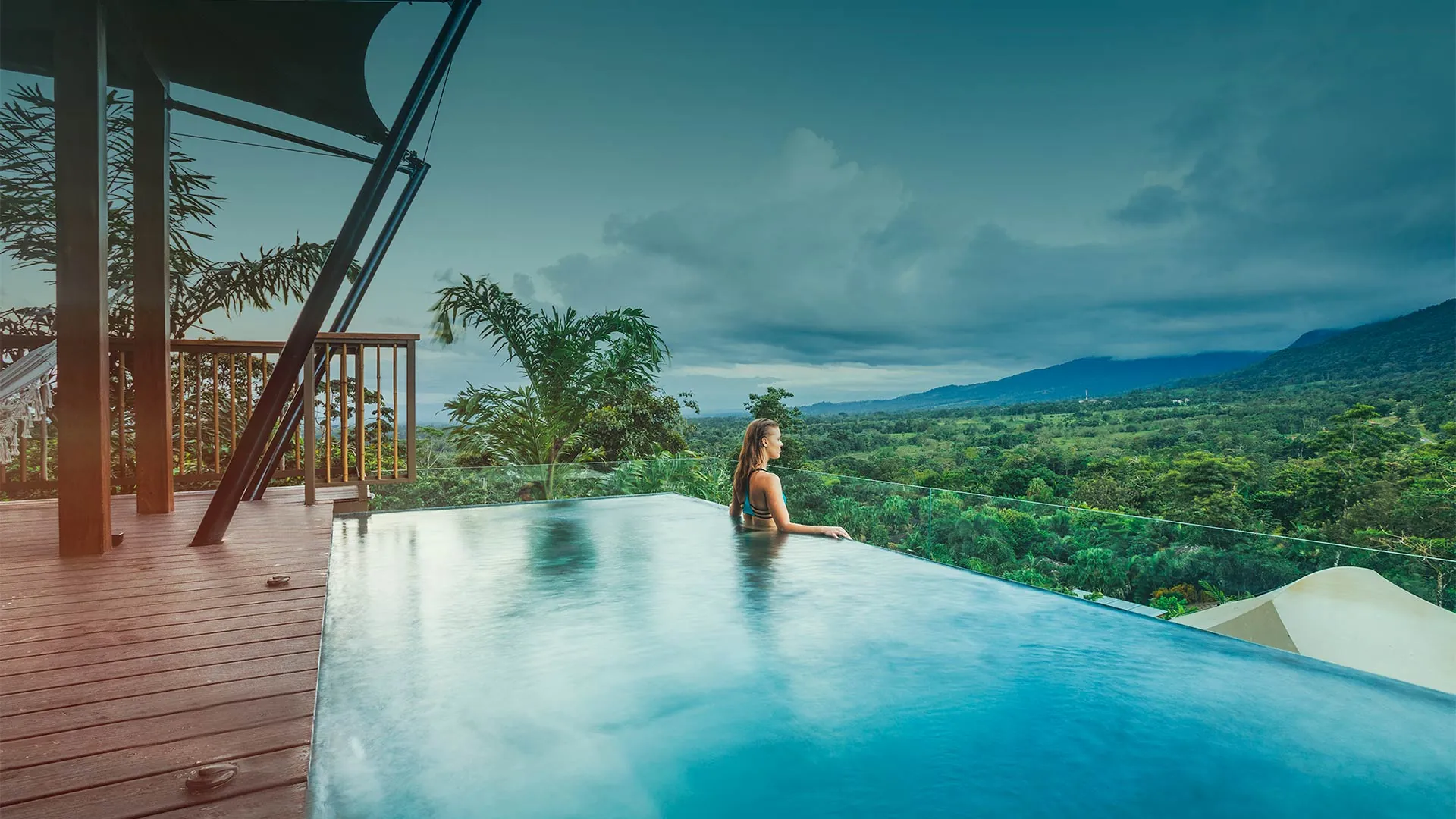
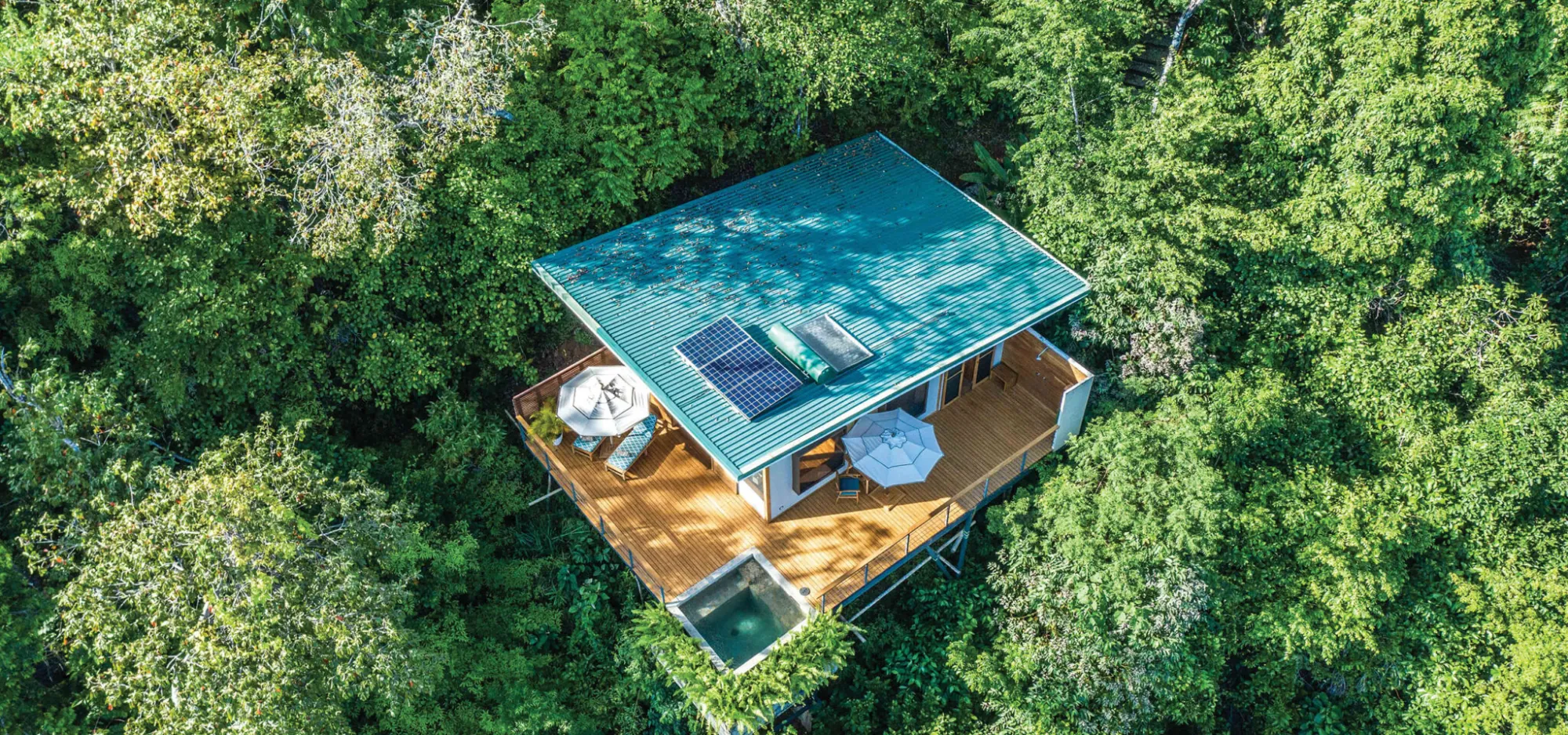
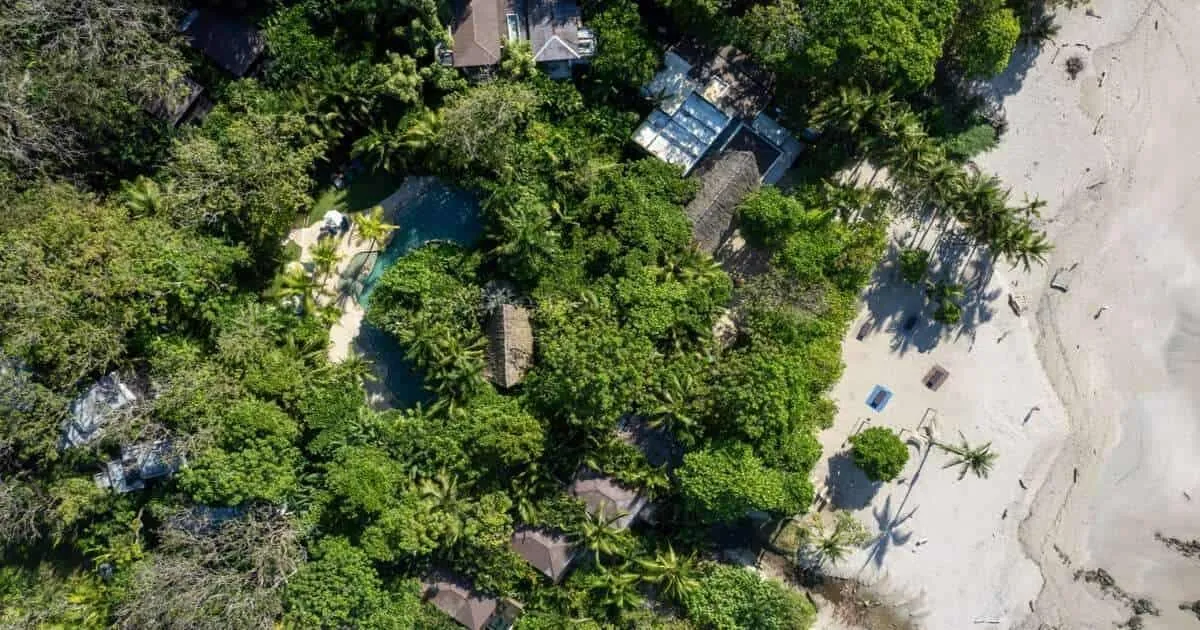
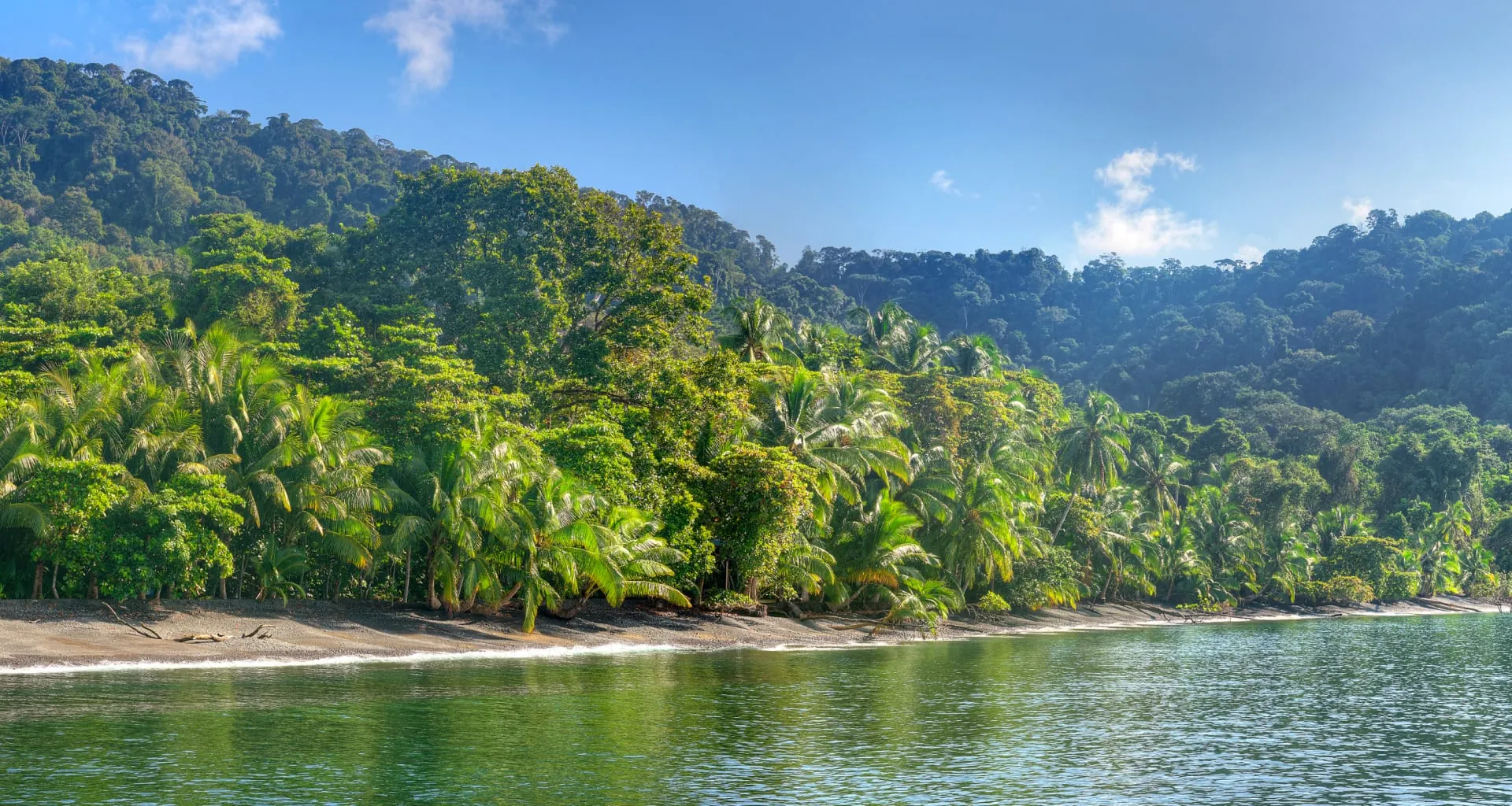
A luxury eco-lodge should offer more than a superb room with trees outside the window. The landscape ought to be the point of the stay, and the business should be able to show that protecting that landscape matters to it. In Costa Rica that can mean a lodge that owns and guards a private rainforest reserve, funds wildlife research, hires most of its staff from neighboring villages or runs on its own hydro and solar power. None of that comes automatically with an infinity pool or a famous name.
The best choice depends on the setting you want to wake up in. An Osa Peninsula bungalow puts you inside lowland rainforest from sunrise onward. A Golfo Dulce lodge adds a calm gulf and boat-only arrival. A Pacuare River lodge is built around the river and a remote valley. A cloud forest or highland hotel trades heat for cool air and quetzal country. A Pacific beach resort near Manuel Antonio or Nosara is easier to reach and pairs nature with the ocean. Here’s how the leading properties compare, and how to check their green claims for yourself.
At a glance: luxury nature lodges compared
| Lodge | Region | Setting | One verified conservation detail |
|---|---|---|---|
| Lapa Ríos | Osa Peninsula | Ridge-top rainforest at Cabo Matapalo | 1,000-acre private rainforest reserve |
| Corcovado Wilderness Lodge | Osa, Drake Bay side | 189 acres beside Corcovado, boat-only | CST Elite in the official directory |
| Playa Nicuesa Rainforest Lodge | Golfo Dulce | Beachfront, boat-only | CST Elite in the official directory |
| Playa Cativo Lodge | Golfo Dulce | Private beach beside Piedras Blancas | 1,000-acre private reserve |
| Pacuare Lodge | Pacuare River | 20 bungalows in a river canyon | 340-hectare protected area and a jaguar camera-trap program |
| Tortuga Lodge | Tortuguero | 29 river-view rooms and gardens | Private nature reserve beside the national park waterways |
| El Silencio Lodge | Bajos del Toro | Highland valley with three waterfalls | CST Elite in the official directory |
| Finca Rosa Blanca | Central Valley | Organic coffee farm with 14 villas and suites | 30 acres reforested; CST Elite |
| Arenas del Mar | Manuel Antonio | About 11 acres between two beaches | CST Elite in the official directory |
| Hotel Punta Islita | Guanacaste coast | Hillside villas and a beach club | 40-hectare protected forest; CST Elite |
This isn’t a numbered ranking. A small forest lodge can do more for conservation than a big resort while offering fewer conventional comforts, and the reverse is also possible. Treat the table as a shortlist built around different kinds of trips.
What earns the “eco” in a luxury lodge
Costa Rica’s official yardstick is the Certification for Sustainable Tourism (CST), run by the Costa Rican Tourism Institute. The CST program is free and voluntary, has two levels, Basic and Elite, and each certificate lasts two calendar years. Basic requires 100 percent of the standard’s mandatory criteria; Elite asks for more on top. The old one-to-five-leaf scale you’ll still see on some hotel websites isn’t issued anymore. Our guide to the five-leaf rating and CST today explains the change.
Checking a lodge takes a minute in the official CST directory of certified businesses. When we searched it on October 20, 2026, Lapa Ríos, Corcovado Wilderness Lodge, Playa Nicuesa, Arenas del Mar, El Silencio, Finca Rosa Blanca, Hotel Punta Islita, the Harmony Hotel and Lagarta Lodge were listed at Elite, while Playa Cativo and Santa Lucía Jungle Hacienda (under its former name, Hotel Villa Lapas) were listed at Basic. Certificates expire, so search again before you book.
Certification is only one test. Also look for land the lodge actually protects (with a size), research or community programs with names and dates, and a clear answer about who guides you and where. “Forest on the property” and “a national park nearby” are very different claims.
Osa Peninsula and Golfo Dulce: deep rainforest, serious logistics
The Osa is the classic luxury eco-lodge destination for good reason. SINAC, Costa Rica’s national parks agency, describes Corcovado National Park as 42,560 hectares of land and 3,354 hectares of sea, created in 1975, with a dry season from mid-December to mid-April. The park asks visitors to come with a registered guide and requires one on the long La Leona to Sirena and Los Patos to Sirena trails, so a lodge that organizes guided park days is a real asset. Our Corcovado and Osa Peninsula guide covers the park sectors in detail.
Lapa Ríos sits in a 1,000-acre private rainforest reserve at Cabo Matapalo, on the southern tip of the peninsula. Its accommodation ranges from forest-view bungalows to suites and a villa, and its activity list runs from a rainforest ridge hike and night walk to Corcovado excursions by boat or land, kayaking and whale watching. Three or four nights let you settle into the forest rather than spending a third of the trip in transit.
Corcovado Wilderness Lodge, which travelers may still know as Casa Corcovado, is on the Drake Bay side and can only be reached by boat, usually via Sierpe. The lodge describes 189 acres of its own rainforest, roughly 2 kilometers of oceanfront above a palm-lined beach, and room choices that include rainforest suites, villas and ocean-view treehouses. Corcovado tours, Caño Island snorkeling and diving, and early birding walks are the core activities.
Across the peninsula, Golfo Dulce is calmer water bordered by steep forest. Playa Nicuesa Rainforest Lodge is a beachfront retreat about 30 minutes by boat from Golfito or Puerto Jiménez, with kayaking, snorkeling, hiking and yoga. Playa Cativo Lodge has a private beach and a 1,000-acre private reserve next to Piedras Blancas National Park, a 15,147-hectare park created in 1990 that SINAC says was once part of Corcovado under the name Bosque Esquinas. Cativo is also boat-only, about 30 minutes from its dock, and its fuller meal plan includes transfers from Golfito or Puerto Jiménez.
Before booking any Osa or gulf lodge, ask what the rate includes: meals, boat and airport transfers, guided walks on the property and guided park entry. On the Osa there’s often no restaurant or taxi outside the gate, so the package is the trip.
Pacuare Lodge: luxury that depends on a river
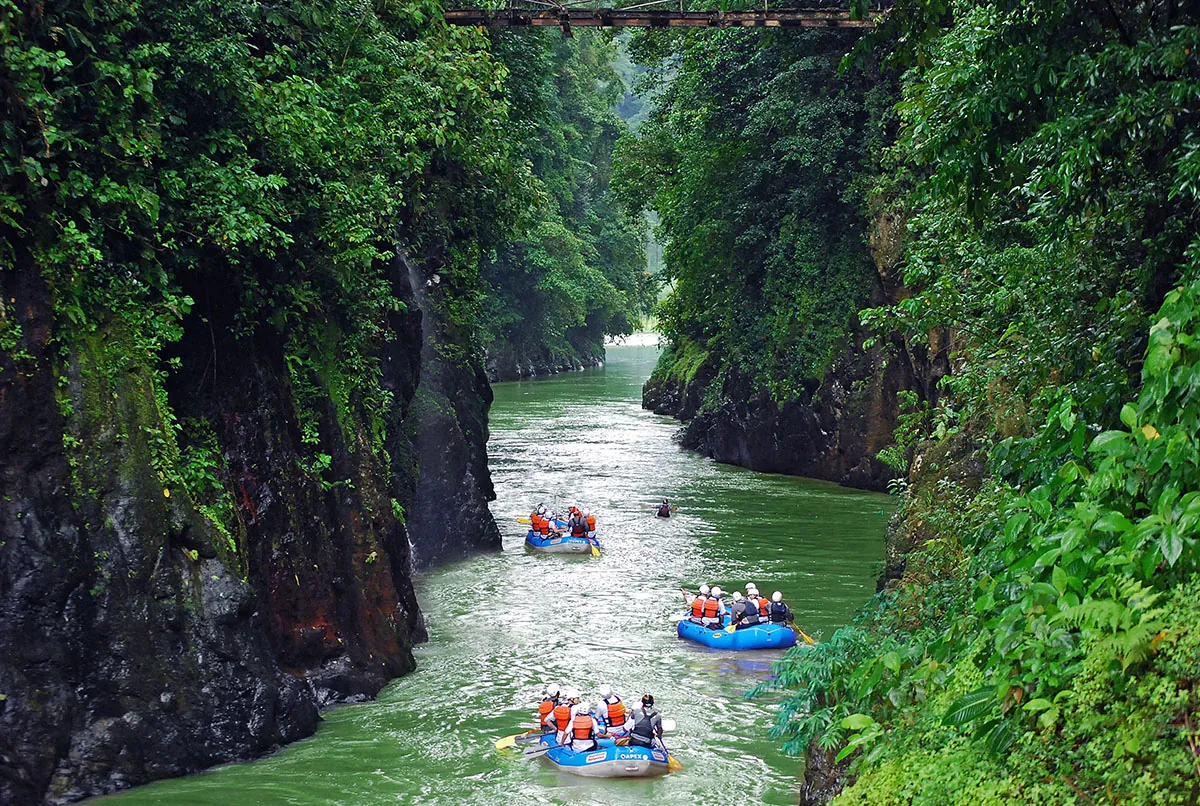
Pacuare Lodge has 20 bungalows in a river canyon on the Caribbean slope, ranging from garden and river-view suites to a canopy villa. Its sustainability page is unusually specific: a 340-hectare protected area, electricity from 3 hydro turbines and 204 solar panels stored in batteries, and a jaguar program run with Costa Rica’s National University since 2009 whose camera traps have recorded 18 large mammal species and identified 5 individual jaguars. Most staff come from neighboring communities, including the Cabécar Indigenous reserve of Nairi Awari, and Cabécar culture programs are offered to guests.
The lodge reports earning CST Elite on January 23, 2024. Because certificates run for two years, check the directory for its current status. Some guests arrive by rafting down the Pacuare and others by road, so ask how you and your luggage travel and whether the rafting section is required.
Tortuguero: quiet luxury on the canals
Tortuguero has no road in. You arrive by boat or small plane, and the canals are your hallways. Tortuga Lodge has 29 rooms facing the Tortuguero River, gardens and a private nature reserve, plus naturalist walks, boat and kayak trips into the park and guided turtle tours in season. Its operator offers charter flights of about 25 minutes from San José.
Time your stay around the turtles if you can. SINAC’s Tortuguero National Park page gives the nesting season as June to October and closes the beach from 6 p.m. to 6 a.m. between March 1 and October 31, except for the official guided turtle program with trained spotters. Read our Tortuguero National Park guide before choosing dates.
Highlands and cloud forest: cool air and quiet luxury
El Silencio Lodge is in Bajos del Toro, about 65 kilometers and roughly 90 minutes from San José’s international airport. Its suites and villas are terraced along a hillside, and the property has three waterfalls and more than 2 kilometers of trails. Yoga, a farm visit and a guided hike are included, and the Samana Wellness Center runs meditation and wellness programs.
In Monteverde, the Monteverde Cloud Forest Preserve became the first protected area in Costa Rica on the IUCN Green List, a global standard for well-managed parks and reserves. Monteverde Lodge and Gardens has 31 rooms set in designed gardens with a private cloud forest reserve, walking distance from town, and runs excursions to the preserve and night tours of its own forest. Family-owned Hotel Belmar, a Monteverde landmark for 40 years, adds a farm experience called Finca Madre Tierra and a strong restaurant. Our Monteverde cloud forest guide compares the reserves.
Savegre Hotel in San Gerardo de Dota sits at 2,200 meters with more than 500 hectares of private cloud forest. The family has hosted visitors since 1973, and the hotel says January to June is the best period for quetzals. It also has a riverside spa.
Close to the airport, Finca Rosa Blanca in Santa Bárbara de Heredia has 14 villas, suites and studios on an organic coffee farm that added 30 acres of reforested land, and it counts more than 137 bird species in its forest. A coffee tour with a naturalist guide follows the bean from plant to cup. It’s an easy first or last night that still feels like a nature stay.
Pacific coast luxury: beaches with forest behind them
Arenas del Mar covers about 11 acres of rainforest reserve between two beaches, one of them Playitas, with direct ocean access and an in-house naturalist. It’s part of the Cayuga Collection of sustainable hotels. Manuel Antonio National Park is next door: SINAC says it’s the country’s most visited protected area, it’s closed on Tuesdays, and tickets are sold only online. Book early in the dry season.
Near Carara National Park, Santa Lucía Jungle Hacienda (formerly Hotel Villa Lapas, now part of the Autograph Collection) sits on a river at the edge of the park, with a spa and scarlet macaws and capuchins on the grounds. Carara, 90 kilometers from San José, protects the only transitional forest of the Central Pacific and records 420 bird species.
On the Guanacaste coast, Hotel Punta Islita has 27 villas, a beach club and a 40-hectare protected forest, plus a community museum and art workshops with local artisans in Islita. In Nosara, the Harmony Hotel is on Playa Guiones with rooms, bungalows, a suite and villas, and every guest gets a complimentary yoga class each day. On a hilltop above Nosara, Lagarta Lodge borders a biological reserve and offers yoga and spa treatments, with beaches within walking distance.
How to choose, and how long to stay
Match the lodge to the experience you care about most:
- Rainforest wildlife from your doorstep: Lapa Ríos, Corcovado Wilderness Lodge, Pacuare Lodge.
- Forest plus calm water: Playa Nicuesa, Playa Cativo.
- Birding and cool air: Savegre, Monteverde Lodge and Gardens, El Silencio.
- Easy access with nature on site: Finca Rosa Blanca, Arenas del Mar, Santa Lucía.
- Beach first, nature close by: Punta Islita, the Harmony Hotel, Lagarta Lodge.
For a first trip, 3 or 4 nights at a remote lodge paired with one easier region works well: the Osa with Manuel Antonio, Pacuare with the Caribbean or the Central Valley, Monteverde with Arenal. Tortuguero deserves at least 2 full nights. Our complete guide to the best eco-lodges in Costa Rica covers every region and price level.
A premium rate may include expert guides, protected land, meals and boat transfers, or it may mostly reflect the room and the spa. Ask the lodge to spell out what’s included, and compare the total rather than the headline rate.
Frequently asked questions
Is a luxury eco-lodge more sustainable than a small guesthouse?
Not necessarily. Price and room size don't measure environmental performance. Look at protected land, energy and water systems, local hiring, documented programs and current CST status. A modest family lodge can outperform a famous resort on all of them.
How do I check whether a lodge is really certified?
Search its name in the official CST directory. If you can't find it, try a former name: Santa Lucía Jungle Hacienda still appears as Hotel Villa Lapas. A five-leaf logo refers to the old scale and isn't current certification.
Which luxury lodges can only be reached by boat?
Corcovado Wilderness Lodge (usually from Sierpe), Playa Nicuesa and Playa Cativo (from the Golfito or Puerto Jiménez side) and every lodge in Tortuguero. Confirm transfer times before booking domestic flights, and travel light.
Do I need a guide to visit Corcovado from a luxury lodge?
SINAC asks all Corcovado visitors to enter through official stations, preferably with a registered guide, and requires a guide on the La Leona to Sirena and Los Patos to Sirena routes. Most Osa lodges arrange guided park days; ask whether they're included.
What's the best luxury option for birdwatching?
It depends on the birds. Savegre at 2,200 meters is quetzal country, best from January to June. Lowland Osa lodges are better for scarlet macaws and rainforest species. Monteverde mixes Pacific and Caribbean slope birds along the Continental Divide.
When is the best time to book?
The Pacific dry season (mid-December to April) is the busiest and fills first. Tortuguero's turtle season runs from June to October. Some remote lodges close or reduce service for part of the wettest months, so check opening dates.