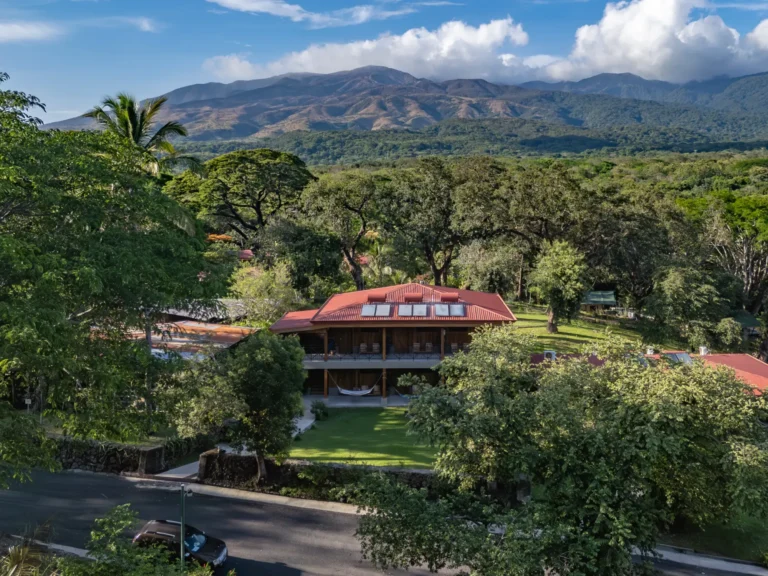
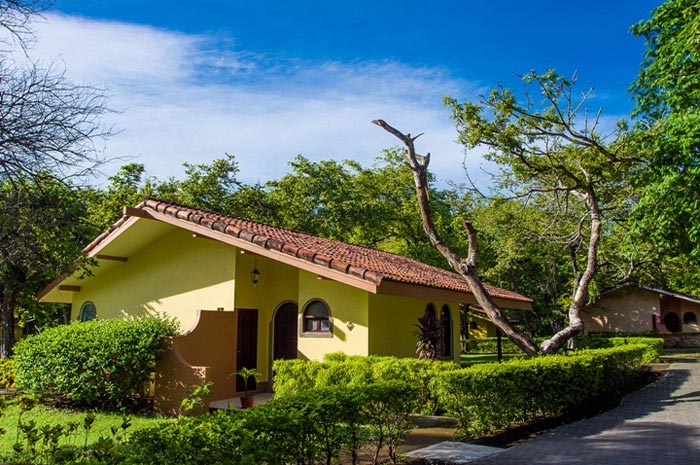
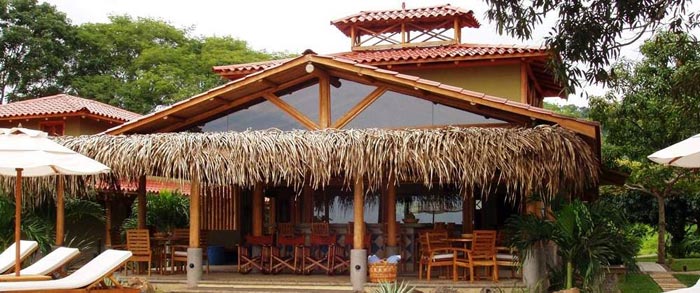
Río Perdido is a small hotel of 20 stilted bungalows on a 1,500-acre private reserve near San Bernardo de Bagaces, where a mineral-rich thermal river runs through a canyon of dry and dwarf forest. You stay here for the warm river pools, the canyon trails and some of the most detailed, independently certified sustainability work in Guanacaste.
At a glance
| Location | About 4 km south of San Bernardo de Bagaces, Guanacaste |
|---|---|
| Style | Boutique bungalow hotel with thermal river, spa and adventure circuit |
| Setting | Two river canyons, tropical dry forest and rocky dwarf forest on a 1,500-acre reserve |
| Best for | Couples and active travelers who want hot springs without a crowded resort |
| Getting there | Roughly one hour by car from Liberia’s international airport; last stretch on gravel |
| CST status | Elite level (checked 2026-10-20) |
Where it is and how you arrive
The hotel sits in the San Bernardo lowlands of Bagaces county, inland from the Pacific beaches and between three volcanoes: Miravalles, Rincón de la Vieja and Tenorio. The MICHELIN Guide listing places it 4 km south of San Bernardo and about an hour’s drive from Daniel Oduber Quirós International Airport in Liberia, via Routes 1 and 164. The final few kilometers past San Bernardo are unpaved.
The name means “lost river.” According to the lodge’s own history page, a bridge that once linked these canyonlands to the rest of the county collapsed years ago and was never rebuilt, which left the area largely cut off. In the wet season the foliage closes over the gorge so completely that the river is hard to see even from above. Curators from Costa Rica’s National Museum have identified pottery fragments found on the land as Chorotega artifacts several centuries old.
The thermal river
This is the main event. The river runs warm for about a mile, with dozens of natural pools at different temperatures, and the gorge is roughly 50 meters deep. The hotel says nothing has been built inside the canyon itself. Its pools are fed by the same underground mineral channels as the river, drinking water comes from its own mineral wells, and the showers in the Center Bungalows run on thermal spring water.
The Michelin listing describes the property as the place where two rivers meet in a dwarf forest. Above the canyon, on the rocky high ground, the vegetation stays low and scrubby; down inside, trees grow almost as tall as the walls, fed by water that flows all year.
Bungalows
All rooms are raised bungalows with steel exteriors and wood and polished concrete interiors, linked by elevated walkways. The accommodations page lists three types:
- East Bungalows (42 m²): two twins that join into a king, a day bed, and an elevated terrace with a hammock. Suited to couples, solo travelers or a parent with one child.
- Center Bungalows (about 69 m²): several bed layouts for up to four, floor-to-ceiling windows onto the forest and side-by-side outdoor showers inside a private steel shell.
- West Bungalows (about 88 m² under roof): the newest category, with one king, a covered terrace and an oversized outdoor tub that can be filled with warm or cold mineral water, set high above the Río Blanco canyon.
Michelin notes that children under eight can’t be accommodated, so this isn’t a choice for families with toddlers.
What you do there
Most of the activity happens on the reserve itself:
- Hiking. Three marked trails cover the property. Volcanes climbs through dry forest to a plateau with views of Miravalles, Rincón de la Vieja and Tenorio. Las Tumbas is the hard one, over eroded volcanic rock up onto the dwarf forest. Carbonatadas is flat and passes Yurro cascade on its way to a naturally carbonated spring you can taste. Guests get one complimentary guided walk, capped at eight people, and GPS maps for going alone.
- Canyon adventure. A zip line runs over the Río Blanco canyon, and white-water tubing takes you down the Río Perdido between pale canyon walls.
- Mountain biking and trail running on single-track with rock sections and berms.
- Yoga in four cliffside pods 43 meters above the thermal river.
- A spa, listed with the wellness program on the hotel site.
Farther afield, the hotel points guests to rafting on the Río Tenorio (the put-in is no more than 30 minutes away by its back route), the Río Celeste hike in Tenorio Volcano National Park, boat trips through the Tempisque wetlands of Palo Verde, and the Las Pailas trail at Rincón de la Vieja.
Food
Meals are served at Perdido Pass, an open-air restaurant, with a separate pool bar. The dining page says breakfast is included and lunch leans on Costa Rican plates such as casado. The kitchen uses produce from the hotel’s own organic garden, which grows more than 50 herbs and vegetables, and the lodge says its chefs cook only with Costa Rican ingredients, most of them from Guanacaste. The site doesn’t spell out diet options, so mention any needs when booking.
Sustainability in detail
Río Perdido publishes more specifics than most hotels in the region. From its sustainability page:
- Land. Protected land grew from 600 to 1,500 acres, and the hotel and buildings cover less than 1% of it. Native and protected trees are planted every year, including the endangered Wimmeria excoriata.
- Water. All wastewater is treated and reused to irrigate young trees and green areas, along with circulated pool water.
- Energy and transport. On-site vehicles are fully electric, and EV charging is free for guests.
- Waste. The hotel runs its own recycling collection center and sends material on through an agreement with the Municipality of Bagaces. Construction wood came from fallen trees or licensed sources.
- People. About 90% of the team comes from nearby communities, many in management roles. San Bernardo became the first community in Bagaces to earn Ecological Blue Flag status for communities.
- Certifications claimed by the lodge. Blue Flag ratings for watershed and climate change, carbon-neutral certification under the INTE B5 standard, and membership in SLH’s Considerate Collection.
The CST claim checks out: the ICT’s certified-entities directory lists Río Perdido Hotel & Thermal River at the Elite level, the program’s highest tier. For what that rating covers, see our guide to CST certification.
Wildlife
The lodge reports capuchin and howler monkeys, armadillos, anteaters and kinkajous on the reserve, along with two hives of native bees kept for conservation rather than honey sales. Dry-forest birding is good on the open trails early in the day. Sightings vary with the season and aren’t guaranteed.
Who it suits
Río Perdido works best for couples, friends and active travelers who want to combine hot water with real hiking and a bit of adrenaline, in a place that publishes its environmental numbers. The Two MICHELIN Keys rating reflects a design-led, upscale stay.
It’s less suited to families with young children, given the age limit, or to anyone who wants a beach within walking distance, since the coast is a drive away. Anyone after a cooler cloud-forest climate should know that Bagaces is hot and dry for much of the year.
To build a northern Guanacaste loop, pair it with Tenorio Lodge or Celeste Mountain Lodge near Río Celeste, or Blue River Resort and Hot Springs on the Rincón de la Vieja side. More options are on our Guanacaste eco-lodges page.
Frequently asked questions
Is the thermal river at Río Perdido natural, or is it a pool complex?
It's a natural river. The thermal stretch runs for about a mile through the canyon, with dozens of rock pools at varying temperatures, and the hotel says it hasn't built anything inside the gorge. Separate hotel pools are fed by the same mineral water.
Can children stay at Río Perdido?
Children aged eight and older can stay, according to the MICHELIN Guide listing. Younger children can't be accommodated, so families with small kids should look elsewhere.
How hard are the hiking trails?
They range from easy to demanding. Carbonatadas is flat and short enough for most guests. Volcanes is a moderate loop with a steep last 250 meters. Las Tumbas involves rocky ground and steep climbs and is best for fit hikers.
Is the CST Elite rating current?
Yes. As of October 2026, the Costa Rica Tourism Institute's official directory of certified businesses lists Río Perdido at the Elite level.