

Hacienda Barú is a former cattle ranch just north of Dominical that has spent decades growing back into forest, and its lodge sits inside the 330-hectare wildlife refuge that resulted. You sleep in simple cottages or pool-view rooms and walk straight onto trails through rainforest, mangrove and wetland where birders have logged more than 365 species. It’s one of the clearest examples on this coast of what happens when pasture is left to recover.
At a glance
| Location | Barú National Wildlife Refuge, about 3 km north of the Dominical bridge |
|---|---|
| Style | Six cottages and six pool-view rooms, no air conditioning |
| Setting | 330 hectares of primary and secondary forest, mangrove, wetland, riverbank and beach at the mouth of the Río Barú |
| Best for | Birders, families and anyone curious about rainforest recovery |
| Getting there | By road on the coastal highway; Dominical is the nearest town |
| CST status | Not in the official CST directory on 2026-Oct-21 |
Where it is
The refuge lies at the mouth of the Río Barú on the southern Pacific coast. A 2009 Tico Times article placed the lodge 3 km north of the Dominical bridge, beside the 3 km sweep of Playa Barú. Dominical’s surf town and the beaches of Costa Ballena are a short drive south.
The protected area is officially the Finca Barú del Pacífico Mixed Wildlife Refuge. According to its Wikipedia entry, it was created by decree on 6 October 1995 and falls under SINAC’s Central Pacific Conservation Area. The Tico Times described the refuge as owned by Steve Stroud, so this is protected private land rather than a public park.
From cattle ranch to refuge
The lodge’s Are We Green page tells the land’s story frankly. Settlers cleared much of the original forest for pasture in the 20th century, and by 1972 only about 180 hectares of forest survived, mostly on slopes too steep to farm and in the salty mangroves near the river mouth. Around 150 hectares of lowland had been cleared completely for rice and cattle. Jaguars, tapirs, peccaries, harpy eagles and scarlet macaws disappeared from the area.
Jack Ewing, a Colorado-born rancher turned naturalist, moved to Costa Rica with his wife Diane in the 1970s, and the couple still live on the refuge, according to his biography on the lodge site. He has written two books about the transformation, Monkeys Are Made of Chocolate and Where Tapirs and Jaguars Once Roamed. The Tico Times reported that Ewing built the first six cabins in the early 1990s with partner Steve Stroud, who owns the refuge. They had expected beachgoers, but visitors kept turning up at the gate wanting to walk in the forest, so the project became a nature refuge.
Today, the lodge says, dense secondary forest stands where cattle once grazed, the remaining forest patches have joined up across the coastal plain, and sloths, pacas, collared peccaries and curassows have come back. Monkeys raid the old cacao groves that still grow in the forest.
Rooms
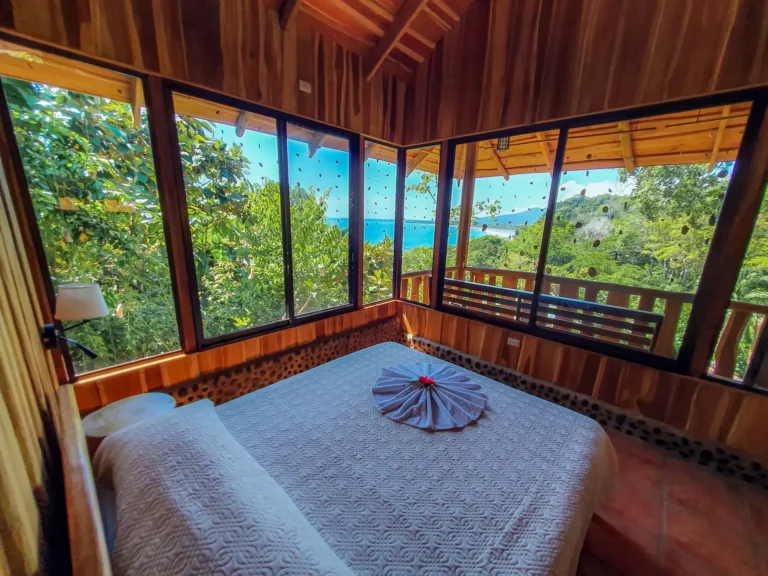
The rooms page lists six cottages and six pool-view rooms:
- Two-bedroom cottages: a king bed in one room, a double and a single in the other, a living room with a sofa, a small fridge, a coffee maker and a terrace.
- Three-bedroom cottages: a larger version for bigger families or groups.
- Pool-view rooms: a king and two singles, two ceiling fans and hot water.
Nothing is air-conditioned. The lodge relies on insulated roofs, high ceilings, cross-ventilation and ceiling fans, and it says plainly that it uses no air conditioning anywhere. The Tico Times noted that the newer rooms were built from plantation pine and teak with plantation cypress furniture. The pool exists because the beach has dangerous rip currents, and the same article said it was treated with an ozone generator rather than heavy chemicals.
Trails and tours
The refuge has about 8 km of trails, and its tour list is long for a property of this size:
- Self-guided trails: the flat Chirincoco, Pizote and Saíno trails are open from 6 am to 5 pm, with a 7-meter birding tower on a hill that works best before 8 am or after 3 pm.
- Bird watching: a three-hour early walk for trogons, motmots, antshrikes, manakins, tinamous and curassows, and a six-hour version through old cacao groves and primary forest with breakfast at the refuge campsite.
- Wildlife and rainforest hikes: guided walks for howler monkeys, sloths, agoutis, armadillos and peccaries, plus a hilly four-hour hike from secondary into primary forest past a medicinal plant garden, and a walk to Chilamate through the lowlands.
- Night walks: two versions, one around the lodge’s ponds and gardens and one on the trails, looking for frogs, owls, caimans, kinkajous and sometimes snakes.
- Canopy: the Flight of the Toucan zipline has seven cables linking 13 ground platforms and a tree platform, starting with a 45-minute forest walk, and the Monkey Challenge is a short aerial obstacle course.
Food and the shop
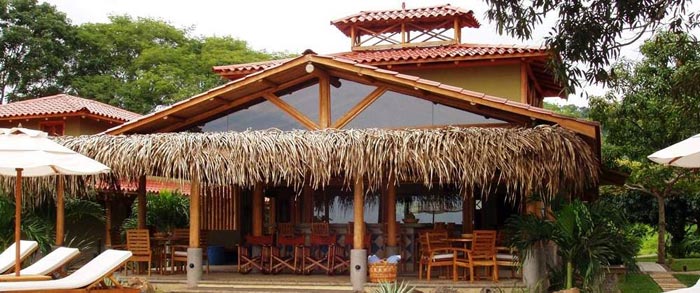
The open-air Jaguarundi Restaurant sits near an old cacao plantation, and guests often watch birds while they eat. The food page describes Costa Rican plates such as fish fillets, grilled chicken, rice and beans, salads and sandwiches, with several vegetarian and gluten-free choices and fresh fruit juices. Breakfast was included with rooms at the time of the 2009 article; check whether it still is when you book. The small gift shop favors local artisans and stocks field guides to Costa Rican wildlife.
Sustainability and community
The lodge’s own list of practices is specific:
- Buildings cover less than 1 percent of the 330 hectares.
- Wood for building and repairs comes from renewable sources.
- Most lighting is LED.
- There’s no air conditioning at all.
- Organic waste is composted for the gardens, and wastewater goes to septic tanks using microorganisms.
- Guests can refill their water bottles at no charge.
- Cleaning products are biodegradable and laundry dries in a solar dryer.
Beyond the property, the refuge forms part of the Paso de la Danta (Path of the Tapir) Biological Corridor, which runs about 100 km from the Sierpe-Térraba mangroves and Corcovado to the Los Santos Forest Reserve. Hacienda Barú says it donated the land for the office of ASANA, the local group leading the corridor, and that its managers and staff sit on school boards, water associations and environmental groups in the area. These are the lodge’s own descriptions; it doesn’t appear in the official CST directory.
Who it suits
Birders should put this near the top of a Costa Ballena list, since the trails, tower and early walks are all on the doorstep. Families get cottages with separate bedrooms, a pool and easy flat trails, and the night walk is a good first taste of the forest after dark. It’s also a fine stop for anyone who wants to see reforestation in practice rather than read about it.
Look elsewhere if you need air conditioning, a spa or a swimmable beach; Playa Barú has strong currents. For more on this coast, see our South Pacific eco-lodges, compare La Cusinga Lodge on its own reserve south of Uvita, and read our birds of Costa Rica guide before your early walk.
Frequently asked questions
Is Hacienda Barú a national park?
No. It's a wildlife refuge created by decree in 1995 on privately owned land, and the lodge, restaurant and tours operate inside it. The nearest national park is Marino Ballena, which starts at Uvita farther south.
Can you swim at the beach by Hacienda Barú?
The refuge reaches Playa Barú, but the beach is known for dangerous rip currents. The lodge built its swimming pool for that reason.
Are the Hacienda Barú rooms air-conditioned?
No. The lodge says it uses no air conditioning anywhere, and it cools rooms with insulated roofs, ventilation and ceiling fans.
How many bird species live in the refuge?
Hacienda Barú says birders have recorded more than 365 species in the refuge, which covers forest, mangrove, wetland and beach habitats.