

Water shapes Costa Rica as surely as mountains do. Rivers carry rain from cloud forest ridges into lowland wetlands, waterfalls carve narrow gorges, and heated water rises near the volcanoes.
The challenge is choosing well. A waterfall is not automatically a safe swimming hole, a scenic river is not automatically suitable for rafting, and a hot spring resort is not automatically an ecotourism project. This guide matches each kind of water experience to the right places, explains the official rules that apply, and names lodges that make good bases.
Water experiences at a glance
| Place | Experience | Who manages it | Swimming? | Key rule or tip |
|---|---|---|---|---|
| La Fortuna Waterfall (Arenal) | 70 m waterfall, about 530 steps down | Local development association | River swimming allowed; follow posted signs | Return climb is steep and humid |
| Río Celeste (Tenorio Volcano National Park) | Blue river, 20 m waterfall, 6 km round-trip trail | SINAC | No, river entry is prohibited | Online tickets only; entry 8 a.m. to 2 p.m. |
| Rincón de la Vieja National Park | Mud pots, fumaroles, La Cangreja and Escondida falls | SINAC | No swimming at either waterfall | Waterfall trail entry before noon |
| Catarata del Toro (Bajos del Toro) | Waterfall dropping into an old volcanic crater | Private | Viewpoints, not a swimming site | Closed Sundays |
| Caño Negro refuge | Wetland boat trips on the Río Frío system | SINAC, mixed public and private land | No | Water levels shift by season |
| Tortuguero National Park | Canal boat and kayak routes | SINAC | No swimming in the sea or lagoons | Set water-trail departure times |
| Pacuare River | Multi-day or day rafting through rainforest | Licensed private operators | Only as part of a guided trip | Routes depend on river level |
Arenal: La Fortuna Waterfall and the hot springs
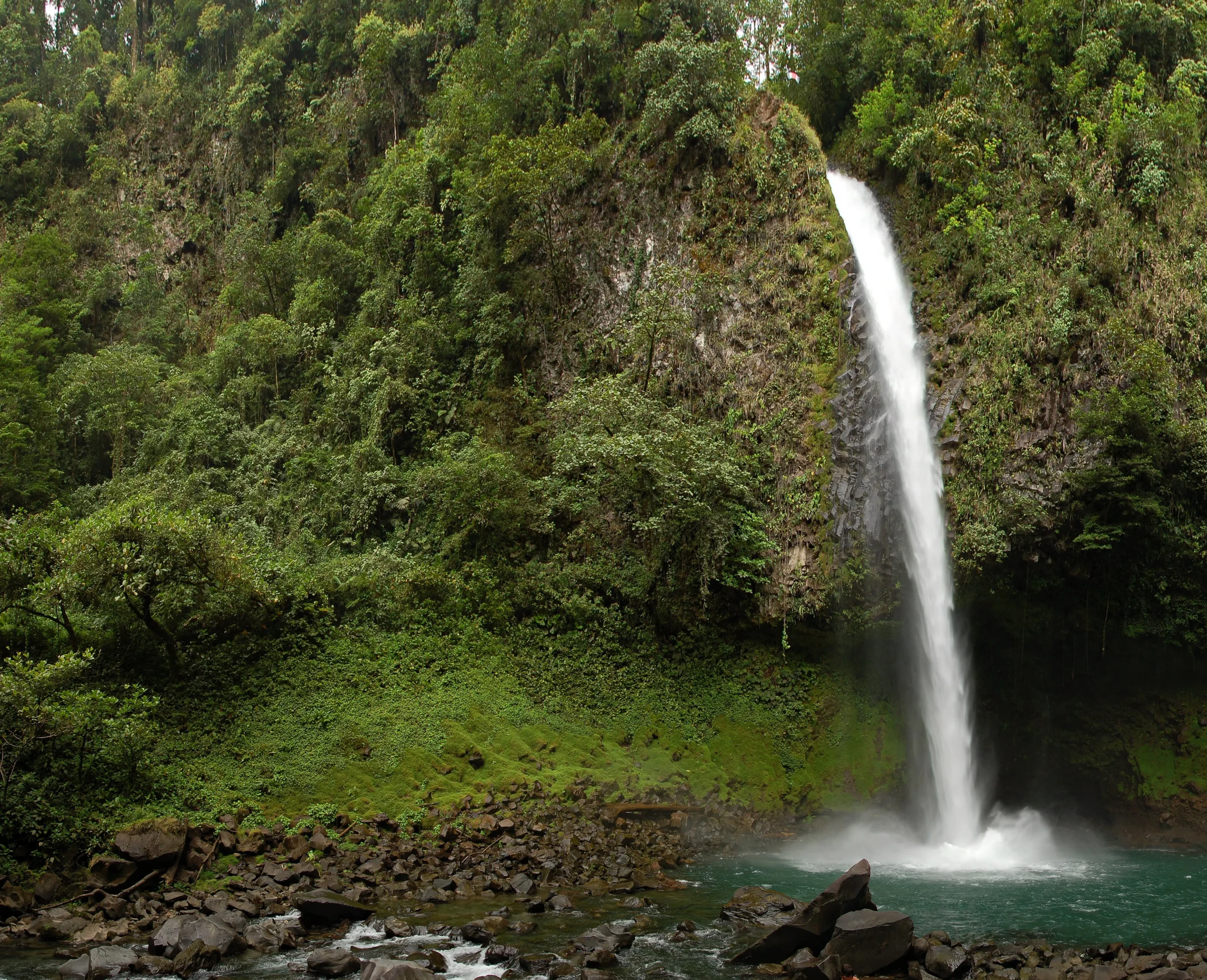
The La Fortuna area is the easiest place to combine rainforest trails, a big waterfall and geothermal pools from one base. According to its operators, La Fortuna Waterfall drops 70 meters and is reached by about 530 steps. It lies in a 210-acre biological reserve at roughly 520 meters above sea level and is run by the Integral Development Association of La Fortuna, a nonprofit founded in 1969, which says entrance income funds local roads, schools, sports, environmental work and public safety. The climb back up in humid heat is the real workout. Swimming is allowed in the river below, but rules near the plunge pool can change after rain, so follow staff instructions on the day.
The volcano itself is protected by Arenal Volcano National Park, created on September 30, 1991. SINAC notes that the park matters as much for water as for scenery: it protects the local water regime that feeds the Arenal reservoir and nearby towns. Its trails cross the 1992 lava flows and pass a ceiba tree more than 400 years old.
Arenal’s hot spring complexes range from small, quiet pools to large landscaped resorts. Treat each as a business to research, not a natural feature: ask where the water comes from, how much is used and how the discharge is treated before it reaches local streams.
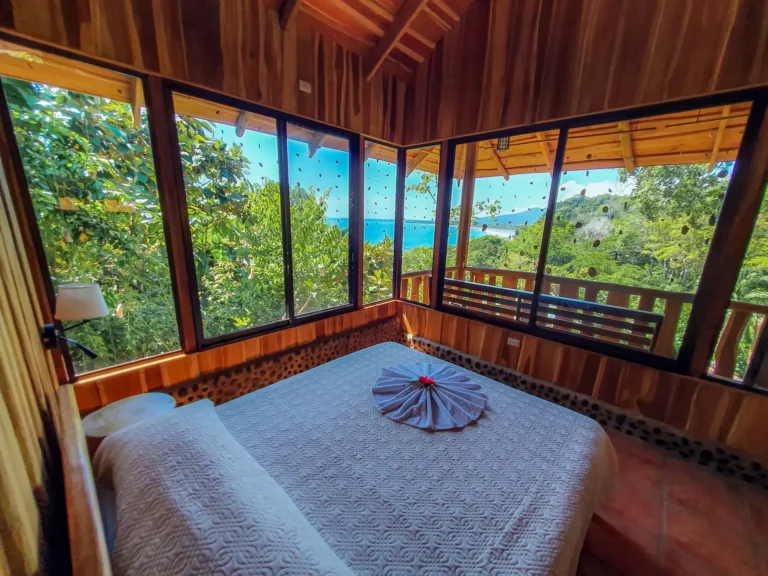
Lodges around Arenal with their own water and forest:
- Arenal Observatory Lodge describes itself as inside the national park, on more than 352 hectares including about 110 hectares of primary forest. Its 11 km of trails include hanging bridges that lead to the Danta waterfall, plus an 800-meter wheelchair-accessible path.
- Rancho Margot, about 40 minutes from La Fortuna near Lake Arenal, is an off-grid working ranch of more than 400 acres with natural spring-fed pools, cold or heated, and arranges kayaking and waterfall outings.
- Chachagua Rain Forest Lodge is a working ranch in the Tilarán foothills bordered by a biological station, about 300 acres in all, a few minutes from La Fortuna.
See more on our Arenal and La Fortuna eco-lodges page, and our Arenal and Río Celeste guide for the full area.
Río Celeste and Tenorio Volcano National Park
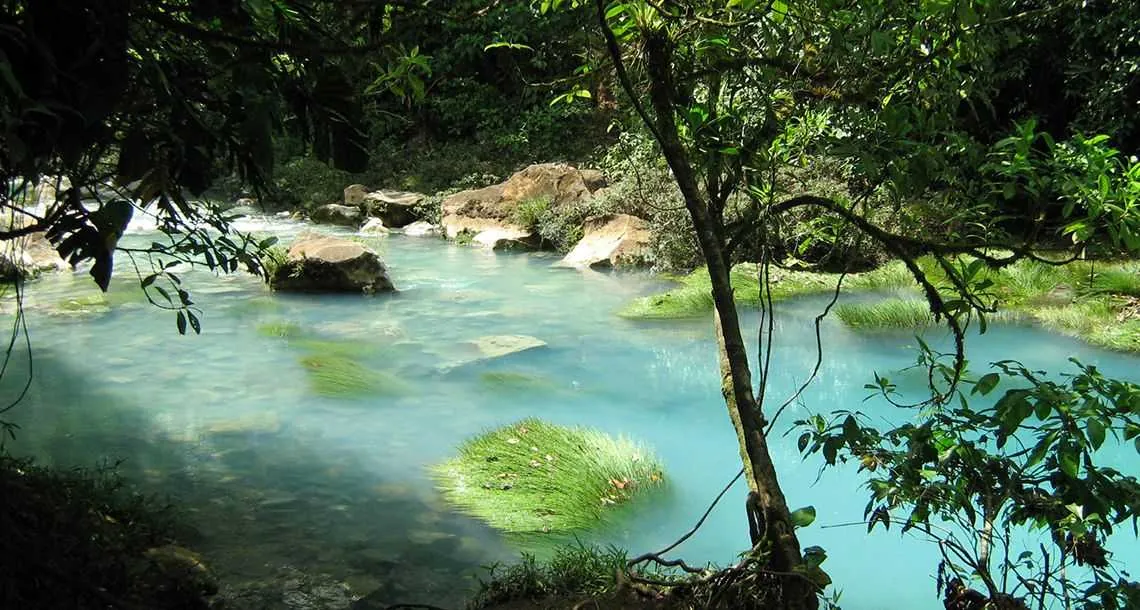
Río Celeste’s sky-blue color is a natural optical effect. Researchers from the University of Costa Rica and the National University explained it in 2013: two clear streams, the Quebrada Agria and the Río Buena Vista, meet at a spot called El Teñidero. There, aluminosilicate mineral particles held in the water scatter sunlight and reflect blue, and the color continues for about 14 km downstream. The team ruled out copper and other metals.
SINAC’s Tenorio page sets out the visiting system:
- The park was created on June 8, 1995, and with its protective zone covers about 18,402 hectares, 9 km from Bijagua.
- Tickets are sold only online through SINAC’s official system. Entry runs from 8 a.m. to 2 p.m., and visitors may stay until 4 p.m.
- Capacity is 1,200 people a day, with no more than 500 on the trail at once.
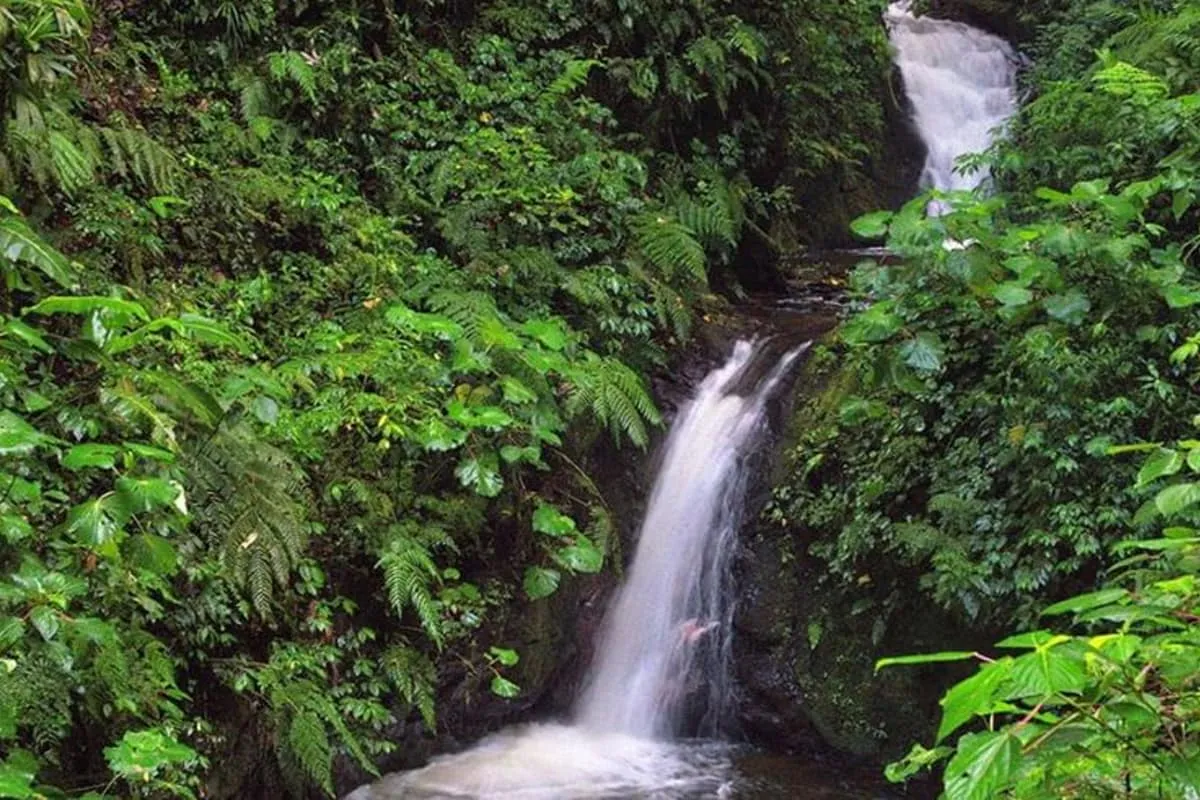
- The Misterios del Tenorio trail is 3 km one way, about 6 km and three hours in total, passing the roughly 20-meter waterfall, a viewpoint, Laguna Azul, bubbling volcanic vents and El Teñidero.
- Entering the river is not permitted, nor are single-use plastics, drones, pets or alcohol.
The park sits mostly under Caribbean weather, with about 3,500 mm of rain a year, so trails are often muddy and the color can fade after heavy rain. Go early and treat the forest and birdlife as part of the reward.
Bijagua is the quieter base:
- Tenorio Lodge sits on seven hectares of gardens and fruit trees around two natural lagoons, at about 500 meters between the Tenorio and Miravalles volcanoes, with two outdoor hot tubs.
- Celeste Mountain Lodge is a bioclimatic-design lodge surrounded by forest reserves near Volcán Tenorio, with views of Tenorio and Miravalles.
Rincón de la Vieja: mud pots, waterfalls and hot springs
For geothermal landscapes in their natural state, Guanacaste’s Rincón de la Vieja National Park is the place. Created by law on October 23, 1973, it covers 14,300 hectares and is the source of 32 rivers on the divide between the Caribbean and Pacific slopes. The 3 km Las Pailas loop, about two hours, passes fumaroles, boiling mud pots and a steaming lagoon where SINAC records temperatures of 78 to 106°C. Stay on the trail; these are not bathing spots.
The waterfall trail reaches La Cangreja, known for its blue water, at 5 km (10 km round trip) and the steeper Escondida falls at 4.3 km. SINAC states plainly that swimming is not allowed at either waterfall, and that you must start the trail before noon; in the rainy season, May to November, access may be restricted. Las Pailas sector opens Tuesday to Sunday and Santa María sector Thursday to Monday, with tickets sold only online. A 7 km linear trail links Las Pailas to Santa María and its thermal waters.
Near the park’s north side, Blue River Resort and Hot Springs has three natural mineral hot spring pools and a short walk to the volcanic Río Azul, plus botanical and butterfly gardens.
Bajos del Toro: cloud forest waterfalls
The steep valley of Bajos del Toro, between the Central Valley and the northern plains, packs dramatic waterfalls into cool, misty mountain forest. Catarata del Toro is a private site where the falls plunge into an old volcanic crater, with four lookouts on the upper part of the property. Nearby, Blue Falls is a separate private attraction with a series of turquoise cascades. The site is open Monday to Saturday from 7 a.m. to 5 p.m. and closed on Sundays. Expect long staircases and wet rock.
El Silencio Lodge in Bajos del Toro has three private waterfalls in its own reserve, more than 2 km of trails and guided tree planting, and lies about 65 km from the international airport, roughly 90 minutes by road, according to the lodge.
Nauyaca and the southern Pacific
Inland from Dominical, the two-tiered Nauyaca waterfalls are among the busiest falls in the south. Several private entrances offer different trails and transport, so confirm which one you are using and what it involves, since heat, steep sections and mud in the green season can make the walk harder than it looks. Swim only where staff permit it, and never when the river is high or brown.
Nauyaca combines well with a few nights on Costa Ballena rather than a long day trip from elsewhere. See our Southern Pacific eco-lodges page for more bases near the waterfalls.
Montezuma and the southern Nicoya Peninsula
The southern Nicoya Peninsula has short, steep streams that tumble through forest gullies to the sea. Montezuma’s well-known waterfalls have long drawn walkers, but cliff jumping and informal scrambles around the upper pools are genuinely risky. Enjoy them from established paths and viewpoints, and do not climb wet rock for a photograph.
A nature-minded stay here can combine waterfalls with forest walks at Cabo Blanco Absolute Natural Reserve near Cabuya and quiet beaches. Anamaya is a clifftop yoga and wellness retreat in the forest above Montezuma, with wide ocean views, a saltwater infinity pool and organic meals with vegetarian, vegan and gluten-free options. Waterfall treks feature in some of its retreat programs, a sensible way to see the falls with company that knows the area.
River safaris: wildlife without a strenuous hike
A slow boat trip reveals habitats you cannot reach on foot.
Caño Negro. In the lower Río Frío basin near the Nicaraguan border, the Caño Negro mixed wildlife refuge was created in 1984 and named a Ramsar wetland of international importance on December 27, 1991, one of Costa Rica’s first two. SINAC lists 307 bird species, 206 resident and 101 migratory, across almost 10,000 hectares of lagoons, flooded forest and seasonal marsh. In the dry season the main lagoon breaks into separate ponds, which concentrates birds but limits where boats can go. The lagoons also hold the tropical gar, an ancient fish often called a living fossil, and some are sacred sites for the Maleku Indigenous people.
Tortuguero. The Tortuguero Conservation Area’s park brochure counts 442 bird species, 138 mammal species and 118 reptile species, notes Ramsar status since 1996, and lists water-trail departures at 6 a.m., 8:30 a.m., 11 a.m. and 2:30 p.m. Its map marks some quieter channels for kayaks and canoes only and states that swimming is not allowed in the sea or the lagoons. Tortuga Lodge and Gardens, one of the oldest lodges in the area, has 29 rooms facing the Tortuguero River and runs guided kayak trips upriver. Our Tortuguero guide covers the canals and turtle season in depth.
Palo Verde and the Tempisque. In Guanacaste, boat trips on the Tempisque River pass the seasonal marshes of Palo Verde National Park, known for waterbirds and crocodiles; our national parks guide has the details.
A boat is not automatically low-impact: loud engines and fast approaches stress wildlife and erode banks. Choose operators who slow down near animals and keep away from nesting sites.
Whitewater rafting and river conservation
Costa Rica’s rafting runs range from gentle family floats to demanding whitewater. The Pacuare is the best known for deep, forested canyon scenery; the Sarapiquí and Savegre rivers offer other options. Grades depend on the section and the day’s water level.
The law sets a baseline. Costa Rica’s adventure tourism regulation, Executive Decree 39703-S-TUR of February 2016, requires operators to use trained, qualified guides for each specific activity who hold the Costa Rican Tourism Institute’s guide credential in the right category, as the 2018 tour guide regulation summarizes. Ask to see credentials, and ask about equipment checks, minimum ages and how the company decides to change routes. Rain far upstream can raise a river within hours even when the put-in is sunny.
On the Pacuare, The Pacuare Jungle Lodge says it protects a 340-hectare reserve, runs on three hydroelectric turbines and 204 solar panels, treats wastewater with septic systems, has supported a jaguar camera-trap program with the National University since 2009, and received the Elite level of Costa Rica’s Sustainable Tourism Certification in January 2024. In Sarapiquí, Selva Verde has welcomed naturalists since 1986 on 500 acres of rainforest, with rafting among the activities nearby.
When rain helps and when it creates danger
Rain gives Costa Rica its waterfalls, but it also makes them hazardous. Visit Costa Rica describes a dry season from mid-December to late April and a green season from May to mid-December, with sharper seasons on the Pacific side and a longer rainy period on the Caribbean coast; in the wettest autumn weeks it suggests the Caribbean as the better bet. Local microclimates vary with altitude.
The main danger is the “cabeza de agua,” a sudden surge of water caused by heavy rain higher in the watershed. During one rain emergency the national emergency commission, CNE, asked tour companies and visitors to cancel water activities in red-alert areas and on any rivers swollen by rain, citing the risk of these sudden floods. If water turns brown, carries branches, or the river grows louder, leave the water and move to higher ground at once.
What to wear and pack
Shoes with real grip beat sandals on almost every waterfall trail. Bring water, a dry bag, sun protection, a light rain jacket and dry clothes. At hot springs, follow posted temperature advice. Keep phones away from cliff edges: many accidents start with a step backward for a photo.
Why watersheds connect ecotourism to conservation
A waterfall’s health depends on the whole catchment above it. Forest cover moderates erosion and flow, while farm runoff, road building and wastewater affect everything downstream. Costa Rica’s Payments for Environmental Services program, run by FONAFIFO under Forestry Law 7575, pays landowners for four services forests provide, one of which is protecting water for towns, farms and hydropower.
That gives you a useful question for any lodge: does it explain the river’s watershed, or does it only sell the waterfall photo? A good naturalist will point out riverside plants, aquatic insects and the link between upstream forest and the coast. If a property claims official sustainability credentials, check them in Costa Rica’s CST program, which now certifies at Basic and Elite levels; our CST certification guide shows how.
Visitors have responsibilities too: keep soap and sunscreen out of streams, pack out food waste, and remember that swimming at a private waterfall says nothing about the rules in a national park river.
Planning a trip around water
For a first visit, Arenal offers the easiest mix of waterfall, hot springs and rainforest. Add Río Celeste from Bijagua for the blue river, or Rincón de la Vieja for mud pots and dry forest falls. Choose Bajos del Toro for cool mountain waterfalls, Caño Negro or Tortuguero for wildlife from a boat, and the Pacuare for rafting. Pick two or three, not all of them. Our rainforest hikes and canopy tours guide and best time to visit guide help you fit the pieces together.
| Region | Water experience | Lodges near the water | What can change |
|---|---|---|---|
| Arenal and La Fortuna | Waterfall, hot springs, lake | Arenal Observatory Lodge, Rancho Margot | Pool rules after rain |
| Bijagua and Tenorio | Río Celeste trail | Tenorio Lodge, Celeste Mountain Lodge | Color and trail conditions |
| Rincón de la Vieja | Mud pots, waterfalls, thermal pools | Blue River Resort | Sector days and volcanic activity |
| Bajos del Toro | Cloud forest waterfalls | El Silencio Lodge | Slippery stairs, afternoon cloud |
| Pacuare and Sarapiquí | Rafting, river forest | The Pacuare Jungle Lodge, Selva Verde | River level, operator decisions |
| Tortuguero | Canal boats and kayaks | Tortuga Lodge and Gardens | Boat schedules, wildlife location |
| Montezuma | Coastal waterfall walks | Anamaya | Flash floods, access paths |
Frequently asked questions
Can you swim at Río Celeste?
No. SINAC prohibits entering the river inside Tenorio Volcano National Park, and visitors must stay on the trail. Some private properties outside the park have their own river access, but check their rules and the water level before going in.
Which waterfalls in Costa Rica allow swimming?
It depends entirely on who manages the site. La Fortuna Waterfall allows swimming in the river below the falls, subject to staff instructions, while SINAC does not allow swimming at Río Celeste or at Rincón de la Vieja's La Cangreja and Escondida falls. At private sites, ask on arrival and never swim after heavy rain.
Do I need tickets in advance for Río Celeste or Rincón de la Vieja?
Yes. SINAC sells tickets for both parks only through its online system. Tenorio allows entry from 8 a.m. to 2 p.m. with a cap of 1,200 visitors a day, and Rincón de la Vieja's two sectors open on different days of the week.
Are Costa Rica's hot springs natural?
The heat is natural, from volcanic activity around Arenal, Rincón de la Vieja and Tenorio, but most places you bathe are built pools fed by thermal water. The fumaroles and mud pots inside Rincón de la Vieja reach 78 to 106°C and are for viewing only.
Is rafting safe in the rainy season?
Professional operators decide by river level and weather, not the calendar, and may change sections or cancel. Costa Rican rules require credentialed, trained guides for adventure activities. Never attempt whitewater without one, and avoid any river during an emergency alert.
What is the best season for waterfalls?
Falls are fullest in the green season, May to mid-December, but trails are muddier and flash floods more likely, so plan mornings and stay flexible. In the dry season, mid-December to late April, trails are easier and some smaller falls shrink. Río Celeste's color is often clearest after a few dry days.